
The following is the second of a four-part series, Adaptation and time: Two factors for sustaining mental health, surviving October 7, its duration, and aftermath.
The three skills we have to help us function, which are the pillars of maintaining and sustaining emotional and psychological health, are these:
- The ability to adapt: the creative means by which we constantly adjust, modify, and fit to changes.
- The ability to imagine: to recreate sensory impressions and feelings in our minds in the absence of external stimuli. To form images and ideas of things never perceived in reality.
- The ability to create meaning: purpose, or significance of something. “Those who have a ‘why’ to live can bear with almost any ‘how.’” F. Nietzsche, as quoted by Viktor Frankl in his book Man’s Search for Meaning.
What all these have in common is the basis or foundation of who we are: sensory beings. Our senses, our sensory system, are “the stuff we are made of.”
How does all this happen?
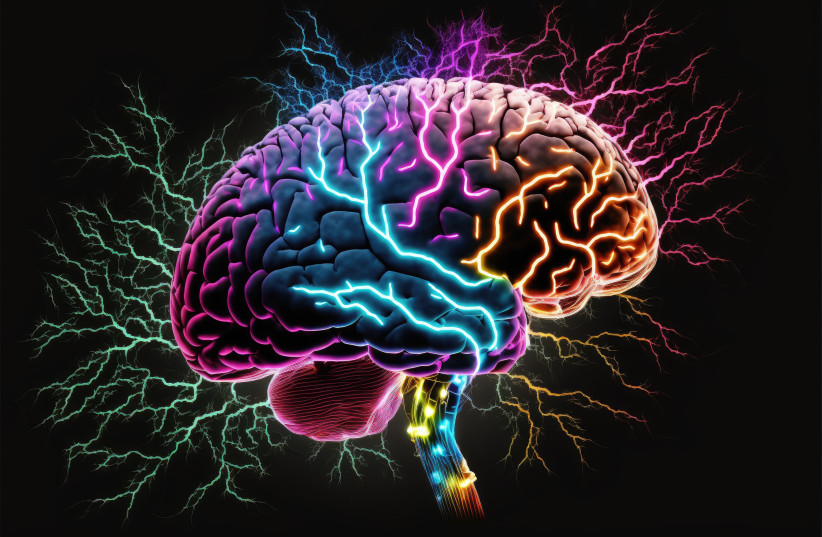
Our “primitive brain” is wired to interpret what we smell, hear, see, touch, and more regarding safety and danger. We then assess the level of danger and choose our actions accordingly. We can stay where we are and continue to do what we were doing in a calm and relaxed way, or we can respond to a perceived threat by taking action – fight, flight, or freeze.
All vertebrates respond to stressful situations by releasing hormones, such as adrenaline and glucocorticoids, which instantaneously increase the animal’s heart rate and energy level.
In a lecture titled “Stress, Health and Coping,” Robert Sapolsky, author of Why Zebras Don’t Get Ulcers, spoke at the annual meeting of the American Association for the Advancement of Science. He said: “The stress response is incredibly ancient evolutionarily. Fish, birds, and reptiles secrete the same stress hormones we do, yet their metabolism doesn’t get messed up the way it does in people and other primates.”
To understand why, he said, “just look at the dichotomy between what your body does during real stress – for example, something is intent on eating you and you’re running for your life – versus what your body does when you’re turning on the same stress response for months on end for purely psychosocial reasons.”
In the short term, he explained, stress hormones are “brilliantly adapted” to help you survive an unexpected threat. “You mobilize energy in your thigh muscles, you increase your blood pressure, and you turn off everything that’s not essential to surviving”, he said. “You think more clearly, and certain aspects of learning and memory are enhanced. All of that is spectacularly adapted if you’re dealing with an acute physical stressor – a real one. [But] if you turn on the stress response chronically for purely psychological reasons, you increase your risk of adult [illnesses].”
Two key points addressed here are:
- The mind/body connection
- What is real and what is experienced as real?
When there is a clear perception of a threat, we automatically engage in one of the three actions of flight, fight, or freeze. When the threat is resolved, we return to what we were doing before. Makes sense, right? Sure, under normal circumstances. What if there is no sense of our being in control of what is taking place, and there is no immediate sense of return to normal? In other words, what if we don’t have control over “what’s next”? Whether we experience feeling in or out of control can become the measuring stick of our survival.
“Between stimulus and response there is a space. In that space is our power to choose our response. In our response lies our growth and our freedom.” – Viktor Frankl
Only humans ask why
All animals can respond to the questions:
- What (identifying/recognizing) – was that sound?
- Where (direction/location) – do I go for shelter?
- When (time) – I have to go find a mate.
- Who (other) – do I choose to fight?
- Which (selection) – is my pack?
- How (action) – will my cub get food?
However, only humans ask why: Why was I born? Why am I here? Why did this happen to me? Why do I feel this way? Humans are self-reflective. We form meaning.
According to Irish novelist and poet James Joyce, our objective reality is subjectively perceived. It is crucial, however, for us to come up with a common sense because we need to construct a common sense for our self-preservation. The paradox is: as we fight to be independent beings, we are dependent on our community. This interplay between the self and the community is what inevitably holds us together.
Time for the takeaway
From the self, Viktor Frankl contended that meaning is not something to be found outside oneself but rather something that must be created and discovered through one’s own choices and actions to the community,
Meaning is about understanding the past. We gather together as a community to hear the stories of resilience and overcoming our suffering. The human capacity for resilience under traumatic experiences is a life-saving one. And we hear of this resilience time and again.
Adapting the right attitude
Living according to an attitude of no choice has been a choice made by Jews and Israelis throughout our history. It has been part of our lives and an important means of adapting before October 7.
My father was a Holocaust survivor and came to Israel and fought in the 1948 War of Independence. In the 1960s, when he was working in Canada, he was asked by Canadian colleagues, who knew he had served in the IDF, how Israel won the Six Day War in 1967. My father replied that Israel has a “secret weapon, a general who leads us named General Ein Brera (no choice).”■
The next installment will be Part Three: How are we adapting today?
Sara Jacobovici is a 30-year veteran in the health and mental health fields as a creative arts psychotherapist. She lives and works in Ra’anana.