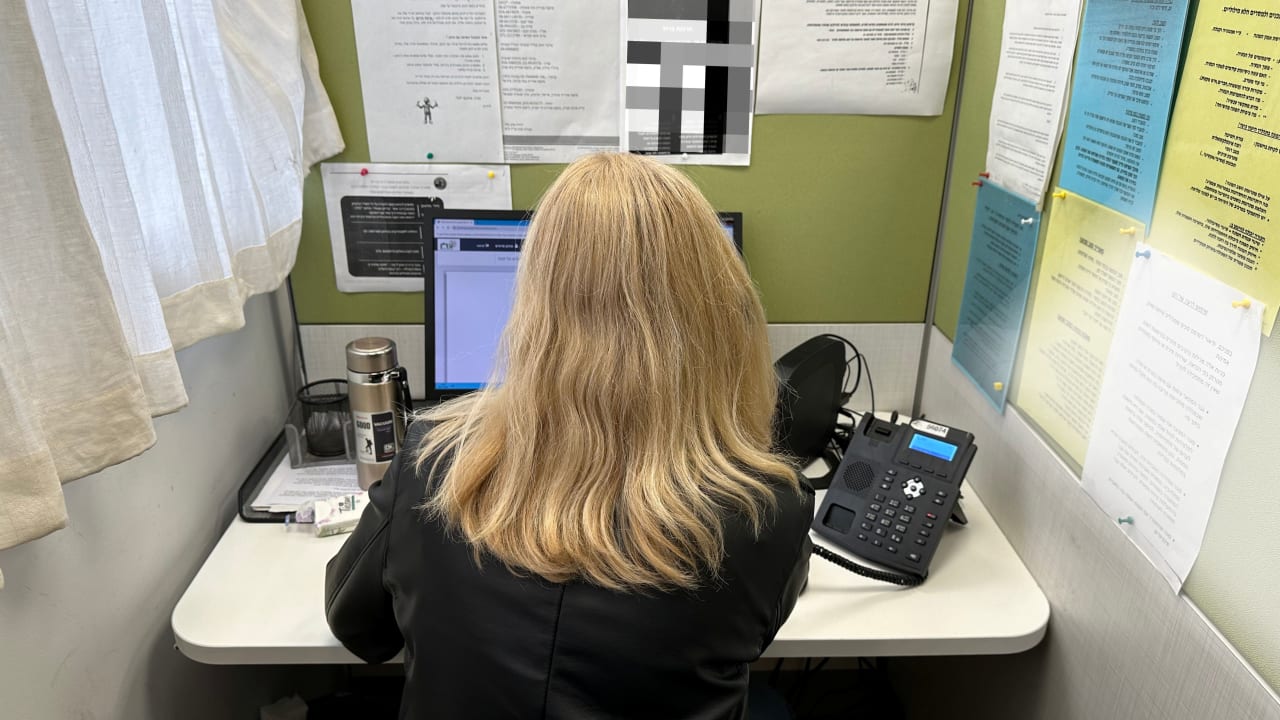
Shouky Oren and David Koren, chairman and CEO of ERAN, respectively, sat down with us to discuss the dramatic rise in requests for help, the essential support from Diaspora Jews, the sacrifices of volunteers, and the establishment of a new emergency operations center for the organization, the first since its founding in 1971.
“At the end of the day, we are a national infrastructure,” says Shouky Oren, chairman of ERAN. “There’s no other organization in the country providing initial mental health support on this scale. The country is experiencing a traumatic period, with many in psychological distress, and ERAN is their listening ear.”

ERAN (Emotional First Aid) offers lifesaving emotional and mental support to the Israeli public across all sectors, anonymously and instantly, via phone and the Internet. This vital service operates 24/7, all year round, primarily funded by donations. While government support exists, it is limited.
“Despite public promises from ministers and directors-general, we have not yet secured a direct agreement with the Health Ministry,” says Oren, who previously served as the accountant-general at the Finance Ministry. “We continue to receive funding through the ‘support’ framework, alongside many other NGOs, which is simply insufficient. At the start of the war, donations increased, allowing us to operate independently of government budgets. However, as the war persists, resources diminish, impacting donations as well.
“ERAN is a listening ear for so many: the elderly, teenagers, soldiers, parents, and more,” Oren emphasizes. “We handle the volume through our dedicated volunteers while also upgrading our systems and improving efficiency.”
“A technological revolution”
David Koren, CEO of ERAN, reports that activity levels increased by hundreds of percent following the beginning of the Israel-Hamas War in October 2023. “Since the start of the war, we’ve handled over half a million calls, which is a remarkable figure.”

“We’ve already exceeded 530,000 calls, with about 100,000 coming from children and teenagers and around 90,000 from reservists, soldiers, and their families. This surge is far beyond typical increases,” he states.
“It’s not just stress; it’s a fundamental shift in the demographic seeking support. Previously, reserve duty was mostly a brief social experience each year. Now, thousands are engaged for months. It’s no longer just duty but an ongoing psychological burden.”
Koren also highlights a global trend, the decrease in suicide rates during wartime, but emphasizes this war is different: “Typically, suicidal thoughts decline during conflicts, like Operation Guardian of the Walls (2021). But nearly two years in, that protective effect has diminished. Early on, there was a dip in suicidal talk. Recently, especially among soldiers, it has resurged, reflecting the impact of sustained conflict.”
Emergency center launched
To manage the pressure, ERAN underwent a significant transformation. A key development was the establishment of a new national emergency operations and training center, the first in its 54-year history.
“We recognized the need for such a facility,” explains Koren. “It serves to train volunteers, host professionals, and deploy 20 volunteers within 20 minutes during emergencies, providing immediate response and expert support. Building it required substantial resources, and both public and private backing are essential for its ongoing operation during crises and regular days.”
Koren notes that the organization experienced a technological revolution driven by the failure of outdated systems and the potential of new tools. “Most requests come via two main channels: phone hotlines and anonymous messaging through WhatsApp or SMS. Our representatives work from 13 branches in Israel and four abroad in North America and Australia,” he says.
“When someone reaches out, they don’t care where the volunteer is located; our system must know and route calls efficiently. This is a major challenge that we’ve overcome. We need to ensure each call is answered swiftly, with backups and data-secured systems, alert protocols, and professional oversight – an important technological feat.
Koren adds that they are considering integrating AI to help volunteers and identify high-risk situations. “We already have hundreds of features, but we proceed cautiously – ethics and values are our priorities.”
Another problem solved with tech was nighttime availability. “In the past, we would beg volunteers to stay another night, not an easy ask for a working person or retiree. Now, with technology, a volunteer can log in from anywhere, globally, securely, and privately, from the comfort of their own home. The result? Fewer unanswered calls.”
“We feel a true sense of mission”
ERAN relies on a professional staff and approximately 1,850 volunteers, including 300 who support online services and around 250 who are located worldwide. They undergo rigorous screening and comprehensive training to provide lifesaving emotional first aid by phone or Internet.
ERAN also offers targeted services:
- Support for soldiers and their families
- Emotional aid for new parents
- A special hotline for Holocaust survivors and seniors
- A kosher support line for ultra-Orthodox Jews
- Services for families of hostages
- Help for survivors of the Nova festival
- Aid for Olim and returning residents in five languages (English, Russian, Amharic, French, and Spanish)
- An Arabic-language hotline
Koren highlights that volunteers are the backbone of the organization; without them, success would be impossible. He notes that a portion of volunteer recruitment comes from the Diaspora, initiated through a program launched at the Israeli-American Council conference in Washington in 2018. “I sat with numerous community leaders and introduced ERAN,” he recalls.
“We expressed a desire to recruit within their communities and provide training. This expanded into courses in Palo Alto, New York, Boston, and Toronto and now involves about 200 volunteers across North America and 50 in Australia.” “Their support is vital, especially for fundraising and volunteer hours.
Without their help, late-night calls would be unmanageable,” Koren states. He also shares that volunteers consider their service a privilege: “They tell me, ‘You don’t understand how much this means to us.’ You’re offering the community a meaningful way to support Israel, a form of volunteering that saves lives.’
“It truly warms our hearts.”
“More calls from young people”
ERAN maintains a close connection with Diaspora communities through its global branches and the support from the Jewish people and Israel advocates. “Sometimes, the most generous aid comes from abroad,” says Oren. “Thanks to donations from Jewish communities and supporters worldwide, we sustain ourselves and reach many in need.”
These efforts also helped establish ERAN’s new Knowledge Center on its website, which provides information, tools, and tips on topics such as loneliness, suicide, trauma, anxiety, violence, cyberbullying, sexual assault, gender identity, eating disorders, depression, self-harm, addiction, and more – issues that have increased significantly during the prolonged war.
The organization also observes a demographic shift: “We’re seeing more young people and families. During the COVID-19 pandemic, loneliness was the primary concern. Now, it’s kids, teens, soldiers and their worried parents, reservists and their families, students, evacuated families, and young parents. The nature of distress has changed, and our response must adapt,” says Oren.
Koren adds: “If in the past most calls came from women, today we see a 10% increase in calls from men. The war hit them deeply, with feelings of helplessness, inability to protect family, or loss of control.”
“Each call is a world unto itself,” Koren stresses. “These are people in real danger, including helpless youth and soldiers having psychological breakdowns. When they call, we must be there.”
“This is our mission,” Koren concludes, “and we have no intention of stopping. Every call is a chance. Every response is hope.”
>> For more information about ERAN and to support mental health, visit: en.eran.org.il
This article was written in cooperation with ERAN.
Translated by Ronnie Rosenman.