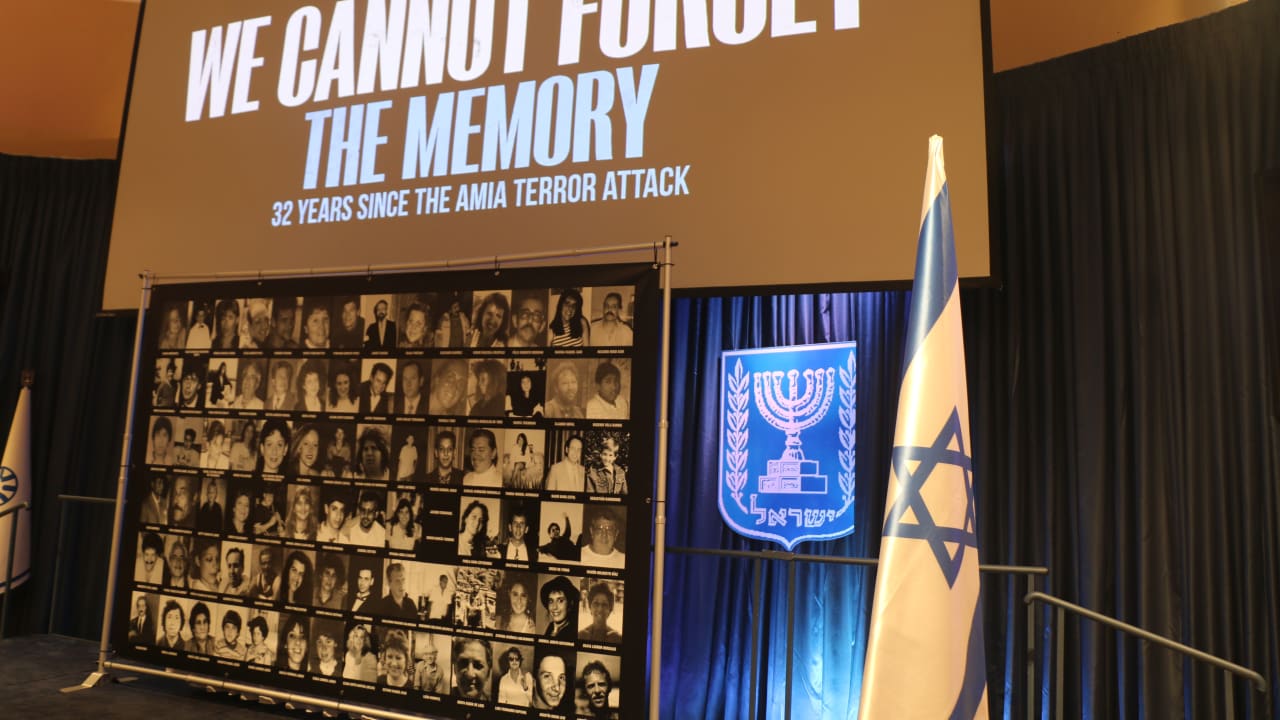
The AMIA bombing was an attack “against humanity as a whole,” Argentina Ambassador Shimon Axel Wahnish said at a ceremony commemorating 32 years since the attack against the Jewish community center in Argentina on Thursday.
“For 32 years, I’ve been hearing that it was an attack against the Jewish community, against Argentina as a whole. But, even if both claims are true, I like to think of it as a wider attack against humanity as a whole,” said Wahnish at the ceremony held in the Foreign Ministry in Jerusalem.
The AMIA bombing killed 85 people and injured more than 300 in 1994, in what remains the deadliest terror attack on Argentinian soil and one of the deadliest against the Jewish community outside of Israel.
“It’s important not to fall into the narrow-sightedness that it was an isolated attack. The attack that we suffered in 1994 was part of a bigger chain of events that includes international terrorism,” he added.
“And if you follow this thread, you can see that it all ends up in the same enemy, that wants to instill psychological terror by means of violence, and who wants to erode the bases of our culture, our civilization, and of all of humanity,” Wahnish explained.

Ties between nations, responsibility to honor and fight for freedom
The ambassador also delved into the similarities between the Israeli and Argentinian national anthems, and pointed out that a key word they share is “freedom.” He also said, “[It’s] our responsibility to honor the memory of those killed in the attack, but also fight for a world with freedom.”
Argentinian President Javier Milei has been keeping this fight alive by pushing for justice and by declaring both Hamas and the Islamic Revolutionary Guard Corps (IRGC) as terror organizations, according to Wahnish.
Eden Bar Tal, director-general of the Foreign Affairs Ministry, who was also present at the ceremony, pointed out during his speech how the Argentine judiciary determined that Iran was responsible for the AMIA attack and the previous 1992 bombing of the Israeli Embassy in Buenos Aires, where 29 people were killed.
“Iran, together with its proxy Hezbollah, carried out these horrendous attacks,” he said, adding that Israel appreciated the recent push by Milei to confront Iranian terrorism and reject granting immunity to the perpetrators.
Roxana Levinson, niece of Jaime Plaksin (who was killed in the AMIA bombing) and Graciela Susevich of Levinson (who was killed in the bombing of the Israeli Embassy in Buenos Aires in 1992) spoke at the ceremony.
Terror attacks destroy families, 'we can't live in peace with Iran'
“Terror attacks don’t only take the victims. The expansion wave takes whole families,” she told those gathered. “And we must remember who was and still is responsible for the tragedy, because the Iranian regime still wants to destroy us, erase us from the map.
“We can’t live in peace with a terror organization. And Iran is a terrorist organization that has its own state, and that finances the appetite for bloodlust of its leaders with the hunger of its people,” Levinson said.
Levinson, who spoke with The Jerusalem Post during the ceremony, said that the latest legal developments in the AMIA case bring hope, but she still doubts that anything can be achieved after so many years of negligence.
“After 32 years of purposefully pushing against the investigation, with proof being destroyed and obstacles placed in the way, it’s difficult to believe that this time there will be a result,” she said of the search for justice in Argentina.
Levinson told the Post that she feels honored to conduct the ceremony. She explained that this was because it was an opportunity to tell the stories of some of the victims, to turn them into “more than just a number.”
The chairman of the World Zionist Organization was also present at the event, along with ambassadors from several countries and key diplomats from the Foreign Ministry.