
- Test car price: NIS 286,000
- Competitors: XPeng P7, Tesla Model 3
- Liked: Equipment, space, performance, range, charging system, value for money
- Disliked: Rear visibility, ergonomics
- Rating: 9/10
It was worth waiting for the next traffic light. Somehow, the stars aligned, and the road ahead cleared, exactly what I needed to launch from the spot the second the light turned green. In a single electric zap, my head, neck, back, almost down to my knees, pressed into the seat, the view swallowed by the rear window, and my soul nearly detached from my body but stayed attached because it got tangled with the coat’s Richartz lining. I’ve driven many powerful cars, but it’s been a long time since I drove one this strong.
Here are just a few numbers that make this machine so special: 777 hp, 0–100 km/h in 3.2 seconds, and a top speed of 268 km/h. This car—sorry, this ballistic missile—is called the 5 and belongs to a Chinese brand called IM. Why “old”? Because IM belongs to China’s SAIC Group, founded in 1955, the largest in China, 7th largest in the world, and owner of brands including MG and Maxus, which are also sold in Israel.
Why “new”? Because IM was established in December 2020 as a joint venture between three Chinese giants: SAIC, Alibaba, and the Zhangjiang Technology Group. The name IM comes from the acronym Intelligence in Motion, with the goal of competing head-to-head with tech stars like Tesla, NIO, XPeng, and Li Auto (currently sold only in China).
IM, imported to Israel by Lubinski, will initially operate with two models, 5 and 6, which correspond to the Tesla Model 3 and Y, or to XPeng P7 and G6, respectively. We met both in China, and now we are testing the 5 arriving in Israel in three engine versions, with the test car being the Performance version with the most powerful motor.
Design
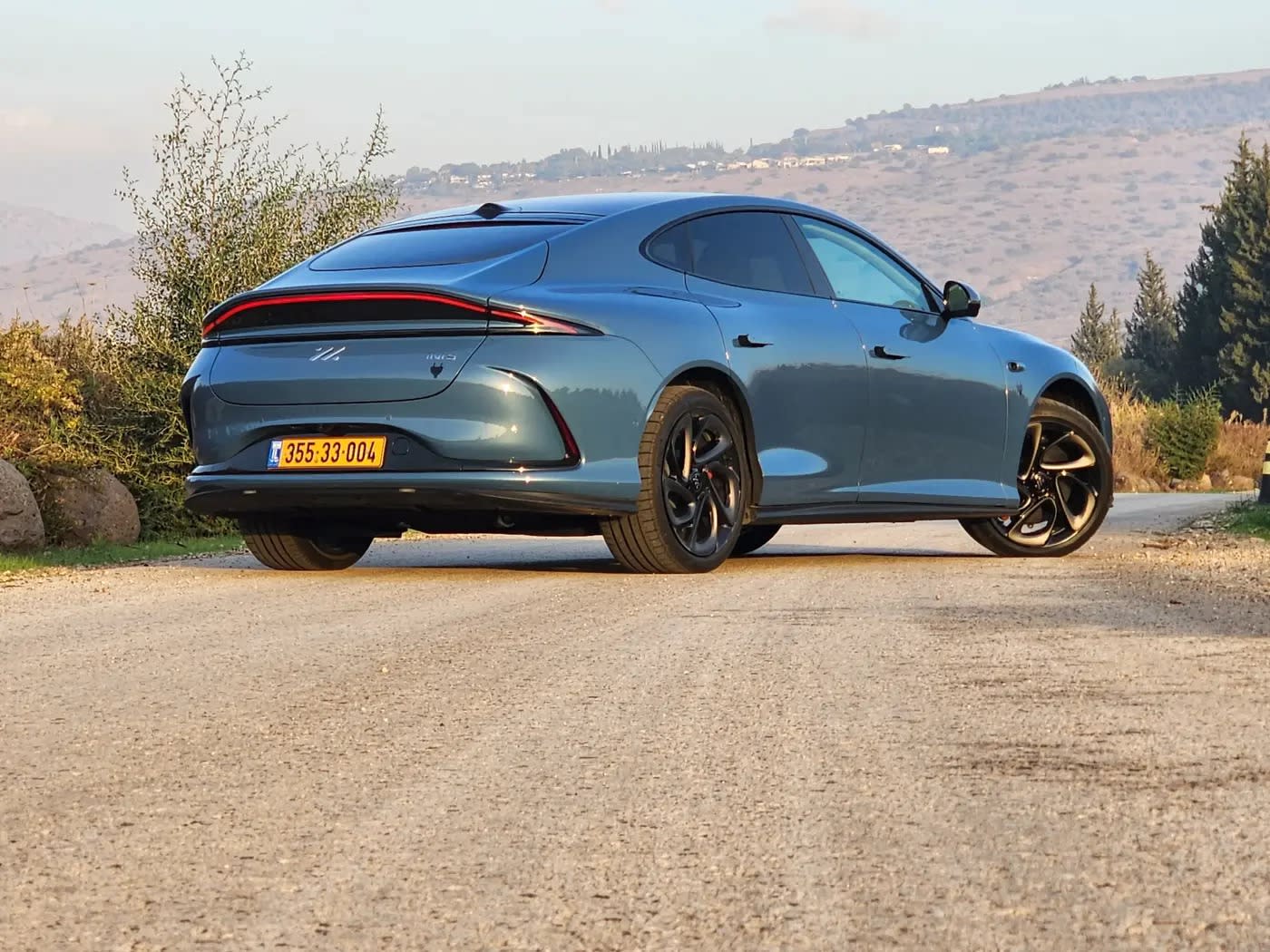
You won’t find a single sharp surface on the 5, not even a tiny hint suggesting the beast inside. Everything is rounded and smooth so it cuts through the air without threatening a single molecule. The look is attractive and very elegant, but it also feels familiar. The only distinctive feature is the curved rear lights, reminiscent of an Aston Martin. There’s no real connection to the British luxury brand, but in China, instead of a narrow light strip, there’s a wide band with animation and text visible to the driver. Currently, the European Union doesn’t allow products that communicate with the environment, so we won’t get it either (for now).

Interior
The rounded theme continues inside, with almost everything wrapped in soft, pleasant materials. A true iron fist inside a silk glove, which also embraces an impressive electronic setup. The eye sees the massive screen array, with a panoramic main display of 26.3 inches stretching across the dashboard, integrating the instrument cluster and the infotainment system operated by touch.
On the center console between the seats is another 10.5-inch screen for climate control and managing the car’s many functions. What the eye doesn’t see is that the system is based on Qualcomm Snapdragon 8295 and NVIDIA OrinX chips, integrating AI. The graphics and resolution are impressive, with processing split in two. Menu transitions are quick, though faster ones exist, while some operations, like automatic parking, are calculated super-fast and almost always very precise.
I have to say, adding the screen between the seats solved some operational issues typical of the new “everything on one screen” generation, because here there are two touchscreens to manage functions. This allows the main screen above to continue displaying navigation or anything else, while the lower one controls something else in parallel. It’s better, but still not perfect. Partly because the system offers many options in different menus, and the steering wheel has buttons without labels or symbols, so you have to memorize their functions.

Some other notes: No rear visibility at all. You can display the rear camera image on the main screen, but it’s time-limited. There’s no glove compartment and another closed storage space is missing. Android Auto isn’t stable enough and occasionally disconnects and reconnects automatically. Windows open and close too slowly, the Hebrew translation needs refinement, and although the car is very well-equipped, the steering wheel adjusts manually, and there’s no adaptive lighting.
With a 2.95-meter wheelbase, passenger space is simply huge, both front and rear. Seats are spacious and comfortable, but we have two notes. The front seats lack lateral support, and in the rear, you can’t slide your feet under the front seats.

Trunk
The tailgate opens with the rear window, revealing a huge opening. Despite being an XXL-sized car, the trunk volume is only moderate—457 liters, similar to competitors, but significantly smaller than the Tesla Model 3 with more compact dimensions. There’s also a front trunk (frunk), but with 18 liters, it isn’t very practical and won’t fit a charging cable, for example.
Equipment
There is only one trim level for all 5 versions, differing only in wheel and tire size. The list is long and includes a fixed panoramic roof, air suspension, rear-wheel steering, a 20-speaker sound system, active noise-canceling system, front seats with heating, ventilation, and driver memory settings, heated rear seats with reclining options, 540-degree camera, blind-spot display on screens when signaling, built-in dash camera, wireless charging pad, electric tailgate, and more.
Safety
The safety system selection is wide, including autonomous emergency braking, lane keeping, adaptive cruise control, blind-spot warning, and lane change via turn lever activation. Operation of these systems is a bit cumbersome (because there’s no feedback on steering wheel buttons), and they aren’t always precise. In any case, the European safety organization tested the car this year and gave it 5-star safety ratings.

Performance and Range
The 5 Performance can be driven gently. Every start returns it to the default “Comfort” setup, with a mellow accelerator pedal to minimize chiropractor visits.
But we’re here to unleash the beast, and a simple touch of the pedal launches it ahead of everyone at the light. Brutal standing starts are so 2012 when we first experienced this in a Tesla, but what’s more impressive is speed accumulation at any pace, especially at high speeds. This agility is achieved easily, bordering on unbearable, because with 777 hp, it has 50 more horses than a BMW M5, and almost twice as much as a Model 3 Performance (460 hp). Anyone behind the wheel must know what they’re doing.
The declared range is 575 km, and with moderate driving, you can achieve around 520 km between charges. But you didn’t buy the Performance version to drive moderately, so range decreases proportionally to fun; in our intensive test, we managed 470 km. Still a long range that will get you anywhere without worry.
Fast charging is extremely fast, with a peak rate of 396 kW. Ultra-fast chargers are rare in Israel, and at a 180 kW station, we went from 10% to 80% in 23 minutes.
Comfort and Handling
The Performance version comes standard with air suspension—another feature not typical for the segment. It works very well, though not perfectly. At any speed, it absorbs almost every road imperfection, especially impressive in the city. At high speeds, it provides very good comfort, though less than what might be expected from air suspension. In China, a more advanced version uses a camera to scan the road surface and adjust shock absorber stiffness to bumps.
Ride quality is also influenced by noise insulation; the 5 includes double-glass windows and active noise cancellation. Performance is very good, though slightly below expectations, mainly due to road noise. Some insulation issues stem from a lack of coverage for the trunk. The powertrain also produces a hum that changes with pedal pressure, though it’s very weak and barely noticeable.
Dynamically, the 5 Performance excels with very high capabilities despite weighing 2.3 tons. The body is balanced in sequences of curves, the steering with 2.15 turns lock-to-lock is sharp and precise, brakes are excellent, and grip is superb. Rear-wheel steering (6 degrees each way) gives excellent urban maneuverability, with a turning radius of 9.98 meters—between a Kia Picanto and Toyota Yaris, closer to Kia.

Bottom Line
The IM5 isn’t perfect. The rear window is tiny, operation is a bit cumbersome, and it needs further ergonomic refinement. Apart from the rear window, everything else could be fixed with a software update. But even so, overall advantages outweigh drawbacks: Excellent space, lots of equipment, super-fast performance, impressive range and charging, high dynamic capabilities, easy city maneuvering, and even good comfort, though slightly below expectation. It costs NIS 1,000 more than the Model 3 Performance, but is far better equipped, comfortable, and behaves excellently.
Rear-wheel steering, air suspension, impressive power, and an official range of nearly 600 km have been seen in other cars, but not at this price. NIS 286,000 also includes an unusually long 8-year or 250,000 km warranty for the battery and car, making this an excellent and, for now, unique package.
The remaining question is the market situation, which currently seems less fluid toward electric cars and more toward hybrid. This will make sales more challenging.
IM5 Performance: Technical Specs
Motor: Electric, 777 hp, 81.8 kg·m torque
Transmission/Drive: Auto, direct, dual
Electric
- Battery capacity (kWh): 100
- Slow charging (kW): 11
- Fast charging (kW): 396
Performance
- 0–100 km/h (s): 3.2
- Top speed (km/h): 268
- Electric range (km): 575
Dimensions
- Length (m): 4.93
- Width (m): 1.96
- Height (m): 1.47
- Wheelbase (m): 2.95
- Trunk volume (rear/front, L): 457 / 18
- Weight (kg): 2,298
Safety
- Euro NCAP crash test rating: 5/5 stars
- Active safety: Autonomous emergency braking (forward and backward), adaptive cruise control, lane keeping and deviation correction, door-open warning for unsafe lane
Warranty:
- 8 years or 250,000 km for vehicle and battery