
A collection of painted sarcophagi and papyrus scrolls dating to Egypt's Third Intermediate Period (c. 1077–664 BCE) was discovered during excavations in Seneb's tomb in the Kurna area on the west bank of the Nile River near Luxor, Egypt's Tourism and Antiquities Ministry said in early March.
During excavations in the southwestern corner of the tomb’s courtyard, archaeologists uncovered a rectangular chamber cut from the rock, thought to be a funerary storage room.
A total of 22 painted wooden sarcophagi were found inside the room, stacked one on top of the other.
“The ancient Egyptians made efficient use of the space by stacking the coffins in 10 horizontal rows, with the lids separated from the boxes to maximize the chamber’s capacity,” former Egyptian antiquities minister Dr. Zahi Hawas explained, calling the discovery "exceptional."
Dr. Hisham El-Leithy, Secretary-General of Egypt’s Supreme Council of Antiquities noted that researchers are working to identify to whom the sarcophagi belonged, since most of them bear “titles rather than personal names.”
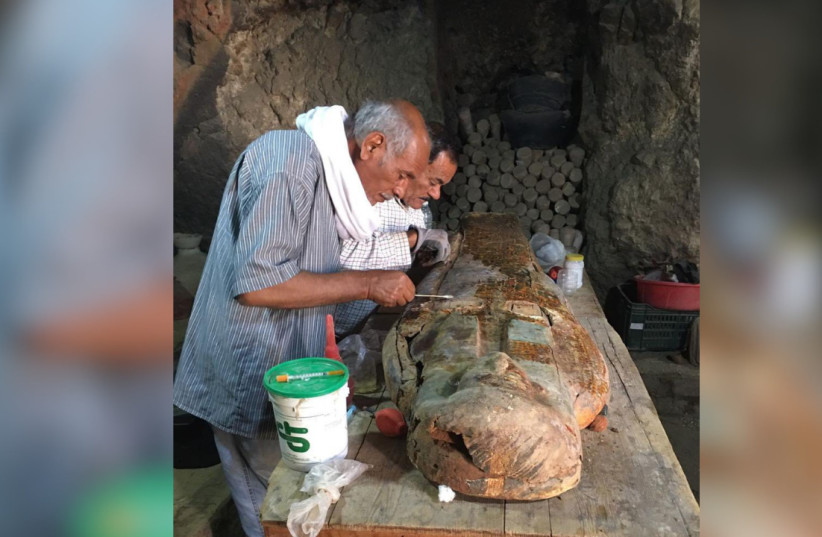
Many of the sarcophagi bore the title of "Singer/Chantress of Amun," a title often held by women of the upper class.
The find gives researchers a chance to further study religious chanters and temple musicians during the time, El-Leithy said, when ritual performance was important in maintaining the cult of Amun at Karnak.
He added that, due to the poor condition of the wood, the Egyptian mission’s conservation team stepped in to carry out “urgent conservation” measures, including treating the deterioration of the wood fibers and carefully cleaning the crumbling painted plaster without affecting the vivid color.
Each sarcophagus was heavily photographed and documented before being transferred to storage for further research.
Excavations to search for the sarcophagi’s original tombs are also underway, mission supervisor Dr. Afifi Rahim added.
Eight pieces of papyrus, pottery storage vessels also found
Eight pieces of papyrus, some with their original clay seals still intact, were also found within the chamber.
Rahim noted that “these papyri constitute an informational treasure whose results the world will await after the completion of restoration and translation work.”
Additional pottery vessels believed to have been used to store leftover materials used during the mummification process were also found.
The discovery represents a “significant addition to the record of distinguished archaeological finds in Egypt,” Egyptian Tourism and Antiquities Minister Sherif Fathy said.