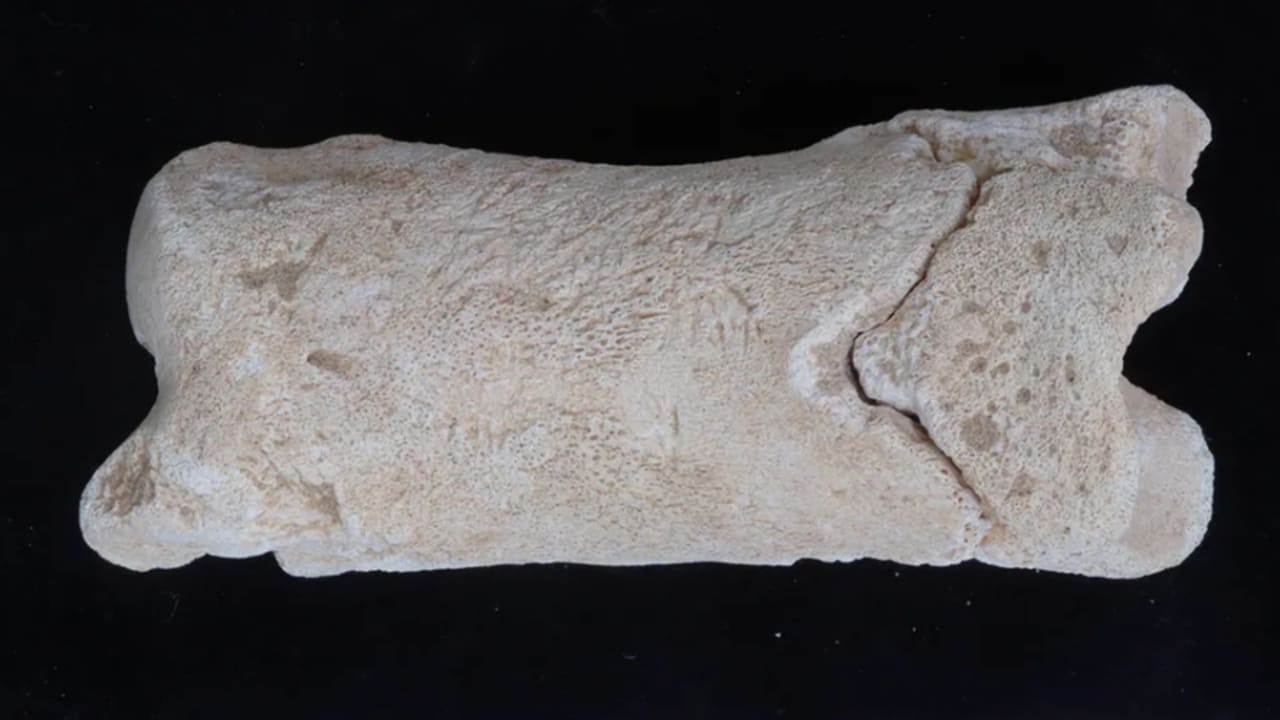
Archaeologists have formally identified a 3,300-year-old bone whistle from Tell el-Amarna that they believe served as a police signal near the royal cemetery, according to Smithsonian Magazine. The piece, uncovered in 2008 in the workers’ settlement known as Stone Village, is a cow toe bone pierced by a single drilled hole and bears no decoration.
“It makes the most sense that the flute was used by a policeman or guard,” said Michelle Langley, Associate Professor of Archaeology at Griffith University, according to Smithsonian Magazine. Langley and colleagues working with the Amarna Project reported in the International Journal of Osteoarchaeology that the artifact is the first bone whistle known from ancient Egypt and points to organized law enforcement supervising royal-tomb labor. “It is unique,” Langley added, according to the same source.
The whistle came from a small stone building on Stone Village’s eastern edge that the study suggested functioned as a security post. The researchers wrote that the find reminds scholars of “the potential sensorial and psychological aspects of social control in an everyday setting.”
To test the hypothesis, the team crafted a replica from fresh cow bone. When air was blown across the hole, it emitted a loud, high-pitched note. Because it produced only a single tone, the group ruled out a musical purpose. Langley explained that the natural contour of the bone’s end provided a convenient lip rest for the user.
Excavators link the device to the Medjay, a force documented in New Kingdom texts and imagery as patrolling royal domains. Langley noted that entry to Akhenaten’s tombs was restricted and guarded, reinforcing the idea that the whistle belonged to security personnel.
Stone Village sat beside a cemetery that contained officials’ graves and the tomb of Akhenaten’s family. Study leaders Anna Stevens and Barry Kemp of the University of Cambridge concluded that the settlement probably served as a checkpoint and was “heavily policed,” reflecting tense oversight of labor.
Tell el-Amarna, founded in 1347 BCE and abandoned in 1332 BCE, held palaces, temples, and tombs dedicated to Aten, the sole deity under Akhenaten. Scenes in the rock-cut tomb of Mahu, chief of police at Akhetaten, depict officers arresting intruders, while parallels at the tomb-workers’ village of Deir el-Medina imply a wider security system across New Kingdom sites.
The researchers argued that “even the most basic, uncooked bone could represent a significant insight into the Egyptian past,” noting that many everyday objects were fashioned from unaltered materials. Stone Village’s network of roads and small buildings allowed officials to observe laborers who moved daily between domestic life and the realm of the dead, and the palm-sized whistle offers a direct signal of how authority was asserted at that boundary.
Written with the help of a news-analysis system.