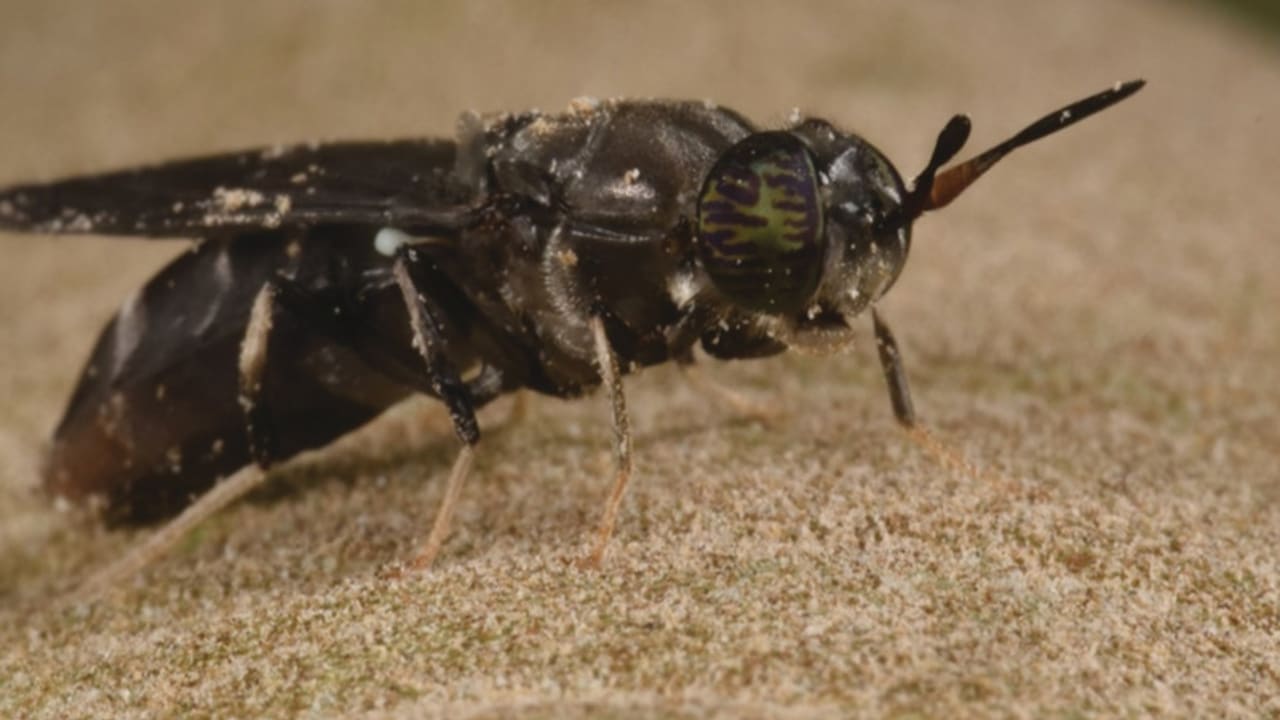
Flies are not only pests to be swatted away. At least one species can be very beneficial for human and animal health. A new study at the Hebrew University of Jerusalem’s Robert H. Smith Faculty of Agriculture, Food, and Environment in Rehovot has found that oil extracted from Hermetia illucens, black soldier fly larvae (BSFL), has potent anti-inflammatory effects on immune cells.
The team’s findings, just published in the International Journal of Molecular Sciences under the title “Impact of Black Soldier Fly Larvae Oil on Immunometabolic Processes,” show that a specially treated form of BSFL oil called MBSFL can minimize key inflammatory signals in immune cells without compromising beneficial immune functions. In practical terms, this means MBSFL could one day offer a natural, sustainable way to help manage inflammation-related conditions in both animals and humans.
The researchers, headed by Prof. Betty (Bertha) Schwartz, told The Jerusalem Post that they found that a modified version of the oil can suppress harmful inflammatory signals while supporting metabolic health.
Born in La Paz, Bolivia, and a member of a Zionist youth movement, Schwartz came to Israel at the age of 18. She earned bachelor’s degrees in chemistry and in biology, a Master of Science degree, and a doctorate in clinical biochemistry, all at Ben-Gurion University of the Negev in Beersheba. Since 2007, Schwartz has been a professor at the Hebrew University’s Rehovot institute.
“The findings offer exciting potential for sustainable, natural feed additives that support animal immunity and reduce reliance on synthetic drugs,” Schwartz said. “This is a step forward in aligning animal health solutions with environmental stewardship,” she added. “The black soldier fly is proving that nature has plenty left to teach us.”
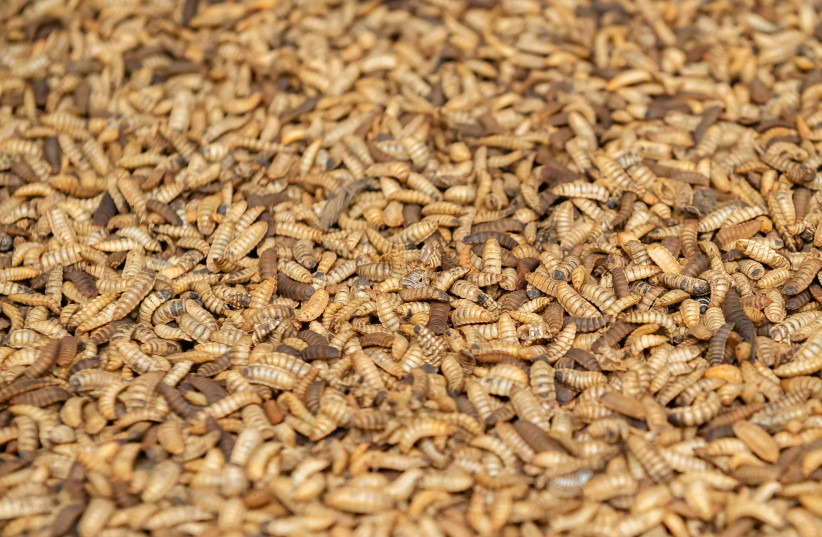
It’s not just for chickens and compost. “We’re always looking for ways to reduce our reliance on synthetic additives in agriculture,” said Schwartz. “What’s exciting here is that black soldier fly larvae oil is not only a sustainable byproduct but could have a genuine role in supporting animal immune health through natural pathways.”
It’s called a “soldier” because it’s very large, two or three times bigger than ordinary flies. “They’re raised in Thailand, India, Russia, and other places, but they could also be raised here.” The flies were cultivated for a while by the BioBee Company in the North, but the project was halted when it did not prove profitable.
In the meantime, a foreign company sends them here as eggs. “They don’t transmit any diseases; rather, they break down the waste products of vegetables. The yellow oil can be used as protein in dog food, but before it is sold, it must be approved by the authorities,” Schwartz explained. “Insects will be used increasingly as food for humans and animals. In Sweden, a company makes non-meat burgers for human consumption.”
The oil, which has been thrown out as waste until now, is amazing because 90% of it is composed of beneficial fatty acids, 40% to 50% of which is medium-chain lauric acid. This is a saturated fatty acid comprising a 12-carbon chain that’s a component of coconut oil and palm kernel oil and is known for its antimicrobial properties and potential health benefits.
“This is very rare in nature. The oil could be put in capsules to be swallowed. When I learned of its composition, I thought of researching it. The oil has been tested against colitis in mice, and it would be relevant to relieve inflammation in Crohn’s disease, but it has to be approved by the authorities,” Schwartz added.
It also contains elements that showed nutritional, anti-bacterial, and anti-inflammatory powers.
How farmers can benefit from insect oil
Farmers will benefit because it could lead to healthier livestock. By modulating inflammation without weakening the immune system, MBSFL could help reduce reliance on antibiotics and improve recovery from infections or stress. As a natural additive to animal feed, it could be developed into a supplement with functional health benefits, especially relevant in poultry and swine production. Since BSFL can be raised on organic waste, this research supports a circular economy model, transforming food scraps into high-value animal health solutions and upcycling water.
While the current study focuses on human immune cells in a lab, Schwartz noted that these findings lay the groundwork for trials in farm animals and open new doors for functional feed development in sustainable agriculture.
Using advanced cell culture models and phosphoproteomic analysis, the research team demonstrated that MBSFL effectively dampens overactive immune responses by blocking inflammatory signaling pathways – especially the notorious NF-B pathway – while promoting metabolic regulators like PPAR that are associated with balanced, anti-inflammatory states, she added.