
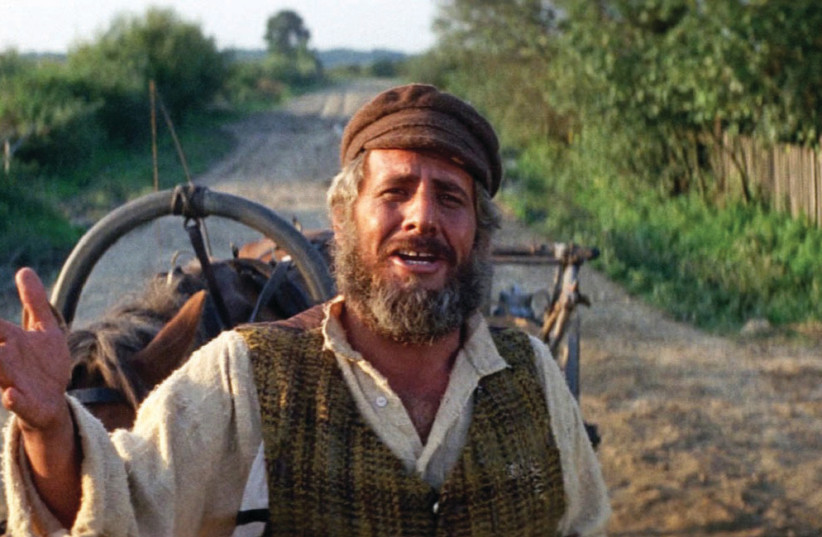
In 1972, as a teenager, I went with my parents to see Fiddler on the Roof with Chaim Topol at Manhattan’s Rivoli Theatre.
In the movie, we watched Tevye’s daughter’s wedding, and I experienced a life-changing event. The movie showed Russian Cossacks bursting into the celebration, destroying property, and turning Jewish joy into humiliation.
The scene showed that most of the Jews stood stunned, and only one young man tried to fight back.
The intermission began immediately after the violent antisemitic attack, and the audience enthusiastically applauded. I stood up, turned toward the theater, and shouted, “What the f*** are you clapping for?”
My parents, both NYC school teachers, were horrified, and my subsequent punishment was very unpleasant. But I was watching Jews being attacked while the world applauded, and I could not accept it.
Of course, the audience was applauding the filmmaking, not the pogrom. Yet to a young Jewish boy, that distinction was unimportant.
More than half a century later, it has acquired an unsettling relevance. When I watch every day how the world is supporting the delegitimization of the only Jewish state.
Earlier in the movie, after celebrating his daughter’s engagement, Tevye receives a warning from the so-called friend, the Russian constable, of impending anti-Jewish violence.
Looking heavenward, he asks: “Dear God. Did you have to send me news like that today of all days? I know we are the chosen people. But once in a while, can’t you choose someone else?”
Behind the humor is Jewish exhaustion: that even happiness comes with the anticipation of catastrophe.
Victor Hugo’s Les Misérables was not merely a story of poverty and suffering. It was an indictment of a society so certain of its own righteousness that it lost sight of justice, mercy, and humanity.
One only needs to look at how the world is treating the only Jewish state to understand Hugo’s deeper message.
Many years later, Israel confronts a different but hauntingly familiar paradox.
A nation that has transformed itself from the vulnerable David into a formidable military power increasingly finds itself cast as Goliath, its legitimacy contested, its identity distorted, and its citizens wondering why strength has not brought security or acceptance.
Hugo understood something we would do well to remember: misery is not measured solely by what people possess, but by what they have lost; their dignity, sense of belonging, and their confidence in tomorrow.
The paradox of strength
Consider an Israeli’s typical morning. October 7, 2023 remains a national festering wound. Hamas, Hezbollah, and Iran remain central security concerns. Iran’s missiles and nuclear ambitions, the burden of reserve duty, and parents’ anxiety for children in uniform are not abstractions.
At home, bitter elections, accusations of irregularities, and disputes over the integrity of investigations have eroded confidence in democracy.
Allegations of foreign interference, including questions involving Qatar and Turkey, deserve rigorous examination rather than premature verdicts. Political opponents increasingly see one another not merely as mistaken, but as existential threats.
And then there is the new America.
The November midterms delivered Congress to the Democrats, amid increasingly contentious debate within the party over Israel. For Israelis accustomed to treating bipartisan American support as a strategic constant, the change is deeply unsettling.
More disturbing still, Vice President JD Vance blamed Republican losses mostly on the Iran war and said voters wanted to “change our relationship to Israel.”
US President Donald Trump acknowledged the war’s electoral cost, even while defending his decision to fight it, as well as the effects of the change in America’s attitudes towards support for Israel.
When such doubts emerge within Israel’s indispensable ally, isolation no longer feels hypothetical.
The Eighth Front
But this misery is not merely the organic product of war and political disagreement. It is intensified by an organized struggle over perception: what we come to call the Eighth Front, the battlefield of cognitive warfare.
Hamas’s operations amid civilian populations create terrible dilemmas for an army confronting armed enemies near homes, schools, and hospitals.
Yet the camera records the aftermath more readily than the military decisions, intelligence, or tactics preceding it. Images become arguments and arguments become verdicts in the public imagination.
Iran’s proxy networks and information operations, Turkey’s hostile political messaging, Qatar’s global media reach and substantial investment in Western universities, and overlapping Islamist and radical Left activist networks all warrant scrutiny as channels of influence.
Coordinated mobilization and deliberate narrative amplification cannot be dismissed as spontaneous public sentiment, but rather as a phenomenon of mass delusional behavior.
The speed with which anti-Israel campaigns spread after October 7 illustrated the power of an existing transnational activist infrastructure.
Some protest against Israeli leadership and policy; others challenge the legitimacy of the Jewish state itself. Conflating the two obscures the danger, but pretending the second does not exist is equally reckless.
Daniel Boorstin warned in his book The Image that representations can become more influential than the reality they depict.
Israel has experienced a remarkable inversion: the Jewish David, historically confronting much larger adversaries, is now cast as Goliath, while the Palestinian becomes David.
The imagery can obscure Iran’s strategic ambitions, Hamas’s responsibility, and the region’s wider conflicts.
More disturbing is the moral inversion through which Jews, heirs to a history culminating in the Holocaust, are portrayed in some campaigns through the language and imagery of their persecutors.
Accusations of genocide and apartheid have enormous political power even before legal questions are resolved. Repetition can harden allegations into unquestioned public assumptions.
For an Israeli mother whose sons and daughters serve in the IDF, who, unlike her counterpart in Hamas or Iran, does not pray that they are accepted in heaven as martyrs.
Or an Israeli member of the Knesset working alongside Arab colleagues in a noisy parliamentary democracy, the distance between lived experience and the world’s portrayal of the apartheid State of Israel can feel incomprehensible.
Those experiences do not answer every criticism of Israeli conduct. They do explain why so many feel they are living inside a story written by someone else.
The misery of the strong
A nation cannot bomb its way out of a legitimacy crisis. An air force cannot intercept an accusation; a tank cannot defeat a narrative. Nor can a democracy rebuild trust while its own citizens regard political rivals as enemies.
Israel needs, immediately, more effective hasbara (public diplomacy) positioned as a National Security Priority: institutional accountability, renewed alliances, and a globally interoperable ecosystem able to confront organized delegitimization without demanding uniformity of thought.
I return to that boy in the Rivoli theater. The audience and I saw the same scene but experienced different realities. Today, Israelis see a country fighting to survive; many abroad see something profoundly different.
The gap between these perceptions is in and of itself a strategic threat.
Tevye’s plea was never for another people to suffer. It was a cry for respite. Israel has learned how to become powerful. Now it must ensure that power protects not only its borders, but its people’s faith in a future worth fighting for.
We need to find pride, comfort, and strength in what Tevye was alluding to in his prayer to God; and while it is not easy being the chosen people, God chose us for a reason, and this reason has helped us survive every enemy to date that has sought our demise.
Am Yisrael Chai.
The writer is a global strategist and a strategic adviser at the Jerusalem Center for Security and Foreign Affairs. Follow him on X: @jeffkahn2020