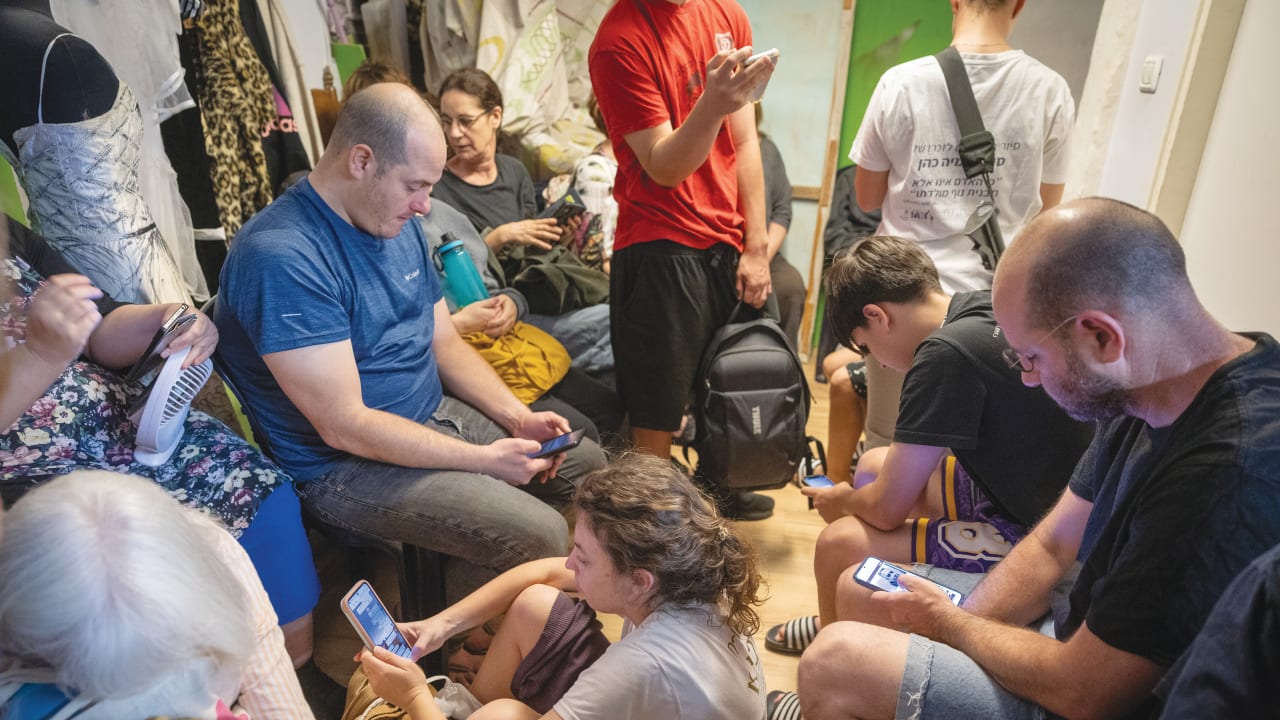
Even with a fragile ceasefire in place, many of us remain traumatized from the war with Iran, while missiles from Yemen and Gaza continue to pose a threat.
As a result, we are still, to some extent, hyper alert for sirens – even on Shabbat. God willing, this week will be quiet, but since Israel launched Operation Rising Lion about two weeks ago, I have received dozens of halachic queries from young parents, expectant mothers, and lone soldiers across Israel. They are students and alumni of the Ohr Torah Stone network asking how to balance Shabbat observance – including using phones, turning on lights or other appliances – with the need to protect both body and mind. These were and are not hypothetical or rare situations; they reflect our lived reality under fire.
Even if this particular conflict is behind us, it serves as an important reminder that in times of stress and life-threatening danger, our halachic system – rooted in the Divine precept of prioritizing physical and mental health – contains essential built-in flexibility.
This flexibility is critical not just to physically save lives, but also to address mental health needs and prevent further mental distress. Before the conflict with Iran started, more than three million people in Israel were suffering from anxiety, depression, and other mental health concerns, according to a government report.
I don’t think anyone would venture to say that this number has not increased significantly since Israel launched its operation against Iran in the dark early morning hours of June 13, when everyone around the country was woken by sirens and automated push notifications on their phones broadcasting an “Extreme alert.”

It was the first such issuance of such a severe warning – and no one yet understood what was happening. The situation clearly presented growing mental health challenges, and illustrates why such challenges must be taken into consideration when providing halachic guidance.
To be certain, our commitment to Shabbat is complete, and we cannot allow our sacred day of rest to become mundane. Yet even so, creating protocols to deal with safety and mental health issues are written into one of the basic halachic cardinal tenets – the primacy of human life.
With the rarest of exceptions, the biblical commandment of “live in them” (Leviticus 18:5) demands the suspension of the commandments when they put our safety, physical life, or mental health at risk. In fact, not to preserve life – including mental and emotional stability – for the sake of keeping Shabbat is itself a violation of Shabbat’s ultimate purpose.
However, when it comes to violating Shabbat to preserve life, it is desirable to keep the “violation” to a minimum, in both the number of violations done and the method in which the violations are performed.
Such considerations, especially regarding physical safety, are to some extent already built into Israeli society.
For example, each Shabbat during war there are a number of rabbinically supervised radio and television stations, also available via mobile phones, computers, and other devices that can be left switched on – known as “gal sheket” (“silent wave”) options – which are silent and have no regular programming, becoming active only when there is potential danger to those watching or listening.
Home Front app, updates treated as necessary for one's safety
By the same token, the Home Front Command app on mobile phones should be left active, as any updates it sends should be treated as necessary for one’s safety. Halacha is also known to allow phones and other devices to be moved during times like these; for example, those on weekend leave from the army, or civilians who need to leave their apartments for shelter, may take radios or phones that are switched on with them because they provide potentially life-saving information.
But going further, what about those with anxiety, who may feel calmer scrolling through news updates after sirens to learn that all the missiles were thankfully intercepted by the IDF? What about those whose Hebrew is especially weak during times of stress, who do not understand the silent Shabbat radio announcements; may they open an English news site?
These are not just technical questions. They are real recent scenarios with real halachic weight, because they affect mental health – and therefore the halachic status of the individual. In many cases, the person may halachically be considered a person who is ill but not critically so, to whom rabbis should be sensitive when providing individual guidance.
I had an especially memorable question of this type last week from a woman with a high-risk pregnancy and anxiety, who has been medically instructed to listen to music, among other techniques, to remain calm and protect her unborn fetus and herself in the current situation. In such a case, halacha mandates that she continue to listen to music on Shabbat – though violations must be minimized by setting up devices before Shabbat begins – such as leaving an app like Spotify open and active all Shabbat, and using headphones that have been fully charged and Bluetooth or cable connected to the device prior to Shabbat.
In this manner, one is able to listen to music to produce a more calming environment without interacting with the device, thereby minimizing the Shabbat violations. This is not a leniency; it is an example of proper Shabbat observance in such conditions.
I BELIEVE it is the rabbi’s halachic responsibility in the current environment to not only permit, but to encourage such “observance” of Shabbat – to protect both physical and mental health during difficult times!
As the guarantors of Torah, we are compelled to examine every phenomenon that occurs in our lives through its prism. That means using all Torah knowledge and concepts to help safeguard life and mental health at a time like this.
Through such activity, we guarantee the eternity of the Jewish people’s covenantal relationship with God. In doing so, we do not compromise Shabbat; we fulfill it in its deepest sense. Halacha remains not only timeless but life-affirming, guiding us with relevance and compassion through contemporary challenges – even in times of war.
Taking this approach also helps ensure that people feel the comfort and love of Judaism and its commandments, and do not come to view it as strictures for the sake of strictures, which can lead to people distancing themselves from a religious or traditional Jewish lifestyle. Now, more than ever, we must show the versatility of halacha to accommodate the spiritual, physical, and mental health needs of all of Am Israel. Shabbat Shalom.
The writer, a rabbi, is president and rosh yeshiva of Ohr Torah Stone.