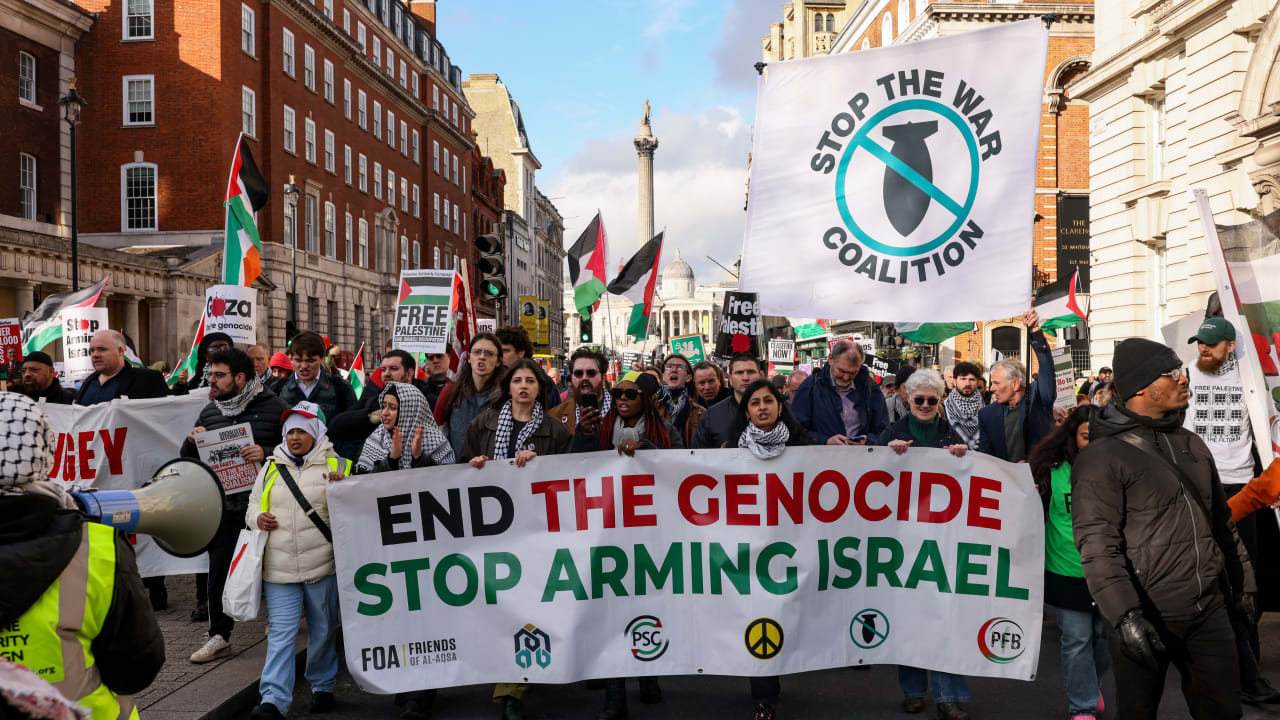
For Olga Deutsch, some of the most consequential battles of this era are waged far from any frontline. They unfold in newspaper columns, NGO briefings, aid networks, courtrooms, and the language of human rights - places where, she argues, falsehood can travel faster than evidence and accusation can outrun accountability. “The ultimate weapon that we have is facts and figures,” she says, and the phrase lands not as a slogan but as an operating principle.
For more stories from The Media Line go to themedialine.org
Poised to take the helm of NGO Monitor in January 2027, Deutsch presents herself as both an archivist and an alarm bell. Founded by Gerald Steinberg, the Jerusalem-based research institute scrutinizes the funding, credibility, and claims of NGOs active in the Israeli-Palestinian arena. Steinberg will move to an emeritus role when Deutsch formally succeeds him. She brings a background that spans finance and international affairs, with studies at the University of Belgrade, the University of Munich, and Columbia University’s School of International and Public Affairs.
Deutsch argues that what is being waged against Israel and against Jews is not a marginal public-relations problem but “the political warfare against the Jewish people and the State of Israel,” a campaign designed to “complement the physical war,” reshape public opinion, and muddy the moral categories by which violence is judged. In that war, she suggests, the uniforms are gone; the actors now arrive as campaigners, analysts, NGOs, and writers in elite publications.
When asked about the debunked allegation that Israelis used trained dogs to rape Palestinian detainees, Deutsch does not simply call it false. She calls it “a perfect example of what we are up against,” a “libelous lie” so grotesque and “preposterous” that “we shouldn’t even be in a position to entertain a conversation around this.” Yet the point, for her, is not just the obscenity of the claim. It is the machinery around it: the fact that such allegations can be seeded, echoed, and laundered into mainstream legitimacy before facts have a chance to catch up.
One of the most visible versions of the allegation appeared in an Al Jazeera report published on May 7, 2026, which cited testimony from former detainees and advocates alleging torture and sexual violence in Israeli detention, including a claim that dogs were used in rape. According to subsequent reporting about how the allegation spread, Al Jazeera raised the dog-rape claim only in the last of four articles on the subject, and that was the one that went viral.
The allegation then moved into major Western outlets as a result of a May 11, 2026, New York Times opinion essay by Nicholas Kristof, who wrote about alleged sexual violence against Palestinians and referenced claims that prisoners had been raped by trained dogs.
Timing, she insists, is part of the method. The allegation, she says, was amplified at the same time as serious reporting on Hamas sexual violence was emerging, and that was not a coincidence. Her argument is that political warfare works by shaping the public conversation as much as by making false claims. The result, she says, is that it becomes harder for the broader public to distinguish truth from lies and politicized reporting from serious journalism.
NGOs and advocacy groups acting as anti-Israel platforms
Deutsch is especially critical of the institutional channels through which such claims travel, saying that some of the NGOs and advocacy groups treated as neutral or rights-based authorities are deeply politicized, and in some cases worse. She says one Geneva-based group functioned “almost like a mouthpiece for Hamas,” while other organizations helped normalize hostile frameworks or lobbied to relax anti-terror vetting in the name of humanitarian access.
Responding to a question about the use of human rights language as a shield for hate, Deutsch suggests that labels are deliberately misused. “They basically hijack each human rights term or issue, and they flip it against us,” she says. “Cancel culture is the new norm, ... and if you’re not toeing the line with my line of thought, then you’re just not right.”
That is why she keeps returning to the language itself. The progression, as she sketches it, is telling: “apartheid,” then “genocide,” then “starvation,” then still broader accusations aimed at the history and intent of Zionism. Each label, she argues, borrows moral power from the human-rights lexicon while stripping away context, evidence, and proportion. “The words are sometimes that much more dangerous than the weapons,” she says, because “when the battle is waged with words, then the lines are blurred, and then everything becomes a conversation and a fight and a debate.”
Her critique of the press is just as cutting. “Most of journalism today, sadly, is opinions,” she says, lamenting a culture in which a writer decides what to believe first and assembles the case later. That shift, in her view, has left audiences unable to distinguish reporting from advocacy, fact from framing, or truth from what she calls “a complete politicized piece.”
In parallel, Deutsch does not portray most people as hateful so much as vulnerable to manipulation. “No one is born anti-Semitic,” she says. Most people, she argues, simply “go about their regular lives,” read the news in passing, and absorb the world as it is presented to them.
The deeper problem is that today’s citizens, especially younger ones, are rarely trained to interrogate sourcing, test opposing arguments, or resist the seduction of emotional certainty. “Most of politics,” she says, “is very personal politics,” reduced to the reflexive question: “How does that make me feel?”

NGO Monitor’s mission: documenting truth amid politicized rhetoric
For Deutsch, feeling appalled by war is not enough to decide complex questions about who is right, who is wrong, or who is a terrorist. War is horrific, suffering is real, and empathy matters, yet none of that is enough to determine who is truthful, who is manipulative, or who is using the language of human rights and victimhood in ways she argues can obscure terror links and political agendas.
That, in essence, is where NGO Monitor places its mission. Deutsch says the organization tries not to get dragged into an “emotional whirlpool,” but instead to document the original sources, affiliations, funding streams, and institutional patterns behind the rhetoric.
She is careful to draw a line between criticism and libel or slander. “Being critical of Israel is OK,” she says. What is not acceptable, in her view, are accusations built on falsehoods, claims that slide into anti-Semitic tropes, and narratives that incite fear or violence while pretending to speak the language of rights. NGO Monitor’s role, as she describes it, is to give the public a place where those claims can be checked against evidence rather than merely repeated.
There is also a broader historical frame to her thinking. She says Gerald Steinberg, NGO Monitor’s founder, recognized 25 years ago that “the human rights space” would become “the main battlefield.” To Deutsch, that prediction now looks prophetic. The very moral vocabulary that should have protected vulnerable people, she argues, has been weaponized and turned against the Jewish state and, by extension, against Jewish communities worldwide.
If the problem sounds sprawling, that is because she believes it is. “The war that is waged against us is a guerrilla war,” she says. “There’s no one singular battlefield.” One front lies in lawfare, another in parliaments, another in the media and social media ecosystem, another in economic policy, and yet another in professions that would once have seemed far removed from geopolitical struggle.
Deutsch even points to what she calls a new “medical project,” describing a “systematic attempt” to weaponize standards and discourse inside the medical world itself. The implication is that no arena is too technical, too ethical, or too insulated to be politicized. The response, she argues, must reflect the fact that this is a war fought across many different fronts: experts for each front, facts for each claim, and a willingness to be slower to respond rather than publish what cannot be verified.
That slowness, she suggests, is both burden and strength. “We are always going to be three steps behind,” she says, because her side will not release a statement or an image before legal teams have verified it. In an era that rewards speed, outrage, and emotional immediacy, that can look like weakness. Deutsch insists it is the opposite: the discipline not to publish what cannot be defended is what preserves credibility at all.
UNRWA and the hidden vulnerabilities of humanitarian aid
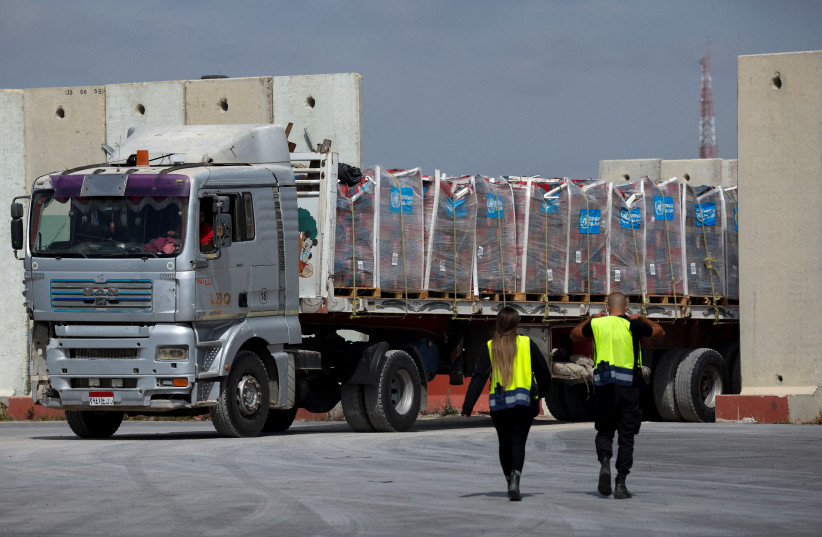
Her concerns sharpen further when the conversation turns to aid. Public debate, she says, tends to focus on the visible components of assistance-trucks, medicine, tents, concrete-but misses the enormous world of non-physical funding flowing through rights work, development programs, women’s initiatives, and other civil-society channels. Those streams, she argues, have been just as consequential, and just as vulnerable to exploitation.
Referring to a recent report based on documents captured in Gaza, Deutsch says the papers showed that Hamas had “completely instrumentalized humanitarian aid infrastructure,” extending control from hospitals to aid organizations, projects, hiring, and information management.
The significance, she notes, is that the documents predated October 7, suggesting that this was not a wartime improvisation but part of the normal operating structure in Gaza. Aid, according to her, was not simply assistance; it was a source of money and a way to control organizations, projects, and discourse.
That is why she treats UNRWA as both a specific problem and a larger symbol. More donor countries, especially in Europe, have resumed funding, she notes, but argues that the real issue is bigger than any single agency. Even if UNRWA were replaced, the same vulnerabilities would remain unless governments created robust vetting mechanisms, clear oversight rules, and real sanctions for abuse. Otherwise, she warns, the world returns to “the same old story” of money and political power being diverted to Hamas.
In answer to the question of how foreign money is laundered and funneled into the United States for use in terrorism-linked and antisemitic causes, Deutsch says democracies are understandably reluctant to suspect charities and human-rights organizations, because those institutions occupy a protected moral space. But that very hesitation, she argues, is what makes them easy to abuse, allowing money to move through nonprofit, advocacy, and other respectable channels before resurfacing in campaigns that spread antisemitic narratives, legitimize extremist causes, or benefit groups tied to terror.
Even when officials are shown evidence, turning a broad commitment to transparency and accountability into actual laws, enforcement standards, and neutral oversight remains difficult and slow.

European Jews face growing insecurity as societal tensions rise
Then there is Europe, where Deutsch speaks as a European who refuses to say that Europe is lost for Jews. But she also calls Europe “an existential crisis” and “in a soul-searching phase,” a place where anti-Jewish hatred is not an isolated pathology but a sign of deeper civic decay.
Her starkest comment widens the lens beyond Jewish life alone: “It always starts with the Jews, but it never ends with them.” In other words, attacks on Jews reveal something broader about the health of a society. For Deutsch, what happens to Jews is a warning light for everyone else.
She paints Europe as fragmented, strategically uncertain, and increasingly marginal. “Europe plays no role,” she says, lamenting a continent that issues grand declarations yet struggles to act cohesively. Europe is “a dog that barks but does not necessarily bite.”
And still, she does not write Europe off. It remains Israel’s “most immediate neighbor” culturally and its biggest trade partner economically, she notes, which means it cannot simply be ignored. The challenge, in her view, is to stop treating Europe as a unified political actor and instead pursue more sophisticated, country-by-country diplomacy while recognizing that Israel’s strategic future may be pivoting elsewhere.

Regional crises bring Israel and Gulf nations closer together
That elsewhere is the Gulf. “The shift already happened,” Deutsch says, arguing that the war with Iran clarified what many Gulf states already understood: whatever their public posture toward Israel, they see Iran as a threat. If those governments continue to value a strong relationship with Washington, she believes, the logic behind the Abraham Accords and broader normalization will continue to expand.
In the Middle East, she adds, the basic rule still holds: “it is the one who is the strongest.” In her view, Israel’s display of “absolute military superiority” has already altered how other states in the region calculate risk, opportunity, and alignment. Power may not settle every question, but it frames the conversation.
Yet for all the attention paid to Iran and the Gulf, Deutsch saves her strongest note of possibility for Lebanon. “The opportunity with Lebanon is the greatest opportunity to me,” she says. If the present moment is seized, and if Hezbollah can be dismantled with American brokerage, she believes it could “change geography here” and transform daily life in Israel in ways that go beyond the Iranian front.
In Deutsch’s view, the fight in the Middle East is no longer confined to rockets, borders, or battlefields; it runs through courtrooms, aid systems, NGO networks, media narratives, and the language of human rights itself. If the terrain is everywhere, then so is the burden of proof-and for her, the only way to resist politics built on accusation, distortion, and emotional reflex is to insist, again and again, on evidence.