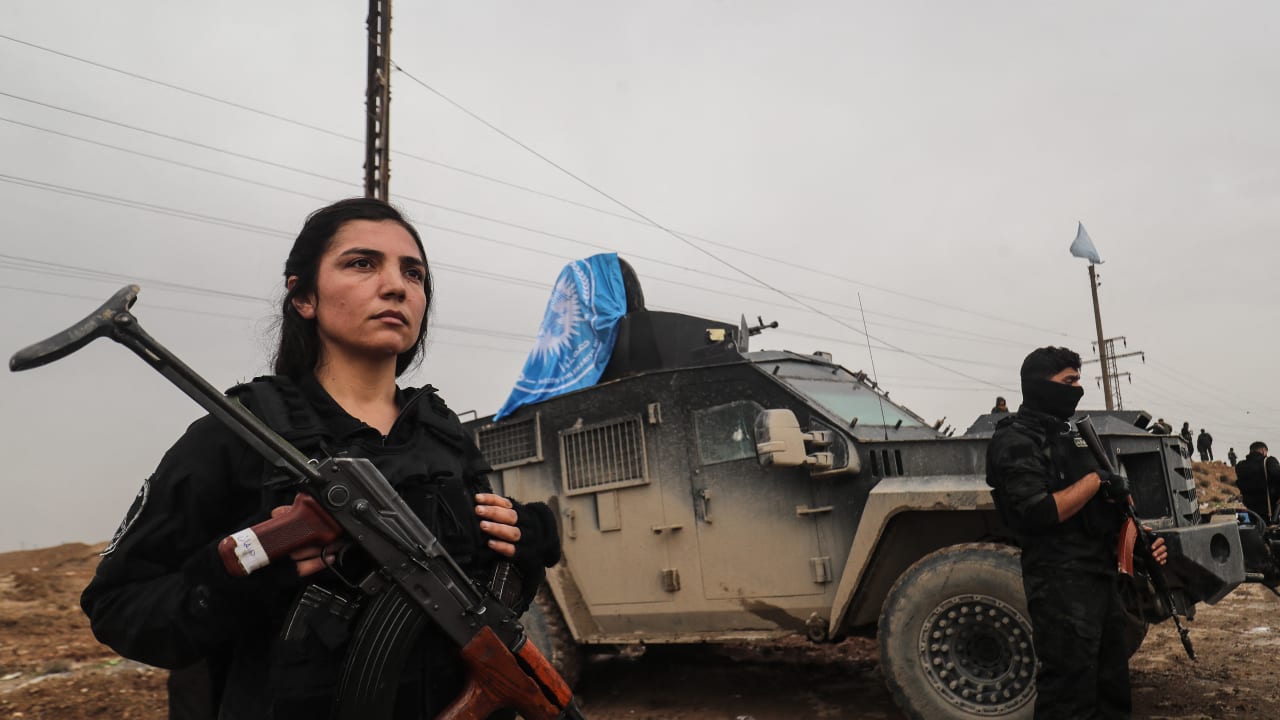
The Syrian militiaman who went viral for allegedly cutting the braid off a female Syrian Democratic Forces fighter he said he killed was arrested by Syrian authorities in Raqqa, according to Kurdish reports on Monday.
Named by the Kurdish Iraqi site Rudaw and the US-based think tank Institute for the Study of War as Rami al-Dahsh, the Syrian Arab Army (SAA) soldier was recorded waving the braid of a woman he claimed at the time he killed. Dahsh later posted a video denying that he had actually cut the braid, or “kezi,” saying it was all a joke.
Local sources told Rudaw that they believed his arrest was “for show” and was aimed at “preventing growing public outrage.”
Notably, the arrest came after the SDF and SAA agreed to an integration deal that would see Kurdish fighters vetted and absorbed into the Sharaa regime’s military.
The Syrian regime, headed by former wanted terrorist Ahmed al-Sharaa, carried out a wave of arrests following investigations proving that state forces participated in the brutalization of Druze in southern Syria months ago.

Arrest, part of a wider crackdown
The Institute of War noted that Dahsh’s arrest came as part of a wider crackdown by Syrian Defense Minister Murhaf Abu Qasra. “These arrests represent nascent steps by the ministry to uphold the chain of command and Syrian laws,” the institute said.
A fairly senior official, the military security head of the 72nd Division, Wissam Abdul Rahman, was arrested on January 30 for his failure to follow orders and stop operations by his forces east of the Euphrates River during a ceasefire in January.
“These arrests will need to be expanded upon to ensure adequate command-and-control and adherence to the law, but the arrests represent some willingness on the part of the Syrian government to respond to abuses and insubordinate officers,” the institute theorized.
Gülistan Savgat, a Syrian Yazidi leader from the Kurdish-Jewish Alliance, told The Jerusalem Post that the Sharaa regime “had to restore its image” by arresting the atrocities committed, which led “humanity to show solidarity with the Kurds.”
Savgat added that she felt it was unclear if the soldier had actually been arrested.
“Many former jihadist remnants in Rojava and throughout Syria are in new roles both in the administration and among the population. The former al-Qaeda members are now dressed in suits and ties, but that is nothing more than an outward image makeover,” she said.
Saying Sharaa was “trying to impress the world” after reaching the integration deal with the Kurdish-led SDF, she noted that this is “a crafty strategy on his part.”
“[Sharaa] is leading us all by the nose,” Savgat said.
“We demand that [Sharaa] make a public statement about all the atrocities they have committed in Rojava, not use this ploy of arresting Hayʼat Tahrir al-Sham militias,” Savgat continued. “Kurds do not trust the Islamic government, and [Sharaa] has in no way distanced himself from his Islamist past.”