
A special army unit found a digitalized copy of former Hamas chief Yahya Sinwar’s six-page handwritten memo, which explicitly called for the terrorist group to target Israeli civilians ahead of the October 7 invasion, The New York Times reported on Saturday.
After the assassination of Mohammed Sinwar, Yahya’s brother and a military leader of Hamas in Gaza, the memo was found on a computer that was not connected to any other network in an underground complex used by Yahya Sinwar while he was in hiding.
The letter, dated August 24, 2022, included directives written in Arabic to target both military and civilian targets, seven Israeli officials told the publication.
Sinwar instructed Hamas to broadcast October 7 atrocities
After viewing the letter, the American newspaper reported that Hamas was instructed to purposely broadcast the atrocities it was committing during the massacre to evoke fear and a feeling of instability across the Jewish state.
“It needs to be affirmed to the unit commanders to undertake these actions intentionally, film them, and broadcast images of them as fast as possible,” the memo read.
“Document the scenes of horror, now, and broadcast them across TV channels for the whole world to see,” a Hamas commander from Gaza City called Abu al-Baraa instructed his operatives in the area of Kibbutz Sa’ad, according to a message intercepted by Israel.
“Slaughter them. End the children of Israel.”
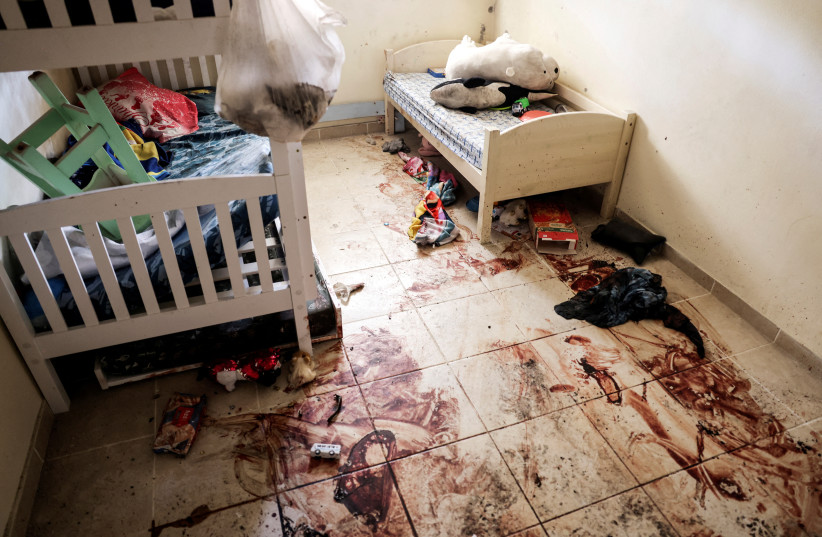
Similar instructions had also been issued by commanders, as revealed by previously unreported communications between them and their subordinates that were intercepted by Israel during the assault and shared with The New York Times.
Notably, in the earlier days of the war, Hamas denied targeting civilians and claimed to have taken women and children hostage for their own safety.
The majority of the children were released in a November 2023 deal, though the children Ariel and Kfir Bibas, and their mother, Shiri, were not released for over a year, and they were killed in captivity. It was later discovered that the family, except for the father, Yarden Bibas, who was released in a hostage deal alive, were beaten to death by Palestinians shortly after their abduction.
Burning the kibbutzim, cruelty to IDF soldier
While Sinwar’s instructions did not include taking civilians hostage, they did order the terrorists to enter residential neighborhoods and set them on fire “with gasoline or diesel from a tanker.”
“Two or three operations must be planned to burn down an entire neighborhood, kibbutz, or something similar,” the memo said.
An intercepted message from a Hamas commander revealed that this directive was followed on October 7.
Abu Muhammed, a Hamas official from Gaza City, told his subordinates: “Start setting homes on fire.”
“Burn, burn,” he said, according to the messages that were intercepted. “I want the whole kibbutz to be in flames.”
“Set fire to anything,” another Hamas leader, Abu al-Abed, was recorded as saying at around the same time.
A different Hamas officer, Abu Muath, had instructed his terrorists to “kill everyone on the road... Kill everyone you encounter” in one intercepted message.
“Men, take a lot of hostages... Take a lot of hostages,” he repeated.
Sinwar’s memo also called for acts of cruelty to be carried out against Israeli soldiers, with an emphasis on such acts needing to be both symbolic and brutal.
“Stomp on the heads of soldiers,” it said.
The memo listed “opening fire on soldiers at point-blank range, slaughtering them with knives, and blowing up tanks” as examples for the sort of acts the Nukhba terrorists were expected to propagate.
Izzat al-Rishq, the Qatar-based director of Hamas’s media office, refused to comment on The New York Times’ report.