
For the better part of a decade, Teddy Neguse didn’t have to look far to find something to be angry about. As one of the most potent voices in Israeli hip-hop, he launched his career with a sharp, protest-driven edge.
He became the megaphone for a generation of young Ethiopian-Israelis growing up in the marginalized neighborhoods of Lod, giving a voice to their collective frustration, systemic alienation, and raw fury.
But fire, while a magnificent catalyst, is exhausting to maintain.
Today, the roaring flames that once defined Neguse’s music have quieted, making way for something far more durable: smoldering embers.
At 31, the rapper is undergoing a profound evolution. He is learning to strip away the heavy armor required to survive his youth, trading unbridled external rage for a striking, sometimes uncomfortable internal honesty.
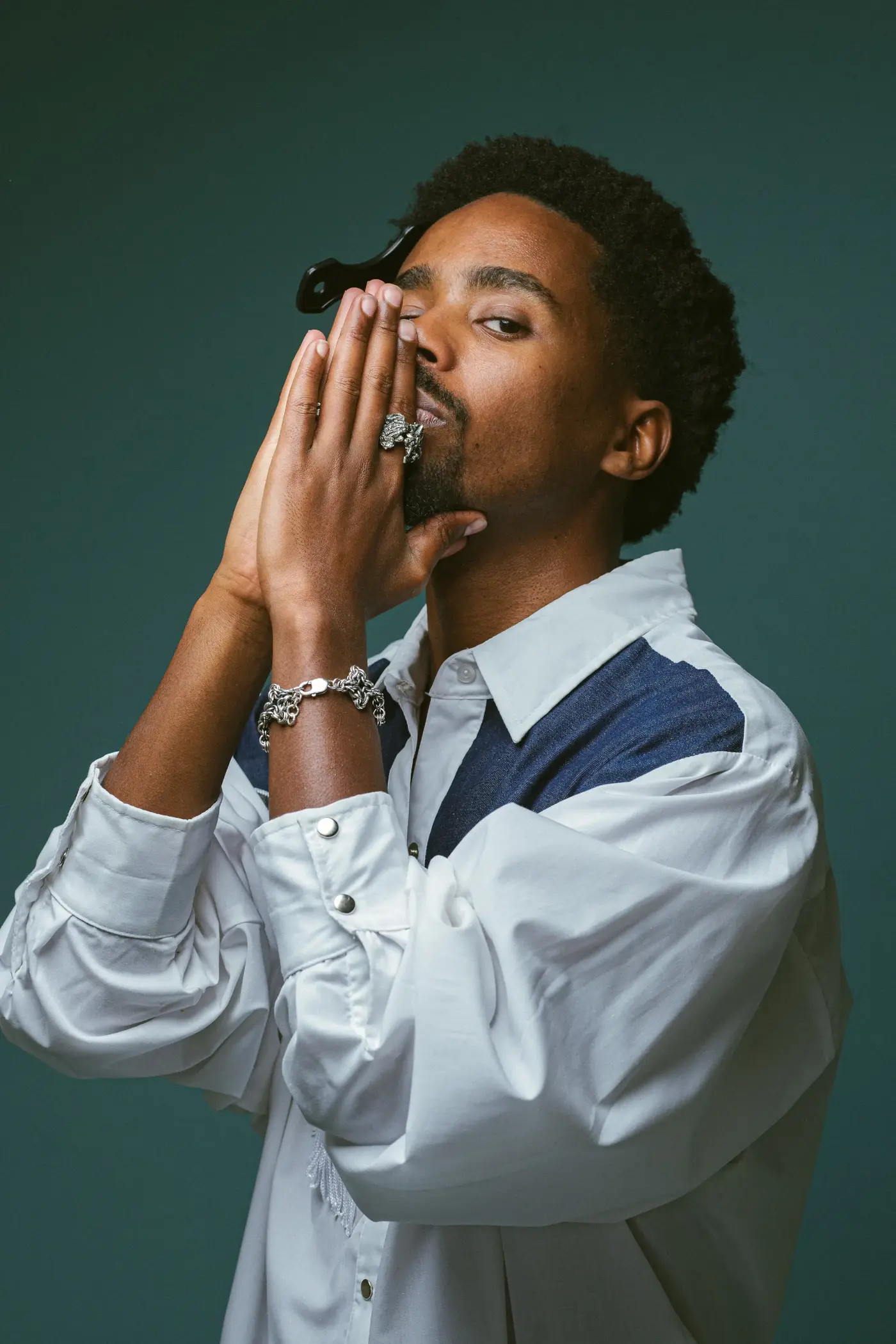
He plans to bring a raw, uncompromising honesty to the stage on November 5 at the Tel Aviv Museum, where he will perform a curated blend of his new album, Ma Ratzitem (What Did You Want?), and classic tracks as part of the Tel Aviv Festival.
Growing up in Lod, a city often unjustly reduced in the media to a mere caricature of crime and hardship, Neguse learned early that survival required a shield.
“Standing your ground sometimes requires being extremely aggressive,” Neguse reflected. “I didn’t always know how to say, ‘Hey, don’t touch me’ – to draw a line. That was the language we used to communicate, and it was inherently very violent.”
To cope, he built a psychological suit of armor. It protected him, but like any heavy plating, it restricted his movement.
Long after he left Lod for the trendy, detached streets of Tel Aviv, the armor remained welded to his psyche. It followed him into his most intimate relationships, forcing him into a state of hyper-vigilance.
“Sometimes I find myself guarding against something that’s purely imaginary,” he admitted, “as if someone is about to close in on me – even though that’s not the case at all.”
Only by leaving Tel Aviv and returning to his parents’ home in Lod did Neguse begin the painful process of dismantling it.
“At the end of the day, I’m something of a nomad,” he said. The return forced him to confront the exact environment that shaped him and, in some ways, kept him stuck.
“Sometimes, I hold a rigid perception of who I was there as a child, and I find myself falling back into certain patterns – things I didn’t have to confront while living in Tel Aviv.”
During his three or four years in the big city, Neguse was plagued by doubts about his identity, his mental health, and his place in the music industry. He realized the anxiety stemmed from a void: a disconnect from his family and his roots.
Returning to Lod allowed him to introduce softness into his life, particularly in his relationship with his father.
“I keep discovering so much,” he shared. “Every day, I get to know my family all over again. As a child, my whole focus was on not being here; I looked for every possible chance to escape. I felt suffocated.
“Now, I realize that even if my sister gets annoyed with me, or I with her... it’s a way of expressing love. We don’t know how to just say, ‘Hey, I missed you.’ It takes work.”
This personal reckoning forms the backbone of his latest album, Ma Ratzitem. A decade into the industry, a milestone that recently earned him a spot on KAN 11’s hip-hop docuseries Zahav Shachor (Black Gold), Neguse is no longer interested in just presenting a flawless, combative front.
In tracks like “Beit Cafe” (“Coffee Shop”) and the brutally honest “Nig’al Me’atzmi” (“Disgusted with Myself”), he invites listeners into his therapy sessions and his darkest self-reflections. He isn’t hiding his flaws anymore.
Through therapy, he has learned to process his inner world and articulate these raw emotions coherently. He even touches on intimacy and romantic passion in tracks like “Magnet,” bringing the same fire he once reserved for protests into the dating world.
“For this album, I decided: ‘Alright, let’s let everyone fully into my head.’ No barriers – just keeping it completely raw.”
Yet, despite his growing profile, Neguse remains fiercely grounded and remarkably hungry. “It sounds like someone who can’t sit still – who’s got ants in his pants,” he said of the new record. “I want to devour everything. I want bigger stages, a larger audience.”
Sold-out show deeply moves hip-hop artist
While hip-hop has exploded into the Israeli mainstream, sometimes at the expense of its underground authenticity, a trend Neguse actively fights by staying close to his roots, sustaining a career independently remains a massive financial and emotional hurdle.
That is why a recent sold-out show for just 300 people at Hameretz2 moved him so deeply.
“For me, it’s like performing at the Menora Arena three times over,” he said. At that show, everything clicked, spurred by a surprise guest appearance from Israeli rock royalty, Berry Sakharof.
“Berry is a living legend,” Neguse beamed. “From the outside, seeing ‘Berry Sakharof and Teddy Neguse,’ you might wonder, ‘What’s the connection?’ When we brought him out, the audience was in total shock.”
Despite the generation gap, the two found an instant, down-to-earth synergy. And as it turns out, Sakharof’s musical palate is surprisingly cutting-edge.
“Berry Sakharof knows British rap in minute detail,” Neguse revealed. “He throws names at me like Skepta, Chip, Abra Cadabra, B Dubble. Personally, I view this as something very niche – so, Berry knows this stuff? It’s incredibly surprising, yet, in a way, it actually suits him.”
To suggest Neguse has gone soft would be a massive misunderstanding.
The struggle of the Ethiopian-Israeli community remains deeply rooted in his heart, but his weapons have changed: he has traded the blunt instrument of unguided anger for the surgical precision of cultural discourse.
When asked about National Security Minister Itamar Ben-Gvir’s paternalistic remarks regarding a “pardon to the Ethiopian community,” Neguse doesn’t mince words: “What an insolent man. Just an insolent man – plain and simple.”
The trauma of his community is not an abstract political talking point for Neguse; it is a lived reality.
While recent high-profile tragedies like the murder of Yemanu Binyamin Zelka sparked national outrage due to viral video footage, Neguse noted that countless others, like Dastao Chakol or his own high school friend, Ashagari Gabru, are murdered in the shadows, entirely ignored by mainstream media.
“For me, this situation is nothing new,” Neguse said quietly. “Many people who hadn’t been exposed to this side of society... have suddenly been confronted with it simply because there’s a video.
“But there are people who live this reality every single day, people for whom this happens right outside their homes, for whom this is just the norm.”
Neguse faces cultural disconnect while performing
This profound cultural disconnect becomes starkest when Neguse looks out from the very stages he has fought to conquer. He recalled a pivotal moment performing at the InDNegev festival – one of the largest crowds of his life – alongside Tomer Yosef.
“I remember a moment where I raised my hand and asked the entire crowd to do the same,” Neguse recalled. “Thousands of people, the main stage... and I didn’t see a single black hand.
“The connection to the crowd feels very intimate, yet at the same time, there’s something that feels quite distant. Where is my neighborhood among these people attending the festival? Where is the place I came from? Suddenly, you experience that gap.”
Neguse acknowledged the immense talent breaking out of the community, pointing to saxophone prodigy Abate Berihun, Ester Rada, Gili Yalo, and the rising Ofek Adanek.
Yet the mainstream industry still struggles to fully embrace them, and a history of starting from a disadvantage can sometimes bruise the very self-confidence needed to create art.
For Neguse, the path forward as a nation requires a collective shedding of our own armor.
“We need to stand on the side of the truth, to look at things with absolute clarity, and to stop trying to cover things up or sweep them under the rug,” he insisted. “The first step is really looking it straight in the eye, and that might be the most painful part.”
By looking into his own eyes first, Neguse is showing a fractured society exactly how to do the same.