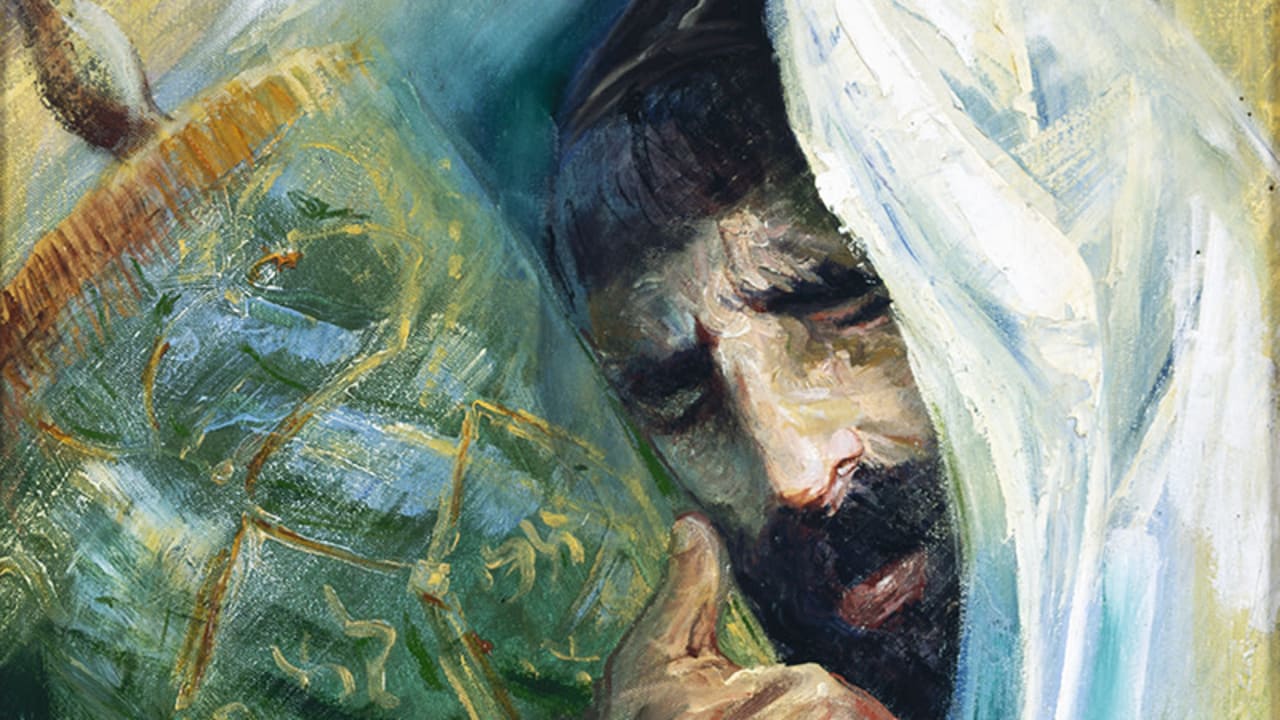
In his book Dance of the Omer, Rav Benji Elson describes Mount Sinai not as a distant historical event but as an experience the Jewish people physically and spiritually entered together – one we renew every year on Shavuot.
Before revelation came preparation. Before the thunder and lightning, there was acclimatization – a gradual opening of the senses to a reality charged with divine presence. The Israelites did not simply arrive at Sinai and receive the Torah in an instant. They had to work on themselves beforehand.
As Elson writes: When entering a great palace or sacred place, people instinctively slow down to absorb the energy of where they are. “You look around, notice where you are, and if you are sensitive enough, you intuit the context and energy of the space in which you just entered.” Only afterward do you begin to move through it, exploring and inhabiting it.
Moses ascends the mountain not merely to receive instruction but also to encounter the divine – and, symbolically, he takes all of us with him.
For artists who take on the challenge of depicting scenes from the Torah – particularly Moses and the giving of the Ten Commandments – the process also begins with preparation.

Huvy Elisha: Inspired by Judeo-Spanish commentary
For one of Israel’s great painters of Torah scenes, Huvy Elisha (1927-2022), born in Jerusalem’s Bukharan Quarter and educated in England, this journey toward Torah learning and biblical imagery came later in life. She was the youngest student ever admitted to London’s prestigious Saint Martin’s School of Art, entering at the age of 14.
Returning to Israel with her businessman husband and three children soon after the ecstatic victory of the Six Day War, she settled into an affluent life in Herzliya. Years later, after marrying off her children, she and her husband chose a humbler, more observant life in accordance with Halacha, moving to the ultra-Orthodox neighborhood of Mea She’arim, where they founded a synagogue below their apartment.
Robert Elisha, Huvy’s younger son and owner of Huvy’s Heart and Art Gallery on Jerusalem’s Washington Street, recalls how his mother educated him into the deeper meaning of her art.
“My mother would say, ‘I’m giving you information I know from the Torah, from Rashi and from Me’am Lo’ez.’”
Me’am Lo’ez, the Judeo-Spanish Torah commentary first published in Ladino in 1730 by Rabbi Yaakov Culi, became one of Huvy Elisha’s major inspirations. It later reached English-speaking audiences through Rabbi Aryeh Kaplan’s monumental English translation, The Torah Anthology – Me’am Lo’ez, published beginning in 1977.
“Me’am Lo’ez was written in response to the growing estrangement from the Hebrew language after the Jewish expulsion from Spain,” Elisha explained, describing where his mother found many of the lesser-known details that inspired her Torah depictions.
“You see Moses coming down from the mountain, and he’s holding the Ten Commandments. If you look carefully at the blue, you see the Torah was made out of sapphire. Moses carried with him all the parts of the first Ten Commandments that he threw down and broke. Those pieces of that precious stone were always with him and made him very rich. That was his financial base.

“Painting isn’t just about what we see, but what we learn.”
For Huvy Elisha, these spiritual insights were essential to convey.
“My mother loved to read the Me’am Lo’ez English translation,” her son recalled.
She “actually pointed out the broken Ten Commandments, telling me how everyone took gold and valuables out of Egypt. The only thing besides the sapphire shards of Torah that Moses took was Joseph in his coffin. Joseph had made the Children of Israel swear they would take him out of Egypt.
“Moses actually took Joseph’s coffin on his shoulders and walked with him. The coffin was heavy – don’t forget Moses was very tall and strong. Still, the coffin was made of a metal weighing hundreds of kilos.
“The big miracle was that he could carry the coffin. It sounds a bit ridiculous to imagine he put this on his shoulders and walked with it, but Kadosh Baruch Hu gave everyone a mitzvah. This was Moses.”
Elisha noted that in some commentaries, the coffin traveled by itself, and perhaps Moses was hovering in the air as well.
“It’s not an issue,” he said with a smile. “Moshe Rabbeinu did it. Full stop.”
Yoram Raanan: A different generation, a different approach
What makes the paintings of Yoram Raanan and Huvy Elisha so compelling in the context of Shavuot is that neither artist approaches Torah as distant history. Both paint as if revelation is still unfolding in real time. However, their paths to that vision could hardly be more different.
Raanan, 73, was born in New Jersey and trained at the University of the Arts in Philadelphia, absorbing the language of Abstract Expressionism and action painting. He pours, drips, smears, and sculpts paint across canvases laid on the floor, using his fingers, palette knives, and rags to create works pulsing with movement, light, and spiritual energy.

Huvy Elisha, by contrast, entered London’s Saint Martin’s School of Art at the beginning of World War II. Immersed in the Old Masters, she was influenced by J.M.W. Turner’s dramatic treatment of light, Impressionism, and classical draftsmanship. Her paintings are rooted in observation, storytelling, and the intimate rhythms of Torah life.
Torah: Where the artists meet
At first, the comparison seems unlikely. Yet despite their radically different techniques, the two artists meet in a profound understanding of Torah inspiration itself.
Raanan’s luminous semi-abstractions dissolve the boundary between heaven and Earth, while Huvy Elisha’s richly detailed scenes invite viewers to step directly into sacred time and divine presence. Neither artist paints Torah as a bystander. Both paint as participants.
That may explain why their work resonates so deeply around Shavuot, the festival of revelation. Like the Israelites standing at Sinai, both artists seem less interested in documenting an event than in recreating the sensation of being there – transformed by collective Jewish consciousness in the presence of Moses and the Divine.
Visual encounters
Yoram Raanan is internationally recognized for large-scale paintings bursting with color, movement, and spiritual exuberance. His Sinai imagery often feels ecstatic – revelation as radiant energy pouring into the world through intuitive play and experimentation. His enormous canvases frequently lead him toward visual discoveries he could never have foreseen when he began.
Raanan lives in the peaceful hills near Jerusalem in Beit Meir with his wife, Magazine writer and meditation teacher Me’ira Raanan, who frequently writes illuminating commentary to accompany her husband’s paintings.
Their collaborative coffee table book The Art of Revelation: A Visual Encounter with the Jewish Bible showcases 160 vibrant Abstract-Expressionist paintings inspired by the weekly Torah portions. Many of the works, lost in the devastating fire that consumed Raanan’s studio in 2016, survive today through these photographic reproductions captured on the artist’s phone.
Speaking about his process, Raanan resists overly explaining his work because, as he put it, “my whole process is basically opening possibilities and finding things in the process of the painting itself.” Much of what emerges on canvas, he said, comes “from a subconscious place, beyond me.” Rather than controlling every outcome intellectually, Raanan described himself as a kli, a “vessel” attempting to tap into a larger flow of energy and intuition.
That openness may explain why viewers often feel present inside his Sinai paintings. However, Raanan himself seems wary of reducing the works to his meanings.
“If I talk about it too much,” he said, “it makes people see it that way.”
Instead, he leaves space for viewers to encounter Sinai personally.
This approach feels deeply connected to the spiritual journey of the Omer itself. In Jewish tradition, the seven weeks between Passover and Shavuot are not simply a countdown but a process of inner preparation – an acclimatization of the soul before revelation.
In Dance of the Omer, Rav Benji Elson describes the Israelites arriving at Sinai slowly – absorbing the atmosphere and energy of the mountain in preparation for revelation.
Raanan’s work seems to function similarly. The paintings do not present Sinai as an event neatly explained but as an experience the viewer enters through color, texture, movement, sensation, and spiritual discovery.
Raanan described himself as “a physical, down-to-earth person. That helps the art be what it is – a marriage between the spiritual, physical, and temporal.”
That tension may be part of what gives his work such force. Sinai itself was both earthly and transcendent – a mountain of rock and dust suddenly charged with divine fire.
One of Raanan’s best-known works, Har Sinai 2, began unexpectedly from a postcard reproduction of a 19th-century David Roberts painting of Mount Sinai. Raanan copied the mountain’s basic form and then, as he said, “just did my usual stuff.” What emerged surprised even him.
“A lot of people did have that feeling of an event at Har Sinai,” he reflected, though he insists the work “wasn’t painted with that thought at all. It just comes from a super conscious place.”
That simple phrase – “super conscious place” – may explain why Raanan’s Sinai paintings resonate so strongly during the season of Shavuot.
Raanan joins a long line of Jewish artists who remind us that Sinai was never intended to remain a distant event. According to Jewish tradition, every Jewish soul stood there. Perhaps artists like Raanan, working intuitively from that “super conscious place,” help us remember what we felt.
Huvy Elisha:
On Instagram – @huvyslegacy
Yoram Raanan:
www.yoramraanan.com
www.instagram.com/raananart
www.facebook.com/RaananArt Photo
The writer is a Haifa-based artist, writer, and creator of Genesis Art, an intuitive art methodology inspired by Torah, personal reflection, and creativity. She developed Genesis Art during her three decades living in Japan and continues teaching and writing from Israel.