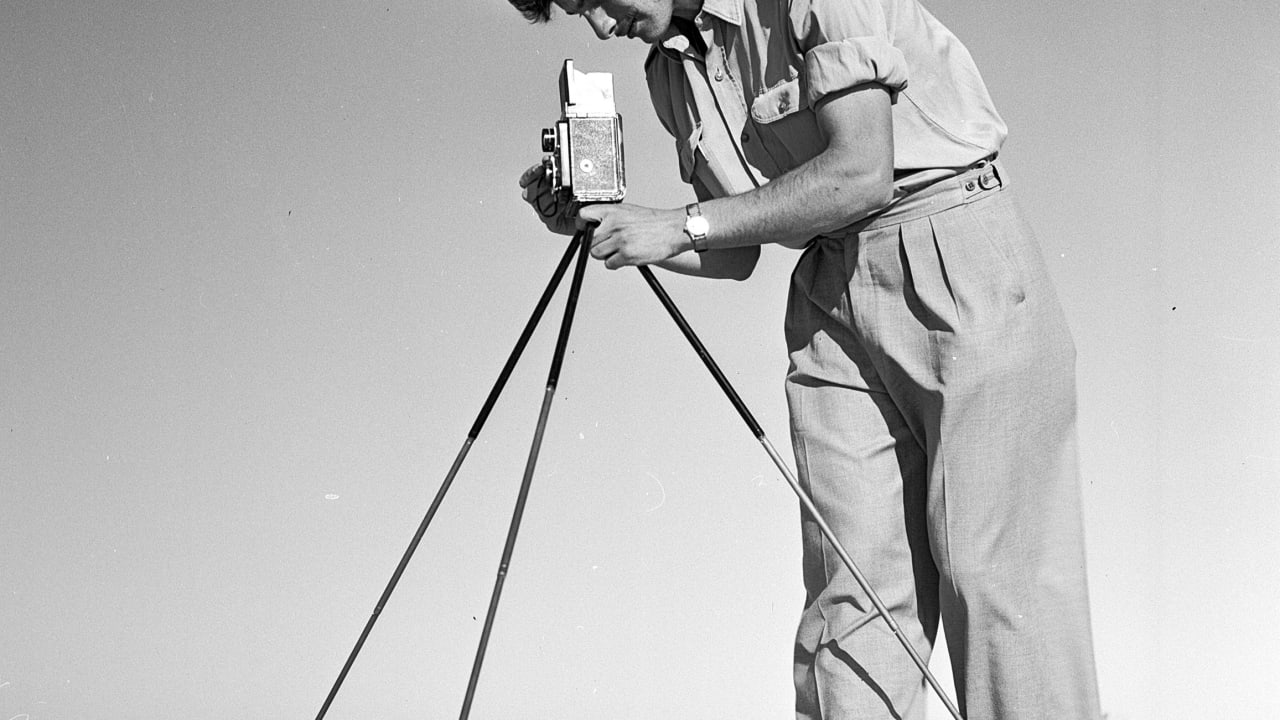
One could plausibly argue that Reuven Milon was the Jerusalemite photographer. Part of the collateral for that claim is currently on the walls of an exhibition area at the International Convention Center (ICC). There are, in fact, 32 pieces of evidence in the aptly and succinctly named Reuven Milon – A Jerusalemite Photographer collection that proffer testament to Jerusalem-born-and-bred Milon’s skill and talent as a photographer and, more to the point, his enduring love for his hometown.
Milon passed away in June 2023 at the age of 95. He was active and focused on his artistic and documentary work, sorting through his tens of thousands of prints and negatives at his home in Beit Hakerem until just a few months before he died. I met him at his apartment on a couple of occasions over the years and was always taken with his genial approach to others and life, and his devotion to his work.
A limited retrospective of his expansive oeuvre opened last Friday at the ICC, curated by Eran Litvin, who was also responsible for his – albeit more compact – showing at the same venue in March 2020. That was when I made Milon’s acquaintance and began to appreciate his insightful view of Jerusalem and his ability to see and capture places and fleeting scenes – minutiae of urban life – with great expertise and consummate sensitivity. They are the kinds of nuances that only someone who lives and breathes a place, and the subject matter at hand, can discern, depict, and then convey to others eloquently and faithfully.
Litvin got in on the Milon act long before I did. “I met him almost 20 years ago at the Zionist Archives. I was a historical researcher for TV programs and movies, and he was the contact for the archives. He also did scanning for them,” the curator recalls. “He told me he also took photographs, and I asked to see some of them.” Litvin was in for quite a surprise. “I visited him at his home, and I was amazed. I’d thought he probably used to go out to the city streets and take some pictures. I discovered that Reuven was obsessive about Jerusalem.”
This wasn’t just about snapping the highlights, chronicling the glittering and momentous events for the history books. Milon dug deep into the nitty-gritty underbelly of city dynamics. “He photographed Jerusalem at its less pretty times. He took pictures of buildings being demolished and the new ones being built.” That smacks of a documentary approach. “Yes, it was genuine historical documentation,” Litvin concurs. “I think it is more about archival-historical photography of a city than artistic photography. He took pictures of a city that looks completely different today.”

Besides the alluring aesthetic of the prints, it is also a comfort to some of us who remember the Jerusalem of half a century or more ago. “Sometimes it is even difficult to identify the spot in the photograph [because it has changed so much],” Litvin notes.
But it wasn’t just about recording places that have long dissipated into the mists of time. There was more to Milon’s work than that. “There were a lot of photographers around in Jerusalem in those days, but I think Reuven stood out for two reasons. One, there was the documentary aspect. The second thing was the human element. He was always looking for a human aspect, whether it was a child, an old man, or maybe an artisan or tradesman.”
A striking example of Milon’s eye for standout human slivers of quotidian life around him is a delightful shot of a freckled-faced boy in raptures over the ice cream cone he’s sinking his teeth into. I remember Milon telling me he homed in on the youngster just waiting for the right moment to capture an expression of pure innocence that spoke volumes. “And look at it,” exclaims his daughter-in-law, Libby Milon. “He photographed the kid with the word ‘artik’ [“popsicle”] on the wall next to him. He always looked for something extra, something contextual.”

These days, in a world awash with cellphone cameras, perhaps such a frame would be harder to capture because we are far more aware that someone might catch us in mid-flight, as it were. Then again, in Milon’s day, certainly in Jerusalem of 1953 when the boy was caught in the throes of sweet ecstasy, anyone prowling the streets looking for stuff to snap would be pretty noticeable as he lugged his – by today’s hi-tech standards – relatively hefty equipment around with him.
Milon’s gentle mien and take on life came to the fore here. “Anyone who met him remarked how modest and quiet he was,” says his son Ram, who now lives in Milon’s apartment, his own childhood home. Milon, by the way, notwithstanding his penchant for his own stomping ground, also roamed the rest of the country and places much farther afield, camera generally at the ready.
Ram also pertinently notes that these were different etiquette times. “He took pictures all over Israel and the world.

Observe and then photograph
He took pictures of all sorts of craftsmen and tradesmen, beggars, peddlers, children, and so on. As far as I recall, he didn’t use to go up to these people and ask for their permission to take their picture. He’d just stand to the side, observe them, and photograph them. Today, it is not so politically correct to do that. You have to ask them if it’s okay, if they don’t mind.” Even with that in mind, considering Milon’s demeanor, it is a fair bet that if he had asked, few – if any at all – would have objected..
We will never know for sure if Milon’s unwitting “sitters” over seven decades of his documentary odyssey had any problem with being recorded, but the spread at the ICC is all the richer for his chutzpa and proclivity for pressing the shutter release button as his well-oiled pictorial antennae locked in on something snapworthy.
His frame of Milkman Singer, taken one early morning in 1959 in the upper reaches of Ben-Yehuda Street, exudes a sense of downtown Jerusalem intimacy, the freshness of the unfolding day, and Milon’s fondness for what others might deem to be “the ordinary.” In this case, the subject knows the camera lens is trained on him as he gazes, a little warily or, possibly, wearily, straight at Milon’s cigarette jutting out at a jaunty angle of his mouth. The milkman, in fetching workman’s attire, is just doing his rounds, as usual, about to set bottles on doorsteps. What could be more prosaic than that? Yet, with his talent for discerning everyday vignettes that may resonate, Milon has left us with deftly crafted snippets of a bygone era that offer some nostalgic comfort for anyone who remembers those days, and possibly suggests to others that life here back in pre-digital times was very different and certainly moved at a gentler pace.

I wondered whether Milon hankered for his hometown of yesteryear, when people seemed to have more patience, when there were fewer “time-saving” digital and other devices around. That comes across in a lovely moment frozen in time on a city street as a customer patiently waits for his pen to be restored to full operational order. The artisan sits at his makeshift sidewalk desk, putting a lot of effort into his work beneath a small sign that reads “Expert in the Repair of Fountain Pens.” How many people under the age of 50 today even know what a fountain pen is?
If I were looking to eke out some Milon angst about the gradual disappearance of the Jerusalem he knew as a boy during the British Mandate, and as a young man, I was to be rebuffed. “I tried to get him to tell me if he was sad over the way the city had changed, and how so many things he’d photographed no longer existed,” Litvin comments. “But I think he liked it. He saw it as the natural evolution of a city. He did take a nostalgic view of things, but he wasn’t angry. He accepted that new buildings had to replace the old ones. Then again, he felt it was important to preserve some of the older buildings at a time when no one talked about conservation.”
Today, we know about those demolished structural specters partly thanks to Milon’s unstinting reportage. “He photographed all sorts of phenomena that have now passed, such as the cinemas of Jerusalem, cafés, all sorts of historic structures like the Generali Building [which still stands at the corner of Jaffa and Shlomzion Hamalka strseet], and, of course, religious structures like synagogues. That is very important.” That included the Mamilla buildings, which had been largely reduced to rubble lying in no-man’s land between West Jerusalem and the Jordanian-held Old City.
Despite hailing from a generation that came from a relatively technologically primitive Israel, which, for example, had to wait decades to watch TV, Milon moved with the times. On one of the occasions I visited him, he took me into the diminutive space near the entrance to the apartment where he worked much of his post-snapping magic. He proudly showed me a 3D camera, and he readily embraced digital photography.
For many years, Milon developed his own films in a spacious laboratory on the basement level of his building, and Ram has lovingly collated some of Milon’s developing and other photographic apparatus in a corner of the lower level of the now modern apartment. The implement collage includes a manual light exposure timer and various other items that would have been cutting edge – or thereabouts – when Milon was producing his own prints.
While Guy Raz, photography curator at the Eretz Israel Museum (MUZA) in Ramat Aviv, does not regard Milon as a bona fide member of the photographic elite in this country, he appreciates his vast, variegated oeuvre. Part of that appears on the House of Photography website (hope.eretzmuseum.org.il/about-photography-house) that Raz established under the MUZA aegis as an online repository for photographers and their work from this part of the world over the last close to two centuries. “I would call Milon’s photography a little naïve,” he says without a trace of negative criticism. “He didn’t look for the drama. I think that is what is compelling about his work. It is like photographs from the days of innocence [of Jerusalem].”
That, Raz feels, is an extension of Milon’s character. “He was a sensitive, nice person. He didn’t look for opportunities to push himself into the limelight. Perhaps that was to his detriment because he is less well known,” Raz suggests.
Milon is, indeed, not mentioned in the same elevated breath as the likes of now 95-year-old Micha Bar-Am – who became known as the national war photographer following his daredevil coverage of the Yom Kippur War – or David Rubinger, who famously snapped three Israeli paratroopers by the Western Wall immediately after its recapture in the Six Day War. Shimon Peres dubbed Rubinger “the photographer of the nation in the making”.
That said, and as patently imparted right across A Jerusalemite Photographer, Milon not only had his finger on his camera shutter release button, but he also had it constantly, and sensitively, applied to the pulse of life coursing through the city he loved.
Milon also had a subtle sense of humor, and there are anecdotal slots in the exhibition, some with intriguing contextual value, such as a haredi boy nonchalantly exhaling cigarette smoke, presumably on Purim when all and sundry among the ultra-Orthodox let their hair down, and another haredi youngster peering through the legs of his kapota-clad elders, no doubt at some rabbinical pantheon member. Jerusalem in the snow, a bewitching film noir-style print of Milon’s wife, Rina, under a street lamp; the façade of the Zion Cinema in the city center showing Gone with the Wind; and soccer fans dangling perilously astride the high perimeter fencing around the now long-gone legendary YMCA pitch then used by Betar Jerusalem spell out the expansive range of life facets Milon lovingly photographed and left for us to enjoy.
It must be said that the spot assigned to Reuven Milon – A Jerusalemite Photographer is hardly a major venue. And to get to the exhibition, you need to make a reservation via the ICC (iccjer.co.il/en/exhibitions/reuven-milon-a-jerusalemite-photographer). This is hardly Milon’s first exhibition – there were 10 between 1954 and 2020 – however, one might have thought the municipality would invest a modicum of effort in making Milon’s pursuit better known to the public. Better still, how about an extensive retrospective at the Israel Museum? Perhaps when he has settled into his office chair, incoming Israel Museum director Jacob (Yasha) Grobman might consider it.
Litvin, for one, would support such an initiative. “Reuven’s work is a genuine national asset,” he says. While there are some 60,000 of Milon’s negative scanned and safely ensconced at the Harvard University archives, there are said to be several hundred thousand waiting to be digitized and secured for posterity.
Reuven Milon – A Jerusalemite
Photographer closes on August 26.
For more information:
milons.co.il/reuven/index_eng.htm