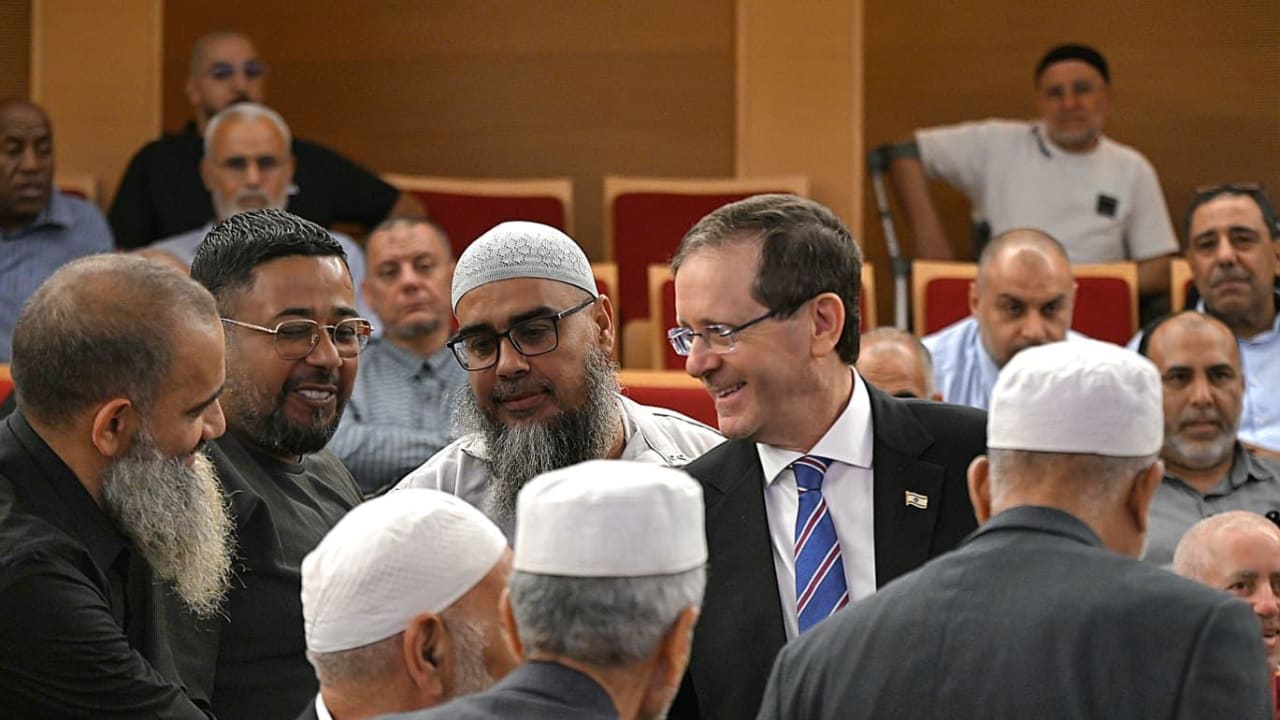
Israel has an “obligation” to protect all its citizens, President Isaac Herzog told 58 imams graduating on Thursday from a joint Open University and Interior Ministry initiative aimed at reducing crime in the Arab sector.
The year-long Imams as Community Leaders program brought Islamic leaders from across the country to the Jewish-majority city of Ra’anana each week to study community resilience, conflict resolution, and violence prevention strategies for communities torn apart by crime.
As Herzog noted, more than 140 Arab citizens of Israel have been murdered since the beginning of the year alone, with major incidents in Jaffa and Holon over the past week. Car bombings in both cities left multiple people severely injured.
A six-year-old boy was among those wounded in the Jaffa explosion, the same explosion that killed his father. Herzog greeted the graduating imams in a small auditorium at the Open University, exchanging warm smiles and handshakes with the country’s Islamic leaders.
“Violence is not a fact of life,” the president said, telling the graduates they were completing the program at a critical moment for Arab society. Herzog said Israel had an obligation to confront the crime crisis and could not continue to view itself as progressive while allowing the bloodshed to continue.

“We need to bring back the quiet to the street,” Herzog asserted, describing the current situation as “unbearable” and promising that Israel’s wider society was willing to struggle alongside its Arab citizens to ensure the issue is finally resolved.
Confidence in state declining
The significance of Herzog’s address was not lost on Open University president Professor Leo Corry, who said it came at a time when confidence in the state’s willingness and ability to tackle crime was declining.
“Regrettably, violence continues to claim victims almost daily and harms citizens’ ability to lead safe and normal lives in the most basic sense of the word. As time passes and violence worsens, there is a growing feeling that state institutions, particularly law enforcement authorities, are not fulfilling their duty to act with all power and means to eradicate crime and support citizens whose lives and the lives of their children have been abandoned,” Corry acknowledged.
The Abraham Initiatives watchdog group published data earlier this week showing that police have solved only 12% of homicides in Arab communities this year, and only 10% of last year’s 252 cases solved or otherwise resolved.
The Arab crime crisis, and what many see as insufficient resources devoted to addressing it, has become a central topic on campus. In February, the university hosted protests “to express solidarity with the pain and distress of the citizens of Arab society in Israel and call on the state to continue acting with determination and responsibility.”
Each of the graduating imams created their own community projects, ranging from forgiveness committees to teaching young children about conflict resolution and the related religious texts, to pushing more religious leaders to join social media, where they can have greater influence on teenage populations.

Course gives imams opportunity to learn from criminology experts, expand toolbox
Graduating Imam Abu Bakr Muhammad, from the Haifa District village of Jatt, told The Jerusalem Post he made the weekly journey to the merkaz because of the severe and growing impact crime is having on his community.
“I came because this course is very important, especially considering everything that’s happening in Arab society. Crime keeps growing and becoming more severe. We’ve reached a point where almost every day and every night there is another incident, another murder or another shooting,” he explained.
Bakr said the course gave imams the opportunity to learn from criminology experts and “expand our toolbox” for mediating conflicts within their communities.
“We can better analyze situations, understand people, and provide help to those who need it,” he shared.
“We came to the course because the professors here were prepared to give us knowledge and broaden our understanding so we can work more effectively, better understand the people we meet, and know how to work with them.”
Bakr said he also learned how to “conduct dialogue” with offenders, victims, and families who have paid the ultimate price in the unresolved crisis.
“Every word matters. Every phrase we use has a different impact. The more people accept us, the better we can understand them. That also makes it possible to facilitate sulha (reconciliation) and similar processes, helping reduce crime as much as possible, or at least prevent people from becoming involved in crime,” he said, adding that he believed most of the impact would be felt in the next generation.
Stressing that the next generation of Arab Israelis needs better opportunities and a stronger sense of belonging, Bakr said he hopes to help raise children in his community to reject crime outright. As part of that effort, he gives talks in schools, private homes, and community centers about the need to “dry up” the pipelines recruiting young people into criminal organizations.
Inspired in large part by children as young as 10 whom he had supported after they witnessed the murder of their own parents, Bakr launched a project with local schools to identify students at risk of recruitment by criminal networks and help redirect their energy toward community and religious activities.
Describing what he has witnessed firsthand, Bakr said criminal families had been allowed to amass “enormous amounts of money,” as well as weapons and influence.
“They are able to influence events and do as they please,” he said.
Promising that police would have the support of Arab Israeli leaders, Bakr urged law enforcement to do more to identify crime hotspots and devote additional resources to Arab communities.
“We’ve seen their success in Jewish communities, in places like Netanya and Ramla. There, they made a real impact and almost completely eliminated organized crime in those areas,” Bakr noted. “We know what they accomplished there, and we want to see them take the same strong approach in Arab society. We will support them if they do. We want them to dry up all the sources from which crime grows.”
Discussing the same criminal networks, Attorney Roy Kahlon, head of the Headquarters for Combating Crime in Arab Society at the Prime Minister’s Office, warned that they now pose a threat to national security and seek “to impose fear on society as a whole, silence witnesses, threaten elected officials, and become the dominant authority on the ground instead of the state.”
“The State of Israel is dealing with threats from abroad, and it must fight with equal determination against the growing threat from within. When an armed criminal organization systematically uses violence to intimidate the public, silence witnesses, threaten police officers, threaten public officials and elected representatives, extort business owners, infiltrate public tenders, damage national infrastructure, and impose its will through fear, it becomes a threat to the state itself,” Kahlon said, adding that the networks were using the same methods as terrorists and that the legal framework needs to be adjusted to account for this.
“We cannot fight organizations that operate like terrorist organizations using legal tools designed to deal with ordinary criminal offenses. We must provide law enforcement and security agencies with the legal authorities they need to confront this threat.”
While advocating tougher legal measures against criminal organizations, Kahlon said prevention remained just as important. Part of that effort, he said, is equipping imams to guide their communities away from crime and help them recover from its effects.
“You are not merely course graduates or public servants. You are community leaders. You are the people others turn to in times of crisis. You have earned the public’s trust. Your words carry weight, significant weight. Sometimes, a single word can have an impact where no other authority is able to make a difference,” he told the graduates. “Sometimes, one courageous decision by a local leader can prevent a murder, save an entire family, or change the course of a community.”