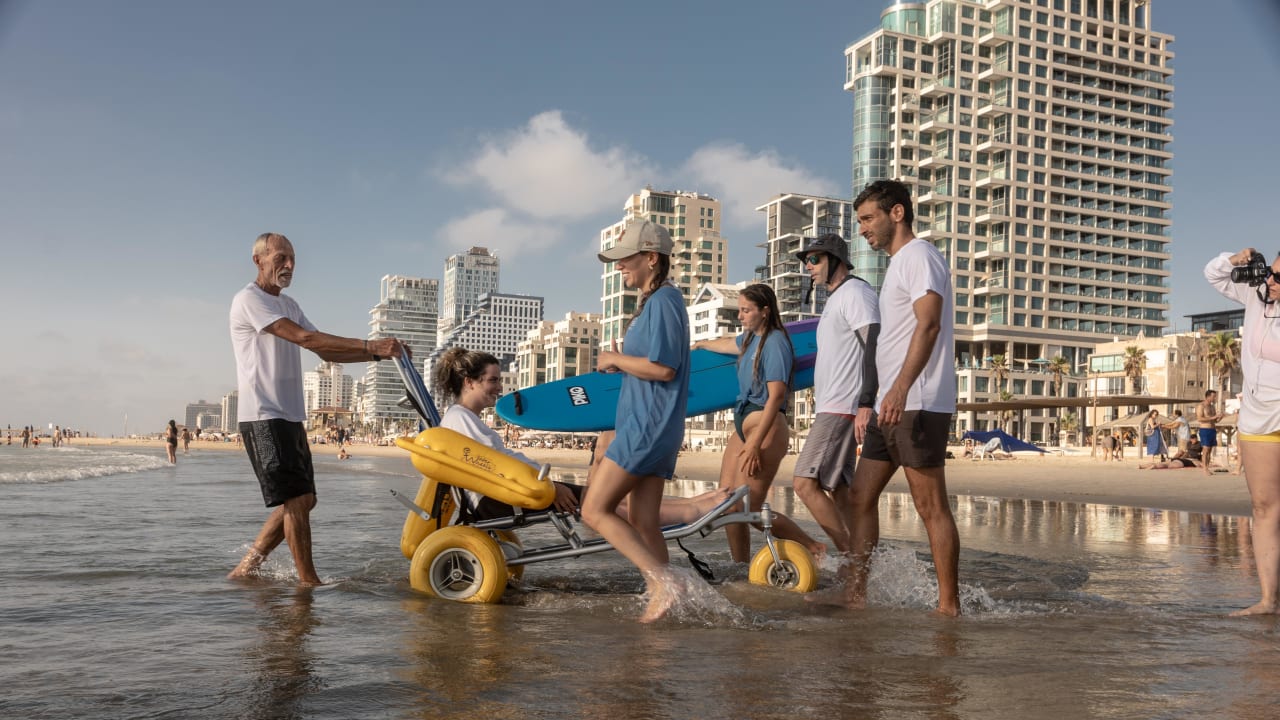
At first glance, Posseable might seem like just a surf club. However, a closer look reveals it serves a much greater purpose. Founded by longtime friends Noy Tzabari, Ziv Amitay, and their partners, this nonprofit in Tel Aviv unites people with and without disabilities to share the ocean, aiming not only to ride waves but also to dismantle barriers.
"I started surfing after I was injured at age 12," Tzabari explains. "And the feeling that if I can surf, I can do anything— I experience that every time I am in the water." She and Amitai took their first steps toward creating the organization after a trip to Sri Lanka.

"Ziv owned a surf school that organized retreats abroad," Tzabari shares. "I always wanted to join but never dared to ask. Then he invited me, and that’s when our journey began." That trip was groundbreaking, featuring a mixed group of people with and without physical disabilities.
"Two of us had physical disabilities in a group of able-bodied individuals. That’s uncommon. Usually, people are grouped only with others with disabilities, which doesn’t always make sense. There’s something natural about being among people with shared interests, regardless of ability."
The experience was transformative, not only for them, but also for others, as Tzabari recalls how "People from all over Sri Lanka came just to support us," "They cared only about volunteering and surfing,” she says, “We became the talk of the entire island."

For Tzabari, who is quadriplegic, the impact was profound. "Surfing is challenging even for those without disabilities. So, when I tell people I do it, I feel it's a badge of pride." What started as a personal breakthrough not only led to an annual surfing trip to the island with a diverse group of individuals with and without disabilities, but also grew into a community. "We now have more than 150 volunteers," she adds. "And we all share one thing - the sea."
This shared interest is vital. "When volunteers come because you're disabled, it doesn’t always feel great," she says. "But here, they come because they love the sea. That breaks down many barriers."
CEO Ziv Amitay explains that the organization customizes equipment to fit each participant’s needs. "We adapt boards with handles, chest cushions, supports for arms or legs. We train every volunteer with a physiotherapist and accessibility expert."
Safety is integral to our approach. "We collaborate with a rehab center specializing in spinal injuries, and nearly every session includes a physiotherapist to ensure we follow proper physical procedures." Posseable runs several different groups. One was created specifically for injured soldiers following the October 7 attack.
"We physically went to hospitals and rehab centers with surfboards. We spoke with every soldier and compiled a list of those who expressed interest. Dozens left their info, and that became a group. We even expanded it to include people with psychological injuries."
Other groups include children with autism from both Jewish and Arab communities in Jaffa. "We met with them all winter, every week. It was a remarkable experience, both physically and emotionally. It helped some of them commit to something and trust someone who isn’t a parent, just to put on a wetsuit and try."
The main Wednesday group involves adults with various disabilities, either from birth or injury, and includes some injured soldiers. "It’s about 30 people, and 12 to 14 surf each week." For Amitay, the bigger picture is always at the forefront of his mind.
"Disability doesn't stop at the water’s edge. People with disabilities often see their future as more limiting, finding housing, a job, or building friendships can be difficult. Statistics also show higher rates of depression." He views Posseable as a community that goes far beyond the water.
"This year, we organized a desert trip with fifteen wheelchair users, their families, and volunteers. For some, a weekend at the Dead Sea is simple, but for one of our surfers who’s been in a wheelchair for ten years with three daughters, it’s not an option, so we decided to do it together, as a family."
According to Amitay, the way forward is clear but requires collective effort. “We’re a small nonprofit, fully certified and compliant with all regulations. Last year, a UK-based nonprofit donated to our multicultural group, helping with funds and equipment."
Besides funding, the organization also seeks volunteers, whether for social media, photography, logistics, behind-the-scenes work, or equipment, to help sustain this budding community. “That’s how we can grow," Amitay concludes, “Help us spread the good.”