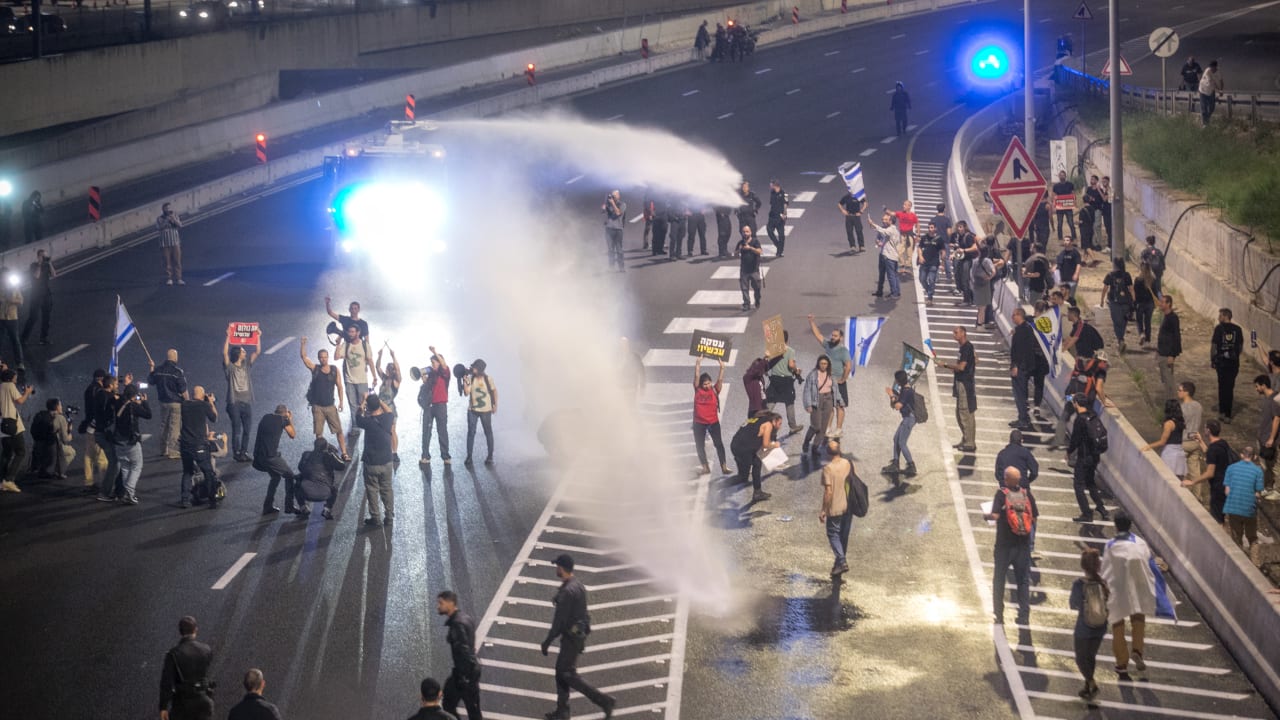
The police's use of water cannons and skunk spray to disperse protests could have serious long-term risks, including the potential for permanent disability, a report by the Knesset Research and Information Center found on Monday.
The report was commissioned by MK Eliyahu Baruchi (United Torah Judaism) before the Knesset's National Security Committee's Monday discussion on Baruchi's bill which aims to regulate the operation of water cannons and skunk spray by seeking to stipulate that a water cannon should only use clear water without any added color or odor substances.
Before the report was published, the Knesset Research and Information Center requested information from official sources regarding the potential health damages resulting from exposure to water cannons and skunk spray.
In response, the Health Ministry stated that they had not been required to examine these methods, and the Environmental Protection Ministry stated that they had never been asked to approve or address skunk spray.
The Defense Ministry did not respond to the request, and the National Security Ministry did not reply to the question regarding health ramifications. The National Security Ministry also refused to provide an opinion on the matter issued by Israel Police's then-chief medical officer in 2010.

The Knesset Research and Information Center then investigated a report from the British government's scientific advisory committee, which examined the health implications and risks of water cannons. This report found that damages can include a wide range of injuries, including musculoskeletal fractures, including in the spine, eye injuries, blunt force trauma, hypothermia, and negative mental health ramifications.
The Israel Medical Association (IMA) has also previously warned about similar health risks.
IMA sent two letters to then-police commissioner Kobi Shabtai in July 2023 and June 2024, following documentation of serious injuries from water cannon impacts on protesters. In the letters, IMA recommended suspending the use of water cannons until a full examination of damages can be conducted. Injuries noted by IMA included severe eye injuries that could lead to irreversible vision damage.
The Knesset Research and Information Center also investigated other countries' usage of skunk spray, contacting fifty European countries. Approximately half responded, with none using skunk spray to disperse protests, making Israel a unique outlier.
However, 23 of the countries permit police to use water cannons in some form, with only Finland, Denmark, and Sweden banning their use, out of the countries that responded.
The UK bans water cannon use in England, Scotland, and Wales, but permits it in Northern Ireland. France considers skunk spray or any other substance with a foul odor as "excessive" in its means, according to the response provided to the Knesset Research and Information Center.
"It is no secret that in Israel, the water cannon vehicle has long since shifted from its original role of maintaining public order to an instrument of violence," Baruchi said in response to the Knesset Research and Information Center's report.
Water cannons are "used in an unregulated manner, exclusively in Israel, with the addition of skunk spray, and with total secrecy about their chemical composition, in an inequitable manner, without documentation or oversight," Baruchi added.
This causes "terrible economic and physical damage to hundreds and thousands of citizens and infrastructures that have no connection to public order violations," he stated.
His proposed bill seeking to regulate water cannons to their original purpose of allowing police to maintain public order while also protecting citizens protesting will help lead to "no more police recklessness," he added.
What is 'skunk spray' and how is it used?
Skunk spray contains unknown chemicals added to the water cannon, which creates a sharp odor that can cause intense nausea and lead to several side effects, most of which are temporary.
Israel Police's public disorder procedures allow them to add various substances, including the unknown chemicals which create skunk spray, to their water cannons and deploy them during disorderly protests.
Skunk spray was originally developed to deal with protests by left-wing activists and Palestinians in the West Bank before being adopted by the police. It is now recurringly used against Haredi (ultra-Orthodox) and Arab protesters, as well as anti-government demonstrators.

In particular, the anti-judicial overhaul protests throughout 2023 saw reports of increasing numbers of serious injuries due to water cannon use and side effects from skunk spray.
The report from the Knesset Research and Information Center found that the composition of skunk spray is confidential. It is known that it consists of yeast and baking soda, which undergo a fermentation process, but also contains substances whose exact nature and effects are not fully known.
Official inquiries regarding the composition of skunk spray went unanswered by the report.
The report noted a November 2024 test by the Hebrew University of Jerusalem's Chemistry Institute on a liquid extracted from the clothing of protesters who were sprayed with skunk liquid.
This test indicated that the sample contained substances that could be toxic, harmful to the environment, dangerous to health, flammable, and capable of causing symptoms in multiple systems of the body.
This led the test examiner, Professor Shlomo Magdassi, to recommend a series of measures, including suspending the use of skunk spray and conducting a thorough review of its health effects.