
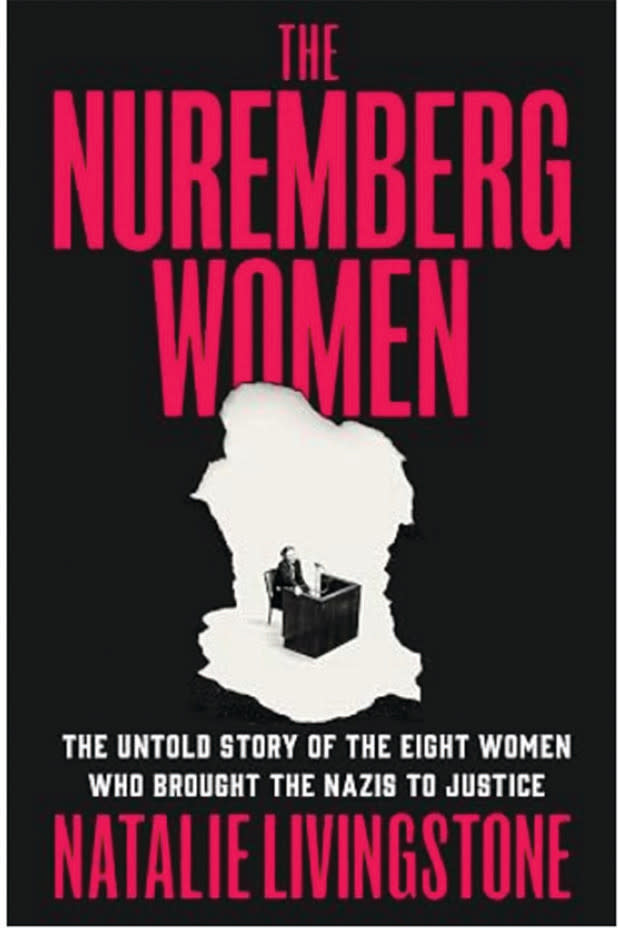
With The Nuremberg Women, Natalie Livingstone opens up a hitherto unexplored area in the modern historical record – the part played by some women in the prosecution of Nazi leaders responsible for the war crimes, crimes against humanity and genocide committed during the Second World War.
Newsreels, photographs, and paintings of the Nuremberg trials, held between November 1945 and October 1946, show a courtroom filled with men – the eight judges, the prosecutors, defending counsel, the prisoners in the dock. Apart from the occasional witness, women were notable by their absence.
Until Livingstone, no author has researched and pursued the idea that the trial was a human enterprise involving researchers, interpreters, journalists, artists, witnesses, and survivors, many of them women.
More than just telling the stories
Her book does more than tell the stories of eight remarkable women. It demonstrates how the conventional historical account can be incomplete, even when the principal events and personalities are well documented.
Even for someone who already knows something about the Nuremberg trials, the book is valuable because it offers a different way of looking at a familiar historical episode.
Livingstone selected eight women from the scores who were personally and directly involved in facilitating the Nuremberg trials. They are as follows:
Laura Knight, the British painter commissioned to record the courtroom proceedings. Her famous painting of the Nuremberg trial is the starting point for Livingstone’s investigation.
Harriet Zetterberg, an American lawyer and exceptionally capable member of the prosecution team, who helped assemble important evidence against Nazi leaders.
Erika Mann, a German journalist. Daughter of novelist Thomas Mann, she was an outspoken anti-Nazi campaigner who had fled Germany. Her reporting provides a particularly revealing perspective on the defeated Nazi leadership.
Ursula von Kardorff – a German reporter whose dispatches raise difficult questions about the relationship between journalism, accommodation with Nazism, and the selective remembrance of one’s own wartime activities.
Rebecca West – a celebrated British literary journalist, whose observations and reportage provided an important contemporary account of the proceedings and their wider significance.
Tatiana Stupnikova – a young Russian interpreter working for the Soviet delegation. Her experience illustrates the difficult position of those required to translate evidence of Nazi crimes while serving a Soviet regime with its own record of atrocities.
Marie-Claude Vaillant-Couturier – a French Resistance member and Auschwitz survivor, whose devastating testimony described the concentration camps and the systematic extermination of their victims.
Ingeborg Kálnoky – a Hungarian countess. She ran the house in which witnesses, concentration camp survivors, and, remarkably, Nazi perpetrators were accommodated while awaiting their involvement in the proceedings.
Livingstone is interested not simply in what these women achieved at Nuremberg, but also in what happened to them before they became involved, and afterward, when many found their professional achievements and public influence marginalized.
Erika Mann: One of the journalists covering the trials
LET US focus on one of the eight – Erika Mann. She was one of the respected journalists covering the trials, but she had an astonishing and eventful life both before and after Nuremberg.
Born in 1905, she was the daughter of the renowned German author Thomas Mann. Livingstone describes her childhood as “gilded.” The fact that her mother had Jewish connections induced the family to leave Germany when Hitler came to power in 1933. But Erika had already written and performed in an anti-Nazi cabaret.
Certain that the new Nazi regime would pursue her, she devised a way to change her nationality and arranged a “marriage of convenience” with an Englishman. The poet W. H. Auden was willing to cooperate. She came to England and married him, very nearly sight unseen, in June 1933. His lover, the gardener Peter Roger, was the witness. Five days later, the Reich propaganda minister, Joseph Goebbels, stripped her of her German citizenship. She and Auden remained friends throughout their lives.
During the 1940s, her parents moved to California. While there, she had a brief relationship with a German conductor 30 years her senior. His name – Bruno Walter, the world-renowned maestro.
She returned to Europe to report the final months of the war. In September 1944 she met and fell in love with an American woman called Betty Knox. Betty had been part of a performing troupe known as “Wilson, Keppel and Betty,” very popular on the British variety stage. Betty left the group, bequeathing her role to her daughter, and became a journalist.
Livingstone tells us that during her time in Nuremberg, Erika “wrote feverishly.” Shortly after the trials, she became very ill, and was rushed to a hospital in Zurich, where she was able to pay for her expensive medical treatment out of the Mann family funds, trapped in Germany during the war but now released.
She recovered, but felt that the German people never came to terms with its Nazi past. In the final analysis, she believed the world had sustained “defeat in victory.”
Livingstone devotes the same degree of consideration to the lives and careers of the other women she selected, paying particular attention to their time spent in the preparation and conduct of the Nuremberg trials.
The work of Stupnikova, the only Russian among the eight, is particularly interesting since it exposed the contradictions of the Soviet Union prosecuting Nazi crimes while concealing its own complicity in the Nazi-Soviet pact.
The Nuremberg Women is an original and outstanding work. With the trials as her central focus, Livingstone has placed the research-based biographies of eight remarkable women into the wider political and legal context of the times. ■
Follow the reviewer at www.a-mid-east-journal.blogspot.com
THE NUREMBERG WOMEN
THE UNTOLD STORY OF THE EIGHT WOMEN WHO BROUGHT THE NAZIS TO JUSTICE
By Natalie Livingstone
St. Martin’s Press
432 pages; $30