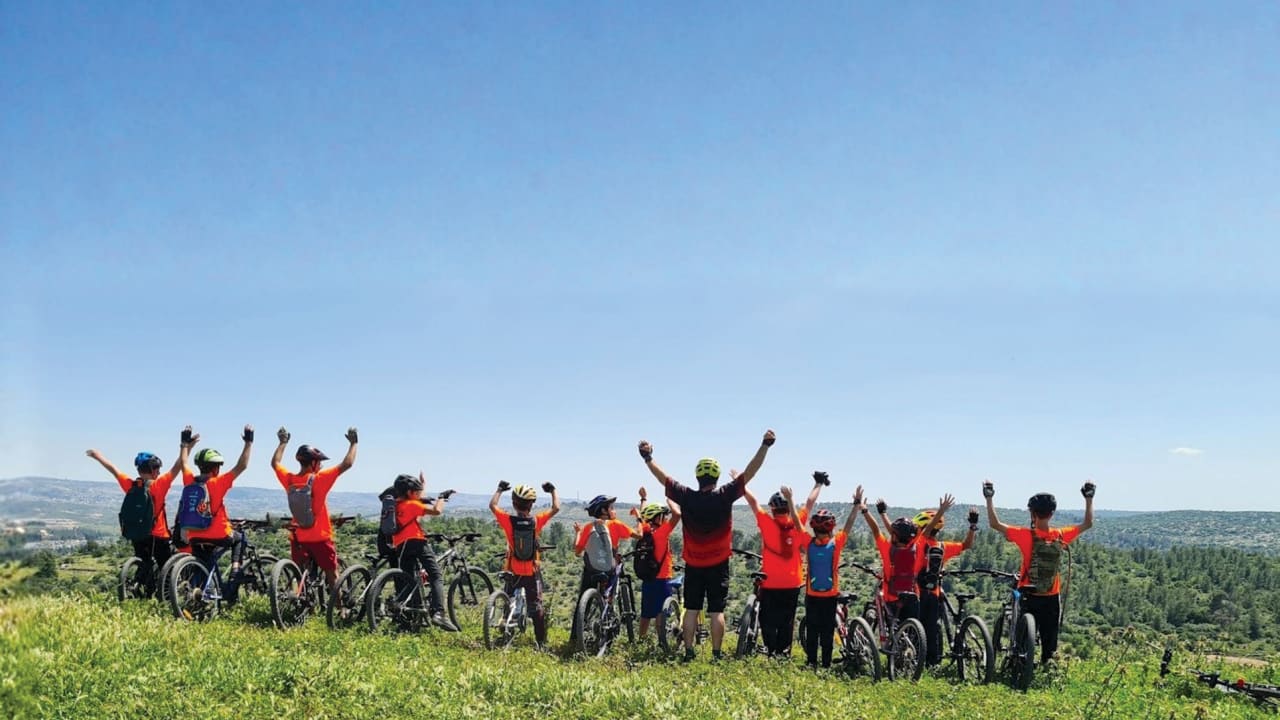

Cycling! Getting on a human-powered two-wheeler and just pedaling your way along the tarmac or, in this particular case, weaving down dusty pathways through the countryside is simply an unmitigated joy.
The on-road discipline is something of a relentlessly “worsening” obsession for me as I chalk up my 10,000+ km. of biking per annum all over the country. But it is the mountain bikers who rule the roost here, at least in basic quantitative terms.
Rabbi Nachum Wasosky is not only a keen proponent of wheeling through rustic terrain; he is also intent on disseminating the benefits of cycling as far and wide as he possibly can, particularly to those he feels have the most to gain from it. That led, in 2012, to the creation of Geerz.
Geerz is a therapeutic, mountain biking program designed primarily to help youngsters faced with any of a range of challenging issues, such as ADD/ADHD, social and behavioral problems, low self-esteem, anger management, family dysfunction, and adolescent anxiety.
The oft-used term “at risk” cropped up frequently during our conversation, and I asked whether Geerz is predominantly tailored to help kids and young adults from Anglo-Saxon backdrops. Ohio-born, Pittsburgh-bred Wasosky surprised me with his looser take on that. “I opened up another youth center here for kids at risk in Ramat Beit Shemesh,” he noted.

That followed in the wake of a previous wholesome initiative – a community center – he founded in Denver, Colorado, where he and his wife lived for two years before making aliyah in 2008.
“We’re on the fringe here. This is officially the [sociopolitical] periphery, and [the condition of being] at risk happens immediately once the native language is your second language. So people who make aliyah are already at risk because they’re not speaking the [local] language,” he explained.
He is cognizant of the breadth of terminology maneuvering space, and said it is often a matter of personal perspective. “Everyone has their own definition of ‘at risk’ because, say, if somebody is not religious, they have their own definitions of what constitutes being at risk for their children. When you get into the religious sector, you have Religious-Zionist and you have American yeshiva [youth] and haredim. Being here is like a melting pot for American Jewry of all sects, and there are a lot [of people] at risk.”
For most of us, presumably, the latter epithet references children and adults who, for a variety of reasons, do not manage to integrate into the societal mainstream, and various aspects thereof, and hence are in a more fragile and vulnerable state.
But I, for one, had never thought of olim as being “at risk” simply by dint of their lack of appropriate language skills. However, on reflection, recalling my struggles with university-style Hebrew verbiage in my first years here – despite coming on aliyah with more than a half-decent linguistic command – it does make sense. You are an outsider, even in a country like Israel where almost everybody seems to hail from “somewhere else.”
“You also get inferiority complexes because you don’t speak the language,” Wasosky continued. It follows, thus, that, to his mind, almost every oleh is “at risk,” at least for a while, until he/she finds his/her verbal communication feet. “It’s very challenging,” he posited.
With that recognition firmly in place, as a newcomer to this country himself with all the concomitant day-to-day interaction logistics that involves, the pedaling rabbi had a more than fair idea of how the social and cultural integration learning curve was affecting his fellow Anglos here.
Tackling the problem
Wasosky got in on the local restorative act as soon as he could, building on his experience in Denver, his training as a counselor, and his business studies degree, to push the remedial envelope even further. Before long, he came to the realization that sticking exclusively with the youth club he’d set up, for middle school and high school students, soon after setting up home and shop in Ramat Beit Shemesh, was not going to provide the desired across-the-board solution.
“I always felt that I was doing good, that we were doing good, that we were helping kids. And I always felt it wasn’t enough. It wasn’t as deep as I wanted to go. I wasn’t affecting as many as I wanted to.”
If his efforts were going to make a real and enduring difference, Wasosky discerned, a fundamental strategic shift would be required. “What we were doing was more reactive than proactive,” he said.
The seed to take his efforts to another level had been sown long before, by a childhood turning point. “As time went on, I realized why I was doing this, even though I went to business school, why I chose this path. I clearly had a fork in the road about what I had to do [in life]. I am the product of a divorced family, from the age of six.” Still, things could have been a lot worse for the youngster. “I had a great upbringing. My mother gave me everything that I could have possibly needed to succeed in life. Some of what she gave me I call my little angels, to make sure I had what everybody else had,” he recounted.
Then again, he didn’t have a steady paternal presence. “I had a good relationship with my father. My father was a gentile,” the rabbi noted. “He grew up Greek Orthodox, and my mother is Jewish. I grew up with Christmas and Easter, and Hanukkah and Passover. I had lots of holidays,” he laughed.
That maternal resolve indirectly infused Wasosky’s eventual career path and led to a philanthropic take on life. “Subconsciously I always said to myself, ‘I need to give kids, create angels for them like I had, for kids that don’t have. There are more kids in this world that don’t have than do have.’” And so, over time, Geerz came to be. “I wanted to provide the kids with the life skills to succeed even though their current situations may not be set up to do that.”

Kids in need
Wasosky found that, sadly, there were plenty of youngsters who were in dire need of his supportive efforts. “There are kids from broken homes, who have issues with sex, drugs, violence, any kind of trauma that you could imagine, whether mental or emotional,” he said. Just living in Israel, as we have all painfully come to learn, particularly over the past couple of years, can provide a lot of the latter. “That’s why I got into creating youth centers and helping youth.”
Off-road cycling had not yet taken off in incremental leaps and bounds to its current level of popularity, but the youngsters in Wasosky’s charge had taken note.
“They kept bugging me about going cycling,” he recalled. “I told them they were always out partying on Thursday nights and there was no way they would get up to go for a ride on Fridays.”
The final push in the desired direction came as Wasosky got into mountain biking himself, along with 25-30 other locals.
“A couple of things happened after a couple of years of the kids bugging me about going for a ride. Number one, there were maybe a handful of people in this town in around 2008-2010 who were riding mountain bikes. There was no WhatsApp back then, and our cycling group kept in touch by email,” he said.
Intrigued by the youth center attendees’ interest, Wasosky decided to research the matter with his peers. “I emailed the other riders and I asked them why they went cycling. I said they could buy themselves a pair of running shoes and go running. It was easier, cheaper, involved less equipment. They wrote back to me, and almost all of them said ‘I am more successful at work, I’m thinking out of the box more, I am taking more risks and succeeding. I am more spiritual, I’m connecting to the land, to God, in ways I never have before – because of cycling. I am healthier. I’ve learned about perseverance.’”
The facts on the ground did it for Wasosky. “I thought, ‘Holy cow, if this information is coming from 30-year-old adults who were successful and educated, how much more so will this have an effect on kids or anyone dealing with any challenges in life?’” The transition from positive thinking to corporeal salutary action was duly made.
“The kids were coming to the center every night of the week. We had ping-pong tables and fussball tables, and food and drink. The kids would hang out, but I wasn’t getting anywhere with them. That’s what I say, it was more preventative. I was helping them in a preventative way, but not in a proactive way,” he said.
It was time to get down and dirty with those who could benefit most from the positive knock-on effects of Wasosky’s favored sporting pastime. The bugging was over. “So I said to the kids, ‘No drinking, no getting high; Thursday night you’re drinking water, you’re going to bed early, you’re getting up, you’re coming to my house at 7 a.m., and we’re going to go on a 90-minute ride.’”
There was some carrot-dangling in there, too. “I said, ‘When we come home, we’re going to have a big bagel, eggs, coffee breakfast for all of you. We’re going to have a blast.’” The ruse delivered, with 10 high school kids turning up for the first ride.
Wasosky is clearly not only blessed with the ability to inspire, he is also a dab hand at getting the preliminaries in order, as well as rallying street-level support for his initiatives. “My friends donated bikes for the ride. We had bikes, helmets, anti-puncture goo in the tires, backpacks, and water, and we went out for 90 minutes.”
The facts on the ground
The fruits of that labor were evident from the get-go. “Two things happened on that ride,” Wasosky said. “Number one, I asked one of the kids, Tzachi, while we were riding, how things were at home, at school. He started talking to me and didn’t stop for 15 minutes,” he recounted.
That made a refreshing and encouraging change from the previous terse exchanges. “At the youth center, if I asked him how he was doing, he’d just say ‘Great.’ If I asked him how things were at home, I’d hear ‘Good.’ How’s school this week – ‘Great’ or ‘Sucks.’ And here, he didn’t stop talking for 15 minutes. I thought, ‘Something is happening here.’ I thought, Something magical is going on, I don’t know what.’”
The outdoor activity also released an emotional blockage in another, seemingly very different, member of the group. “At the end of the ride there was another boy, Yehuda. He was like the stud. He was the cool kid of the group. He was in shape, lifted weights, went running. He was good-looking, smoked cigarettes. After the last big hill of the ride, we’re all at the top, sitting on a rock, waiting and wondering where Yehuda was. Five to seven minutes later, Yehuda comes up, helmet off, walking his bike, cursing at himself, at me.”
A watershed event was in the offing. “He took out his pack of cigarettes, and I say, ‘Yehuda listen, you already haven’t smoked for 90 minutes. We’re going to be at the house soon. You can have coffee and a cigarette at the house.’ He said: ‘Nachum, you don’t understand.’ He ripped up the entire pack of cigarettes in front of us.”
Geerz was moving up a gear. “I told my wife, ‘We’re sitting on a gold mine.’ I said we were going to take all our curriculums and everything we’ve been teaching kids for 10 years, and we’re going to build a curriculum and teach kids on the bike.”
Every Friday, Wasosky imparted some of his technical biking expertise to 15 or so youngsters. It wasn’t just about learning how to weave, brake, select the right gear, and keep their balance. There were invaluable life lessons learned along the way, such as tackling qualms head-on and dealing with challenges, while the kids’ self-esteem took a definitive shot in the arm.
“When, for example, we learned how to go down a scary technical downhill, I taught them the body position and where to look, and how to navigate to go down that scary section. And at the bottom, I spoke to them about overcoming fear. And I had them share with me how they can overcome fear,” he related.
New skills for life
That, I noted, is particularly important for teenagers feeling their way into adult life.
“For everybody!” Wasosky exclaimed.
“The same thing happened when we went uphill, and they learned how to climb, and fall, and get back on the bike, and restart. I taught them about perseverance and not giving up, and practice makes perfect.”
Nonetheless, after a while, Wasosky ran out of volunteering spirit steam, and the riding sessions ended.
But, as it turned out, the cyclists’ parents were keenly aware of, and mightily grateful for, the rewards their offspring were reaping from the rides. “They told me they wanted us to carry on riding. They said they’d pay me. They said they’d never seen their kids getting up in the morning. They were fighting less at home; they’re making their beds; and there was less destructive behavior.” The wonders of cycling!
Wasosky worked out the finances, and Geerz took on orderly programmatic form, and took off. “We started in 2012, and we now have 150 classes on how to overcome challenges through the bike. In the middle of the 90-minute ride, they get off the bike and the instructor teaches that week’s bike lesson and life lesson,” he said.
The stats are proof of the remedial boon which is being put to sorely needed use in these post-Oct. 7 days. “We have 600 riders every week, and that includes IDF veterans, around the whole country.”
A quarter of those ride weekly in the environs of Beit Shemesh, with others taking place in the Galilee, in communities near Gaza such as Shavei Darom, and elsewhere.
Veterans of the latest war in Gaza are increasingly availing themselves of Geerz’s services. “We currently have six groups of IDF veterans, and we have requests for 23 more,” Wasosky pointed out.
It is a fundamentally hands-on – actually hands- and legs-on – vehicle for acquiring important skill sets to be applied in later life, too.
It is, said Wasosky, very much about self-help. “We don’t dictate to the kids or veterans what they are learning therapeutically. We show them that through this [cycling] skill, they can learn how to overcome fear. But then we ask them how they can apply that to their life. We have them say it out loud to us.”
That has got to be good for all concerned – although possibly not for the Big Pharma folk, as Geerz participants come off medications – and is demonstrably making positive, life-affirming, resilience-building and curative waves for families, individuals, and entire communities. And right across the country, taking in community groups, special education school students of all religious or secular persuasions – including haredi yeshiva attendees – and youth villages.
There are certain logistical and financial facts to be met and navigated. “Every instructor is trained by us and paid by us,” Wasosky noted. “Our [annual] budget is close to $2 million. The fees are nominal for the kids to join. Everybody must pay, to have some skin in the game, but it’s a highly subsidized program. There are no barriers to entry. We understand what we’re sitting on and how this therapeutic program is helping.”
That, he stated, is not just a gut feeling. “We know it is helping because the family doctors, the school counselors, the rabbis, the therapists, and the social workers are sending the kids to us. They tell us we are helping and are saving the lives of these children.”
But that doesn’t come cheap, and Geerz manages to keep its head above water with the help of a number of corporate donors, both here and in the States, and by raising much-needed wherewithal through an annual charity mountain bike ride. The next fundraiser is due to take place in March 2026, with Wasosky hoping to accrue $800,000 in the process.
“Unfortunately, there is great need for our help,” Wasosky said, “and, fortunately, we’re here at the right time.”
For more information: www.geerz.site/get-into-geerz/en