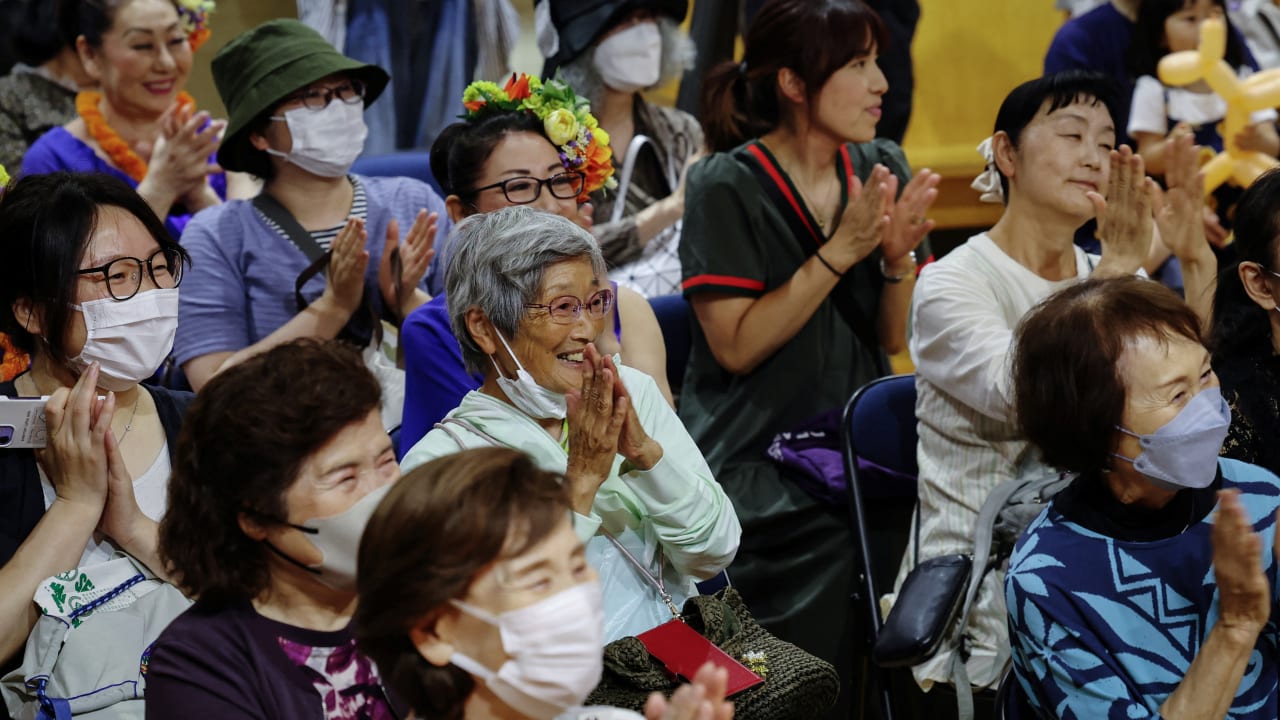
Japan recorded a new high of 99,763 centenarians this year, continuing a decades-long rise even as the country’s overall population sharply declines.
The Health, Labour and Welfare Ministry said the number of residents aged 100 and older stood as of September 15 at nearly 100,000 – an increase of 4,644 from the previous year. It was the 55th consecutive annual rise, bringing the national rate to 80.58 centenarians per 100,000 people.
Women comprised the overwhelming majority at 88%, or 87,784 individuals. Men totaled 11,979.
‘Walking gave me strength’
Shigeko Kagawa, 114, of Yamatokoriyama, is the nation’s oldest resident. A former obstetrician-gynecologist, Kagawa told DW that years of walking to patients’ homes during her career helped build the leg strength that supports her today.
The Gerontology Research Group lists her as the world’s sixth-oldest person. She carried the Olympic torch during the Tokyo 2021 Games at age 109. Today, she spends her time reading newspapers, watching television and practicing calligraphy.

Japan’s oldest man is 111-year-old Kiyotaka Mizuno of Iwata City.
Longevity contrasts with demographic decline
Shimane Prefecture registered the highest ratio of centenarians for the 13th straight year, at 168.69 per 100,000 people. Analysts cite a combination of environment, community-based living and cultural factors, though no single explanation has been identified.
Japan began tracking centenarians in 1963, when just 153 were registered. The figure rose to nearly 1,000 by 1981 and surpassed 10,000 by 1998. Life expectancy remains among the highest in the world, with projections for 2024 at 87.13 years for women and 81.09 for men.
Health experts credit longevity to a low-fat diet high in fish, rice and vegetables; low obesity; regular exercise; and low rates of heart disease and cancer.
Record decline in population
At the same time, the country is shrinking. Japan saw only 686,061 births in 2024, compared to 1,605,298 deaths – a gap of nearly one million. The population stood at 120.65 million on January 1, 2025, marking a year-on-year decline of more than 900,000, the steepest since records began nearly six decades ago.
The birthrate dropped to six per 1,000 people in 2023, the 16th straight annual decline.
Former prime minister Shigeru Ishiba called the demographic shift a “silent plague” and a “quiet emergency.” According to Tagesschau, he pledged new measures including free childcare and more flexible working conditions.
Current policies focus on shorter workweeks and expanded healthcare, though government officials admit the results remain limited.
Aging society strains economy
With an aging population and shrinking workforce, Japan faces intensifying pressure on its healthcare and pension systems. Economists warn of a dual crisis: rising care costs alongside falling tax revenue and a declining labor pool.
The ministry releases its centenarian tally each year ahead of Respect for the Aged Day, held on the third Monday in September. The announcement serves both as a celebration of long life and a stark reminder of the country’s demographic challenges.
Japan continues to hold the world’s highest average life expectancy at 84.5 years. Only a handful of supercentenarians globally are older than Kagawa. The current oldest living person is believed to be 116-year-old Ethel Caterham of Britain.