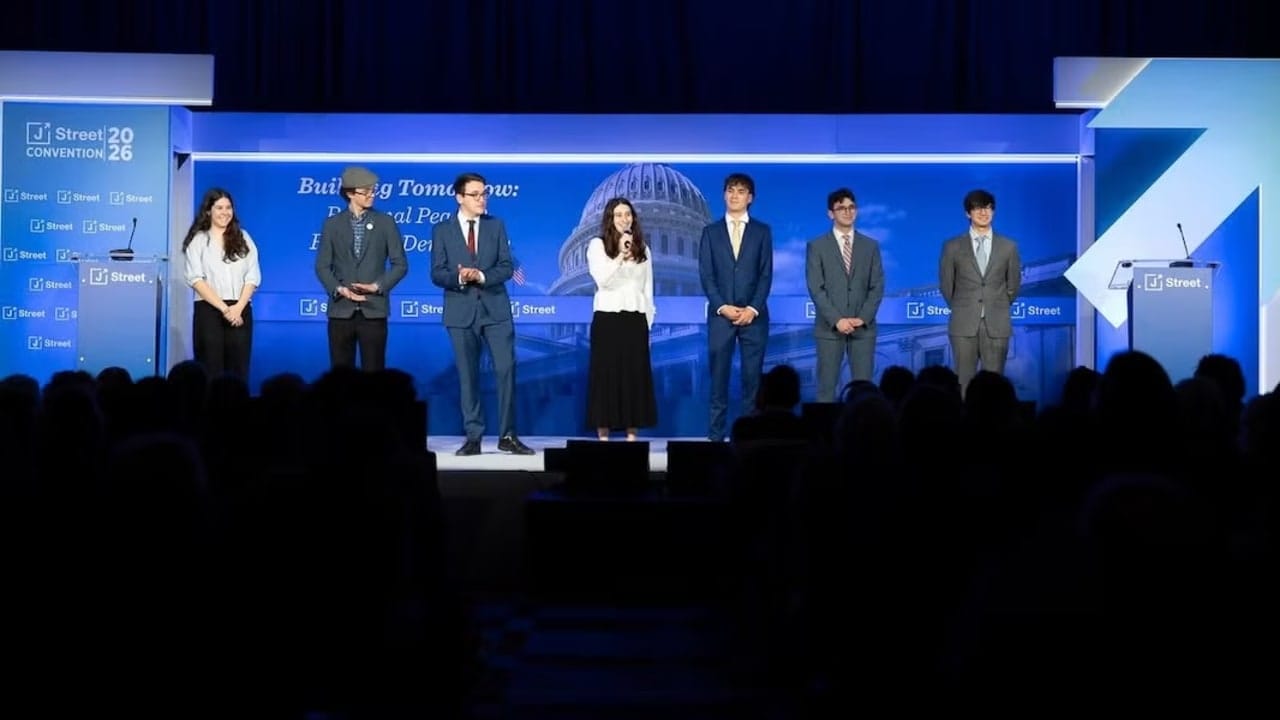
A group of Jewish students at Sarah Lawrence College say they faced fierce resistance after trying to establish a campus chapter of J Street U following the October 7 attacks.
Student Senate rejects J Street U chapter
Last fall, Toffler and another Jewish student tried to change the situation. They decided to form a campus chapter of J Street U, the college arm of the liberal pro-Israel group. With the help of a faculty advisor, they tried to make the club a campus reality.
Nearly two dozen such J Street U chapters have formed nationwide since Oct. 7, as students have sought to promote the group’s self-described “pro-Israel, pro-Palestinian and pro-peace” outlook as an alternative to anti-Israel activism surging on campuses — as well as to hawkish campus pro-Israel activism.
But when the students applied to the student government at Sarah Lawrence, an elite progressive liberal arts college in New York’s Westchester County, to make J Street U an official club, they encountered fierce resistance.
After voicing their strong opposition to the group, the Student Senate rejected the J Street U application, the first time a J Street campus chapter has ever been rejected anywhere, according to the group. (The final vote tally was not included in the meeting minutes.) When the students appealed the decision, the senate rejected the appeal as well. And though some faculty and alumni supportive of the students have tried to lobby Sarah Lawrence’s administration to intervene, the college leadership has so far chosen not to.

The Sarah Lawrence J Street rejection offers a window into how campus politics around Israel have evolved since Oct. 7. Two years after anti-Israel protests roiled campuses, even Jewish groups that support Palestinian statehood and sharply oppose Israeli government policies can be treated as beyond the pale.
According to several Sarah Lawrence students and faculty members, it’s rare but not unprecedented for the student senate to reject a student club application. But what happened in deliberations over the J Street U application, they said, was shocking.
Student senators compared recognizing the group to approving “a white supremacist organization,” according to an audio recording and transcript of the meeting obtained by the Jewish Telegraphic Agency.
One senator said they were concerned about “the whole Zionist language” of the group, “that’s still furthering the same logic of Israeli sovereignty and self-determination when there is no existence or security for Israel that’s not contingent on Palestinian displacement, on apartheid, on genocide.”
The application was rejected. The Jewish students appealed to the same body. In March, their appeal was rejected, too.
Faculty and Jewish leaders criticize decision
The Student Senate did not return several JTA requests for comment.
The case, according to J Street, marks the first time a J Street U campus chapter has been blocked from forming.
“We are proud of the work students do to create spaces for dialogue and diverse perspectives on the Israeli/Palestinian conflict,” Jeremy Ben-Ami, J Street’s president, told JTA in a statement. “J Street has long opposed efforts to curb speech and free expression on campus, and we encourage Sarah Lawrence’s administration to approve the chapter’s application.”
At other schools where student governments have recently taken aim at Jewish groups — such as when The New School’s student government tried to block funding to the campus Hillel last month — administrators have rejected their decisions.
Sarah Lawrence’s senate bylaws allow for the intervention of the school’s dean or other leadership to “grant … recognition of the organization” in cases “when it is in the best interests of the college.” Despite prodding from local J Street allies, President Crystal Collins Judd has not stepped in. On Monday, faculty members delivered a petition to Judd, drawing on those bylaws in calling on her to intervene to permit the campus J Street U chapter. Yet so far, the president has opted not to take action.
Sarah Lawrence’s administration “does not intervene in the process unless there is a clear violation of policy,” the school’s dean of students, Dave Stanfield, told JTA. Stanfield also said it was “not unusual for organizations to be denied recognition.”
He suggested that students hoping to form a J Street U chapter should explore other means of activism or try again next year.
“For students who may be disappointed by this outcome, including those nearing graduation, there are multiple avenues for community-building, programming, and engagement on campus,” he wrote in an email. “For students returning next academic year, they can reapply for organization recognition.”
Toffler graduated on Friday. “I am sad that we never got recognition as a club,” they said. “I think we could have positively contributed to the political conversation on campus.”
Jewish faculty, too, were upset about how the J Street students were treated.
“I was immediately alarmed,” Matthew Ellis, an endowed chair of Middle East studies at the college, told JTA when he heard about the rejection. “That just smacked of very obvious, blatant political discrimination.”
Campus tensions over Israel continue to deepen
For the past few years, Ellis said, he had already been struggling to promote responsible campus dialogue about “the complexities of Zionism.” Some students have been receptive, he said, but a hardline pro-Palestinian contingent “has taken up all the space on campus.”
“And then the J Street thing happens,” he recalled. “I just put my palm to my head: ‘Jesus, what is going on?'”
Rejecting the J Street U chapter, the faculty petition argues, violated Sarah Lawrence’s “Principles for Mutual Respect” and its policy to “foster honest inquiry, free speech, and open discourse.” The petition, circulated to a limited number of faculty members, has garnered more than 20 signatures.
“We, the faculty, and I, very much including myself, have clearly not been successful in helping students understand that the only community worth belonging to is a community in which everyone welcomes disagreement rather than trying to shut it down,” novelist Brian Morton, a longtime Sarah Lawrence professor, told JTA.
“This should be one of the bedrock ideas of higher education,” he added, “but somehow we’re failing to get it across.”