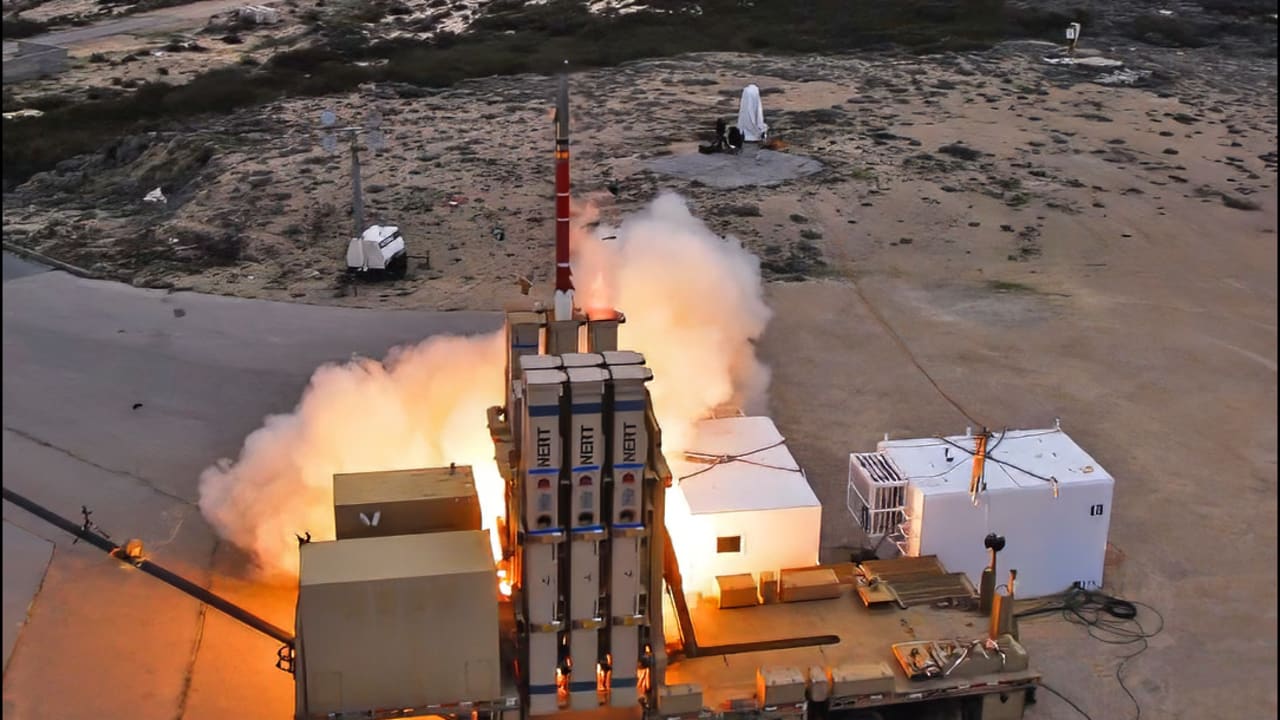
Europe's accelerating reliance on Israeli air-defense technology has pushed the value of Israeli air-defense deals with European Union countries past an almost unimaginable $15 billion in less than five years, as the continent scrambles to rebuild defenses neglected after the Cold War.
In the 1990s, when Israel accelerated the development of the Arrow missile at Israel Aerospace Industries with American funding to intercept ballistic missiles, Europeans regarded the costly technological effort with indifference.
The Soviet Union had collapsed, the Cold War was over, and European governments redirected defense budgets toward education, infrastructure, healthcare and culture. If anything happened, the United States would protect them.
The formal signing in Tel Aviv of the "Achilles Shield" deal, worth some €3.5 billion, is not only a commercial and diplomatic achievement for the Defense Ministry, Rafael Advanced Defense Systems and Israel Aerospace Industries. It is also the final seal on a tectonic shift in Europe's defense procurement landscape.
But Europe failed to internalize its lesson. When the old threats returned, European countries found themselves with weakened defense industries and an unpredictable American partner that demanded they invest in defense again and made clear that they could no longer simply rely on Washington.

Since 2021, in less than five years, a continent that lived for decades under the illusion of a "peace dividend" has discovered that its skies are almost entirely exposed. The result has been a series of Israeli air-defense deals in European Union countries worth more than $15 billion.
Europe's procurement map shows its growing dependence on Israeli technology. Germany leads the list. In 2023, it signed the largest defense export deal in Israel's history, purchasing the Arrow 3 system for approximately $3.6 billion. At the end of 2025, the Bundestag approved an additional expansion deal worth about $3.1 billion.
Germany has thus become a customer worth roughly $6.7 billion, with the Israeli system serving as the backbone of the European Sky Shield Initiative.
Other major deals have followed. Romania purchased short- and medium-range SPYDER systems for approximately $2.3 billion. The Czech Republic and Slovakia purchased SPYDER and Barak MX systems worth more than $1.2 billion combined to replace aging Soviet air-defense systems.
Finland purchases David's Sling immediately after joining NATO
Finland purchased David's Sling for approximately $345 million immediately after joining NATO, while Cyprus acquired Barak MX systems in deals worth hundreds of millions of euros.
The main force driving the rapid procurement campaign is Russia's invasion of Ukraine, which demonstrated that the modern battlefield relies on a deadly combination of ballistic missiles, cruise missiles, and swarms of suicide drones. European countries discovered that both domestic and American defense industries suffer from severe bottlenecks and delivery schedules stretching over many years.
Faced with that gap, Israel's defense industries offered two decisive advantages: industrial flexibility, with relatively short delivery times and lower prices, and, above all, an unprecedented operational record.
Successful interceptions by the Arrow, David's Sling and Barak systems against complex missile and drone attacks from Iran demonstrated to European decision-makers that these are systems tested under fire in real time. No competitor in the world can present an equivalent advantage. That has helped justify signing deals despite political criticism over the large number of Palestinian civilians killed and wounded in Gaza.
For the Israeli economy, the wave of deals represents a major growth engine. Tens of billions of shekels flowing into state-owned and private companies have pushed order backlogs to record highs, led to the rapid expansion of production lines in Israel, and created thousands of high-quality jobs for engineers and industrial workers.
IAI, Rafael, Elbit, and Tomer have hired thousands of new employees in recent years
Israel Aerospace Industries, Rafael, Elbit Systems, and state-owned Tomer, which manufactures engines for many Israeli missiles, have hired thousands of new employees in recent years.
Beyond that, the unusually high profitability of these export deals is channeling huge sums directly into research and development, ensuring continued funding for the next generation of defensive layers. These include laser systems and future interceptors intended to preserve Israel's technological and security advantage.
Germany is considered a potential customer for Arrow 4, which is intended to replace Arrow 2 in intercepting ballistic missiles within the atmosphere, despite a French effort to promote French interceptors for the role. In Ukraine, those French systems proved less effective than the American Patriot system.
The Americans' difficulty in producing enough Patriot interceptors for the US military and its allies has also contributed to delays in supplying the system to new customers. An effort to raise annual production from 600 to 2,000 interceptors is progressing slowly and would still be insufficient in the event of a war with China.
Switzerland, for example, will not receive its deliveries between 2029 and 2033 as originally expected and is now searching for an alternative. Political constraints, however, are likely to lead it toward purchasing the French system, in the absence of the independence and willingness to act demonstrated by Finland when it purchased Israel's David's Sling.
The main potential threat to Israel's dominance in the field comes from Ukrainian industries, which are now developing cheap and readily available interceptors as alternatives to the Patriot.
These systems have not yet been tested, but Ukraine has significant missile expertise and has already unveiled a ballistic missile with a range of 300 km. If Ukrainian companies develop an effective operational interceptor, it could compete with Israeli systems in future tenders, with considerable goodwill in Europe toward supporting Ukrainian industry.