Price (base/test vehicle): NIS 230,000 / 245,000
Competitors: Lynk & Co 08
We liked: Design, equipment, space, performance, and comfort
We didn’t like: Road handling, ergonomics despite improvements
Score: 8.5/10
For years, Volkswagen and General Motors have been struggling with the surplus of brands they accumulated over time. Customers have difficulty distinguishing between them, and each brand drives up marketing costs. The Americans eventually eliminated Pontiac, Oldsmobile, Hummer, and Saturn. The Germans, on the other hand, have apparently managed to successfully differentiate between Skoda and Seat (as well as Volkswagen and Audi), while also creating another brand along the way: The Spanish Cupra.
The Chinese, for their part, seem to be running a secret production line for new brands. Take Chery, for example: Beyond its core brand, it launched Jaecoo, which is positioned slightly above it but sold at similar prices. There is also Omoda, positioned above Jaecoo, as well as Lepas, Jetour and iCar for off-road, and the semi-luxury Xceed. It took General Motors more than 100 years to create so many brands - Chery did it in a decade. From its perspective, more brands at home mean greater market presence.
Jaecoo and Chery have already entered the list of the ten best-selling car brands in Israel just two to three years after arriving, and now Omoda is joining them. Like Volkswagen and GM, it shares mechanical components with the manufacturer’s other brands to reduce costs, while differentiating itself through exterior and interior design. Slightly more luxurious, priced like a three-year-old used luxury car of similar size.
The Omoda 7 is a sibling model to the Jaecoo 7, Israel’s sales leader, with a few extra centimeters in size. The Omoda 9 we are testing is a cousin of the Chery Tiggo 9 and Jaecoo 8. The main difference: The Omoda has no third row and no seven seats - just two rows and five seats - creating a very spacious vehicle. Later this year, the smaller Omoda 5 will also arrive, which is essentially where the brand originated.

Design
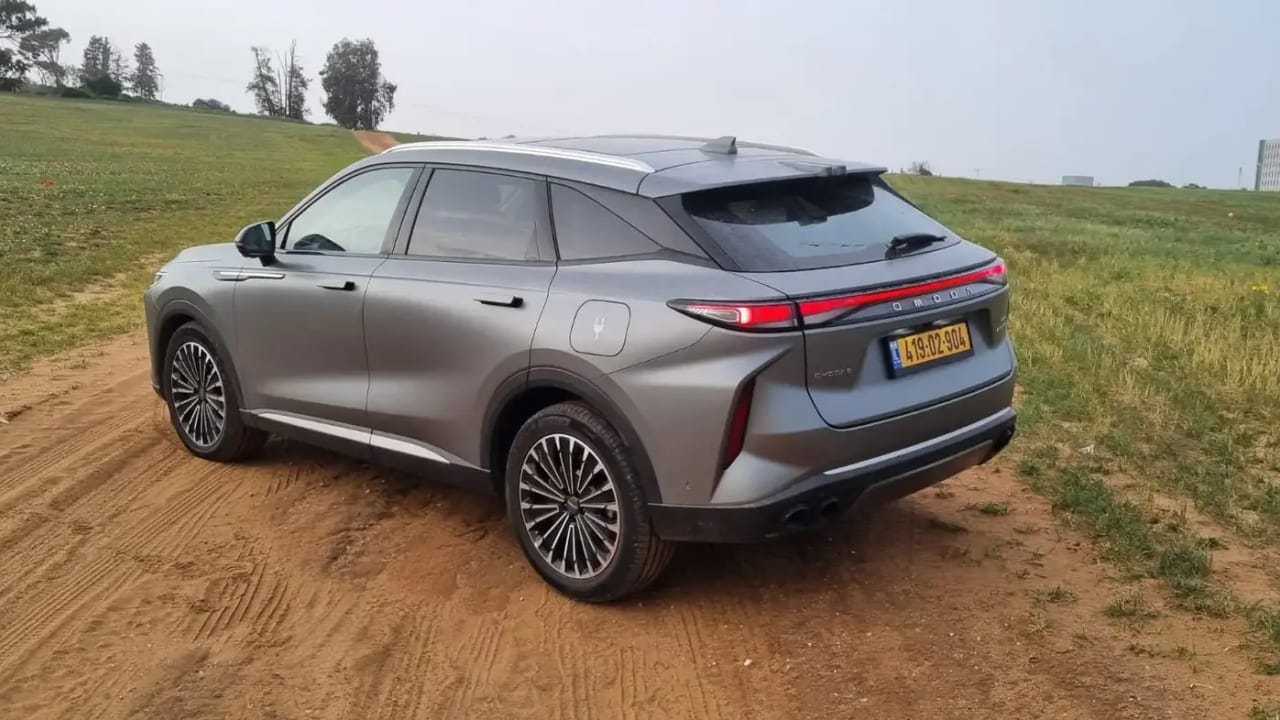
The 9 has a coupe-crossover look, and the brushed gray paint of the test vehicle (a NIS 3,000 option) definitely enhances it. The front creates a sense of motion with merging star-like elements, and unlike many Chinese cars, there is no obvious “inspiration” from Western models. Dimensions are generous: 4.78 meters long, 1.92 meters wide, 1.67 meters high, with a 2.82-meter wheelbase.
Interior
The driver’s environment is among the best we’ve encountered in Chinese vehicles. First, there are rotary controls for climate temperature - one for the driver and one for the passenger - and turning them immediately brings up a detailed climate control screen for adjusting intensity and more. There is also a touch control for audio volume, positioned closer to the passenger, while the driver has steering-wheel controls. Second, material quality is generally good, aside from some plastics in the doors. Third, the adaptive cruise control is well calibrated with almost no false alerts.

Not everything is perfect: The (electric) steering wheel adjustment range is insufficient, and despite major improvements in ergonomics, switching between screens requires too many taps, with too many essential functions accessible only through the screens - such as regenerative braking intensity. The interface itself is familiar from other Chery and Jaecoo models, but even Audi often shares dashboards with Volkswagen and Skoda.
The front seats are spacious, electrically adjustable, and offer reasonable support. Operation is similar to Mercedes, with seat-shaped controls on the front doors, and a physical button activates the massage function, which immediately opens a screen to select intensity and type.
In the rear, space resembles that of executive sedans. Seating is high-set, with air vents in the center and doors, charging ports, a panoramic roof, and an overall non-mainstream feel.
The trunk offers a huge 660 liters, with an electric tailgate and retractable cover. It’s a shame that beneath it there’s storage for the charging cable but no space for a spare wheel.

Equipment
The entry-level Harmony trim (NIS 230,000) includes 20-inch wheels, a panoramic roof, dual 12.3-inch displays for the instrument cluster and infotainment, electrically adjustable and heated front seats, synthetic leather upholstery, and a Sony audio system with 8 speakers.
The top Vision trim (NIS 245,000), which we tested, adds ventilated seats, massage for driver and passenger, genuine leather upholstery, and a Sony system with 14 speakers, including a subwoofer and headrest speakers for the driver.
Safety
5 out of 5 stars in the 2025 European crash test, with 9 airbags. Includes autonomous emergency braking, adaptive cruise control, lane-keeping assistance, blind-spot monitoring, and more.

Engine and performance
The 9 shares its plug-in hybrid system with the Tiggo 9 and Jaecoo 8. A 1.5-liter turbocharged gasoline engine and two electric motors produce a combined 449 hp delivered to all four wheels, with a 3-speed automatic gearbox for the gasoline engine. You can select (via a physical rotary dial!) between nine driving modes, but even in “Eco” performance is very strong, while in “Sport” it feels like a speedboat. Official 0–100 km/h acceleration is 4.9 seconds, firmly in sports and EV territory.
Fuel consumption
The manufacturer claims an electric range of 145 km and a combined consumption of 59 km per liter.
In practice, range was close to 120 km, with the gasoline engine engaging once the battery drops below 15%. The car politely informs you and suggests switching to smart (hybrid) mode due to battery level - something it does anyway. Once the engine slightly recharges the battery and the car returns to electric mode, the same notification appears again when it drops to 15%, even after a short time. A message to the Chinese engineers who might read this: Enough - just do what’s needed without telling us again and again.
Hybrid consumption with a charged battery was 35–40 km per liter. With an empty battery - relevant for those who buy it for tax benefits and don’t bother charging - consumption drops to 14–15 km per liter.

Electric
A 34.4 kWh battery provides the long range. AC charging is possible at 6.6 kW and DC fast charging at 70 kW.
With a charged battery, fuel consumption is an excellent 35–40 km per liter - but only for about 150 km until the battery drops to 15%, and the cycle repeats. Didn’t charge? Expect about 14–15 km per liter.
Comfort and handling
The Omoda 9 is a long-distance cruiser. Despite all-wheel drive, abundant power, and Michelin tires, it struggles to hide its 2.2-ton weight on winding roads. The steering is also not very precise. The tuning is soft for excellent ride comfort, except over small bumps and rough surfaces. The ride is also quiet.

Bottom line
The Omoda 9 is a high-quality, well-designed product with more premium touches than its platform siblings. If a quarter-million shekels sounds expensive for a Chinese car, you’ll likely encounter one of the 2,000 Jaecoo 8 units already on the road this year at similar prices.
It’s not truly a luxury car - ride comfort, handling, and ergonomics are not quite there yet, despite improvements over Chery and Jaecoo models. But the design is impressive, the powertrain is excellent, and the car feels more refined than Jaecoo models. It’s not as practical as the Jaecoo 8, which offers seven seats at the same price, and it’s still not at the level of crossovers like the Volvo XC60 or Lexus NX of similar size. But it costs nearly half as much and is extremely well equipped, which may create a dilemma. And at the pace the Chinese are advancing, this is an increasing headache for traditional luxury brands.
Omoda 9: Technical specifications
Engines: 1.5L turbo gasoline and two electric motors, 449 hp
Transmission: Automatic, 3-speed (gasoline engine only), all-wheel drive
Electric
Battery capacity (kWh): 34.4
AC charging (kW): 6.6
DC fast charging (kW): 71
Performance (manufacturer)
0–100 km/h (sec): 4.9
Top speed (km/h): 180
Electric range (km, manufacturer): 145
Electric range (km, test): 118
Fuel consumption hybrid, charged battery (manufacturer, km/l): 58.8
Fuel consumption hybrid, charged battery (test, km/l): 35
Fuel consumption hybrid, uncharged battery (manufacturer): –
Fuel consumption hybrid, uncharged battery (test): 15
Dimensions:
Length (m): 4.775
Width (m): 1.92
Height (m): 1.671
Wheelbase (m): 2.80
Trunk volume (liters): 660
Weight (kg): 2,195
Safety
European crash test rating: 5 out of 5 stars (2025)
Active safety: Autonomous emergency braking (forward and reverse), adaptive cruise control, lane keeping and departure prevention, blind spot monitoring and collision prevention, door opening warning, driver attention alert
Warranty
6 years or 150,000 km for the vehicle, 8 years or 150,000 km for the battery