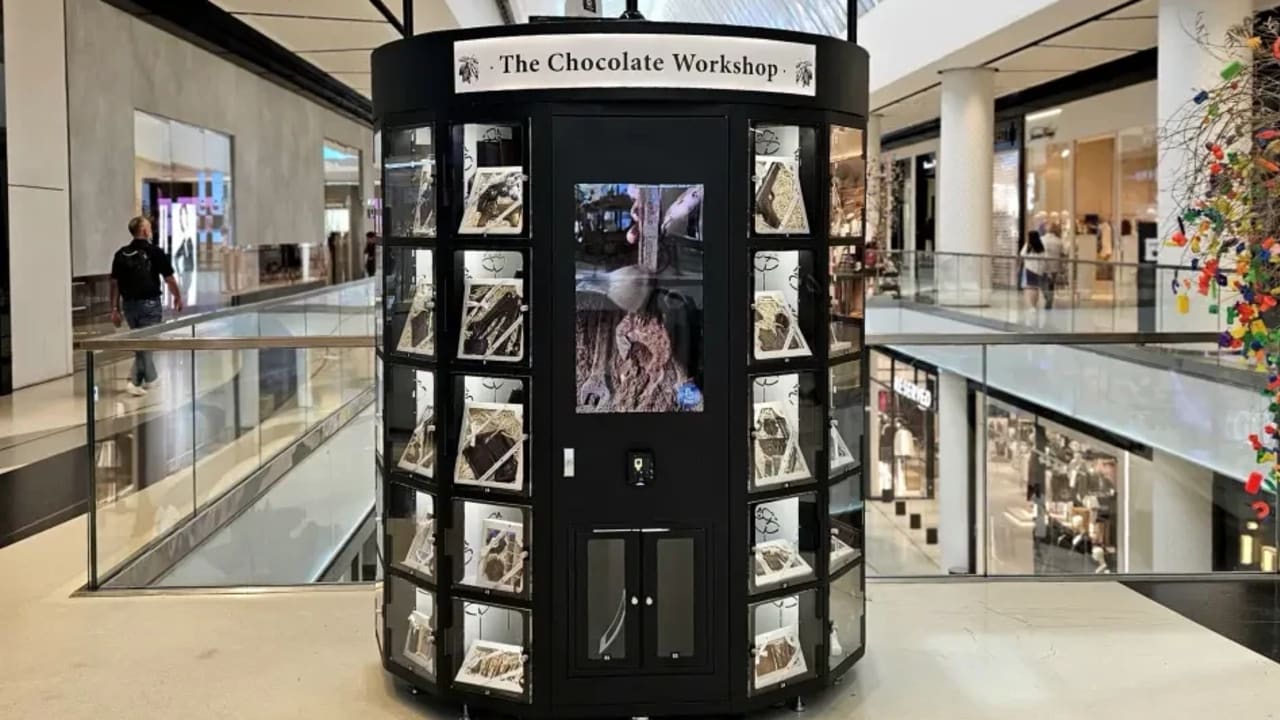
Just before the Tishrei holidays, an unusual vending machine landed at the TLV Mall in Tel Aviv: Instead of drinks or snacks, it offers luxurious chocolate packages with realistic designs, the creation of chocolatier Ela Harpak from Kibbutz Gvar’am in the Gaza envelope region. Harpak, the owner of the brand The Chocolate Workshop, is taking her first step outside her familiar boundaries. “When you have such a machine, you don’t actually need a store or employees. It’s also a model that’s easy to replicate and place in other malls and locations around the country,” she explains.
But alongside innovation, Harpak also speaks openly about today’s tough business reality: “My real challenge as a business owner is to survive financially, to keep my head above water. We’re very affected by the security situation, and you always have to be flexible and find solutions.” The machine, for her, is one such solution. “Until recently, everything was through deliveries via my website, and also limited in terms of delivery areas, since the packages must be kept at a certain temperature. Also, in the center of the country, people are used to ordering something and receiving it within a few hours. It was hard to meet that through deliveries. Now, the machine also allows residents of central Israel to purchase the packages.”

For those who don’t yet know, Harpak explains that “realistic-design chocolate packages are basically chocolate sets designed as items from our daily lives. They look real down to the texture level and are personalized according to the recipient’s profession, interests, or hobbies.” For example, she details, “there’s a dentist’s package that includes a toothbrush, toothpaste, pliers, syringe, scissors, jaw, and a medical emblem; there’s a ‘Glam Box’ with perfume, beauty products, and a designer handbag; there’s also a ‘Vacation Mode’ package with a mini camera, sunglasses, and a pair of flip-flops; and even a ‘Sweet Investment’ package with a wallet containing a million dollars, a luxury pen, a Bitcoin, a credit card, and a calculator — all, of course, made of chocolate.”
How did you get into this field?
“I’ve been in the chocolate industry for 13 years. It started when I went to London to study patisserie at Le Cordon Bleu. That was a dream come true. When I came back to Israel, I opened a chocolate workshop business. Four years ago, I wanted to refresh things and started the line of realistic packages. There was a costume contest at the kibbutz, and they asked me to make a chocolate Oscar statue for the winner. That’s how it started. Everyone loved it, and I kept going. It’s designed chocolate — not just another generic chocolate box or a box of pralines. It excites and delights the recipient, creating an experience. As beautiful as the package looks, it’s also tasty, made of high-quality Belgian chocolate.”
A hotel room full of chocolate
Harpak, 44, married and a mother of three boys, grew up in Haifa. Her mother is from the kibbutz. In 2012, when she married, she moved to Gvar’am. On October 7, she recounts, “Luckily, our kibbutz was not harmed — the terrorists didn’t reach us. The access path to the kibbutz is far from the main road, and that’s what saved us. The terrorists skipped over the kibbutz. We were in the shelter, full of fear and terror, realizing there was no army and no one coming. We saw the pictures and understood that the terrorists could reach us at any moment. Around 5:00 p.m., a protected convoy was organized, and we left through the eastern side of the kibbutz, through a grove. We were evacuated for about six months, most of the time at a hotel in Caesarea. We returned to the kibbutz in March 2024.”
How did the war affect your business?
“In the first month, I abandoned the business. My husband stayed at the kibbutz with the security team, and I was alone with the kids — all the equipment was left at the kibbutz. At first, we were in Moshav Hatzeva in the Arava. I heard that the children of Kibbutz Be’eri were at the Dead Sea, near us. I asked my husband to bring whatever he could from the kibbutz, and I gave them chocolate workshops. That brought my energy back. When I got to Caesarea, I was more organized with equipment, and the hotel room was full of chocolate. From there, I continued doing workshops. Around that time, various organizations began initiatives to help businesses from the envelope, and there was a flood of orders. At first, I couldn’t even handle it — it was hard to produce that much. Some companies even offered to give me an advance payment, and I’d produce when I could.”
Did the war affect the nature of your products?
“For example, there’s a package for a soldier or officer that includes a military boot, dog tag, and the IDF emblem. This package existed before October 7, but demand for it increased after the war. New packages also emerged following special requests. One family of a fallen soldier contacted me — he loved rubber duckies and chocolate. They asked if I could make a package in his memory. I did, and they were very moved. I also made a gun-shaped package as a gift for the security coordinator in the envelope, inspired by the war.”
The realistic chocolate packages, she says, are now sold mainly in Italy and England. “I have a collaboration with a factory in Italy that produces the molds for me. I send them a photo of an object I want, and they 3D print and create the molds. At first, I made the molds myself based on customer requests. I once took one of my kids’ toy guns and pressed it into food-safe silicone to make a mold. But since silicone in Israel is very expensive, and the Italian silicone is of much higher quality, I decided to order from there. Now I rarely make custom molds anymore — I have an inventory of about 20 package types to choose from. Occasionally, I update, add, or change designs.”
Of all your packages, which is the most popular?
“The toolbox package, which comes in two sizes — six or nine items — like a hammer, pliers, nut, bolt, etc. That’s the best seller. Many women buy it for their fathers or partners. One woman bought it for her husband for their anniversary with the inscription: ‘A relationship takes work.’ This package was also the most popular before the holidays. I added the message ‘A year of action and success.’”

What was the most unusual order you’ve received?
“There was an orthopedic doctor who was leaving his position, and the doctors at the hospital asked me to make a package. They brought me real knee implants, and I made chocolate implants from silicone molds. They looked completely real.”
The chocolate packages she makes sell for between NIS 80 and NIS 350. “I order the Belgian chocolate from an Israeli importer,” she says. “The price of chocolate has doubled in the past year. Although prices in Europe have recently dropped, in Israel they’re still rising. Considering the cost of raw materials and the amount of thought that goes into each creation, my prices are definitely reasonable. It’s not just another chocolate package, but a unique and refined gift. When you want to give something special to someone dear to you, you’re willing to invest. Beyond that, it’s also an exciting unboxing experience — people often share it on social media.”
Do you have any sweet idea that hasn’t yet been realized?
“Last Hanukkah, I made chocolate dreidels with the inscription Bring them home now. I truly hope that this coming Hanukkah, I’ll be able to make an updated version: How good it is that you’re home.”