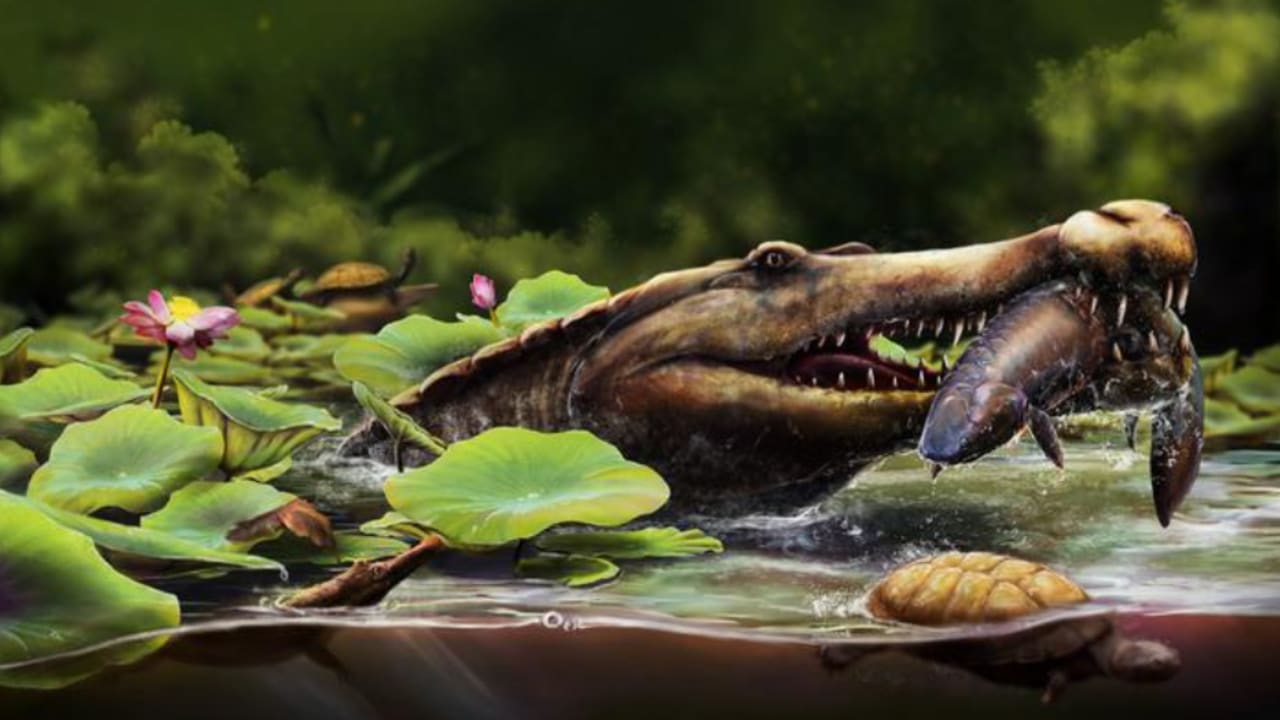
A field team from the Mansoura University Vertebrate Paleontology Center in Egypt identified a previously unknown crocodile species, Wadisuchus kassabi, that lived in what is now Egypt about 80 million years ago. “The discovery underlines the Western Desert’s importance as a natural repository of secrets from ancient geological eras,” said the university president Dr. Sherif Khater, as reported by Al-Masry Al-Youm.
Described in the Zoological Journal of the Linnean Society, the animal represents the oldest known member of Dyrosauridae, a family of marine crocodiles that survived the end-Cretaceous mass extinction and later flourished, reported EurekAlert.
“High-resolution CT scans and 3D surface models enabled us to reveal unprecedented anatomical details,” said Professor Hesham Sallam, founder of the Mansoura University Vertebrate Paleontology Center and senior author of the study. His team examined two partial skulls and two snout tips from four individuals at different growth stages.
The genus name combines wadi, for the site near the Kharga and Baris oases, with suchus, invoking the ancient Egyptian crocodile-headed deity Sobek. The species name honors Ahmed Kassebi, a pioneer of Egyptian vertebrate paleontology.
Lead author Dr. Sara Saber, an assistant lecturer at Assiut University, outlined several defining traits: “Wadisuchus kassabi had four teeth at the front of the snout rather than five, nostrils on top of the snout for surface breathing, and a deep notch where the jaws met,” she said. She estimated the crocodile’s length at 3.5–4 meters, with a slender muzzle about two-thirds of the skull length suited for catching fish and sea turtles. Saber added that the find pushed back evidence for an African origin of Dyrosauridae and suggested the group’s diversification began during the Early Coniacian–Santonian, roughly 87–83 million years ago.
Bilal Salem, a PhD student at Ohio University and assistant lecturer at Benha University, led the evolutionary analysis. “Our phylogenetic work consistently placed Wadisuchus at the base of Dyrosauridae,” he said, noting that early members of the family likely emerged in Africa before spreading to Asia, Europe, and the Americas.
Field crews uncovered the fossils in Cretaceous strata of alternating red sandstone and green clay laid down in shallow coastal waters of the ancient Tethys Ocean, indicating a marine lifestyle. CT data showed lightweight, porous bone that would have aided maneuverability at sea. Sallam said these skull features marked an important step in dyrosaurid evolution.
The preparation of this article relied on a news-analysis system.