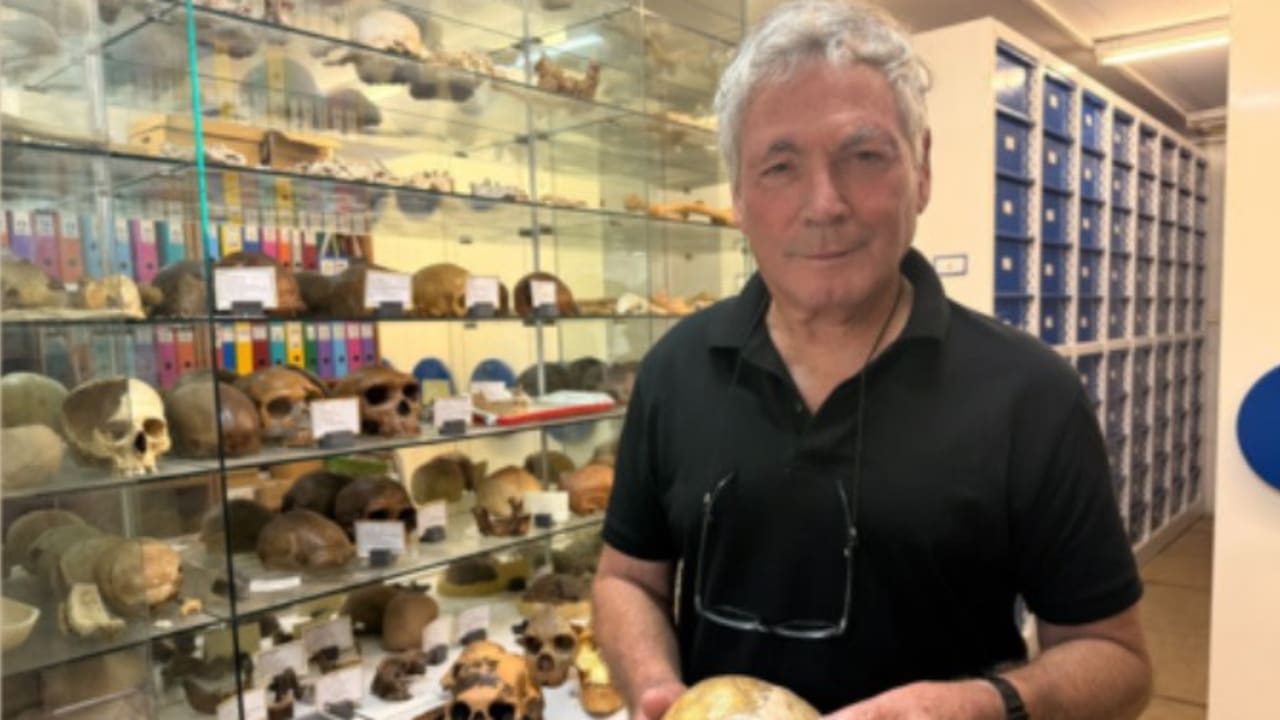
An international team from Tel Aviv University and France’s National Centre for Scientific Research announced that a reanalysis of a child’s skull from Skhul Cave on Mount Carmel in Israel provided the oldest known physical evidence of interbreeding between Neanderthals and Homo Sapiens, dating to about 140,000 years ago and pushing back the timeline by nearly 80,000 years. Experts remained divided over the interpretation.
Tel Aviv University said in an official statement that the Skhul fossil constituted the earliest physical indication that ancient Neanderthals and modern humans not only shared territory but also had social interactions and common descendants. “Each new fossil forces us to revise established schemes. The Skhul child reminds us that the history of humanity is a network of encounters, crossings, and transformations, rather than a straight line of successive replacements”, said the authors, according to Página/12.
Researchers from Tel Aviv University and CNRS used CT and micro-CT scanning to build a three-dimensional model of the skull and examine the internal vascular system, the inner ear, and the lower jaw. Professor Israel Hershkovitz and his team conducted high-resolution scans and compared the specimen with other fossils, finding that the braincase resembled that of a modern human while the jaw showed typical Neanderthal features; they also identified Neanderthal-like traits in the brain’s blood vessel system and the inner ear, reported Münchner Merkur.
“The combination of features seen in Skhūl I may indicate that the child is a hybrid”, the researchers wrote. “There is no way that this morphology represents a variability of Homo Sapiens,” and the child was objectively a hybrid, said Anne Dambricourt Malassé of CNRS. Despite the extinction of Neanderthals forty thousand years ago, 2 to 6 percent of our genome today is of Neanderthal origin. But those genetic mixtures occurred 60 to 40 thousand years ago. This fossil is dated to 140 thousand years ago, so it’s extraordinarily important, said Hershkovitz.
Not all specialists agreed. Chris Stringer, a paleoanthropologist at the Natural History Museum in London, told Live Science that in considering all evidence, he believed the Skhul fossils primarily aligned with Homo Sapiens. John Hawks, a Professor of Anthropology from the University of Wisconsin-Madison stated "Human populations are variable and there can be a lot of variability in their appearance and physical shape, even without mixing with ancient groups such as Neanderthals." A definitive clarification would require DNA.
The child, a girl aged three to five years, lay in one of the oldest known burial sites of humanity. Archaeologists first uncovered the Skhul remains in 1932 in a cave near Haifa, and for decades the skeleton was classified as early Homo Sapiens despite its modern human-like braincase and Neanderthal-like jaw.
Findings from the Nesher Ramla site suggested Homo Sapiens groups left Africa about 200,000 years ago and encountered Neanderthals in the Levant, where archaeological records indicated Neanderthals lived as early as 400,000 years ago. Researchers described the Near East as an evolutionary crossroads where coexistence and contact occurred, and argued that local Neanderthals eventually disappeared as they were absorbed by Homo Sapiens through generations of hybridization, leaving genetic traces in millions of people.
The study challenged long-held views that Neanderthals and Homo Sapiens were totally separate without prolonged contact and was described by its authors as a milestone that could change the chronology of human evolution. What Skhul tells us is that Homo Sapiens is not a malevolent, aggressive being, but one that managed to live in peace with other groups, said Hershkovitz.
Written with the help of a news-analysis system.