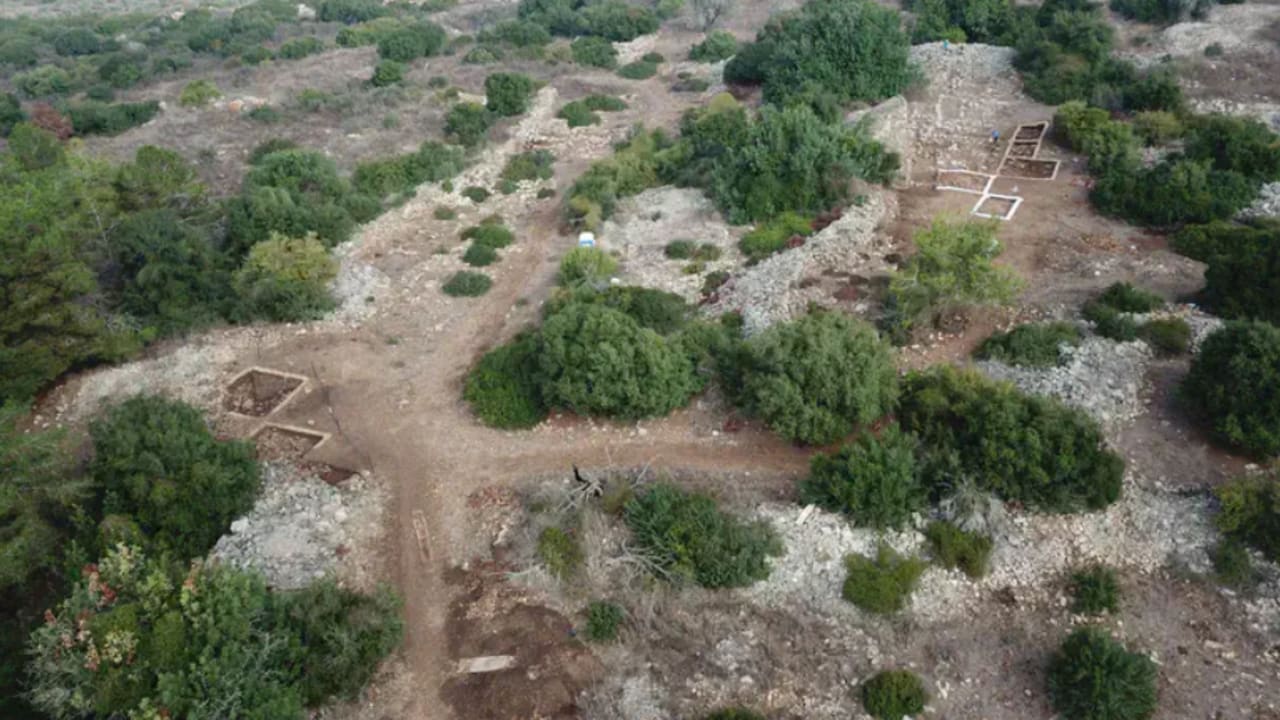
A peer-reviewed article released in the journal PLOS ONE introduced a major turn in the archaeological story of the Early Iron Age settlement of El Ahwat in northern Samaria. Microscopic and chemical analyses of metal droplets, slag, and other smelting waste from the hilltop site showed that its metalworkers produced bronze locally about 3,000 years ago rather than merely re-melting broken tools, as scholars previously believed.
A University of Haifa team led by Shai Bar of the Zinman Institute of Archaeology, with Yoav Bornstein and Gal Bar-Matov-Paz from the School of Archaeology and Maritime Cultures, sent dozens of beads of metal, angular slag, and partially fused ore for laboratory tests. Microscopic photography, structural inspection, and lead-isotope measurements revealed copper-tin alloying reactions on the surfaces of the droplets—clear evidence of primary bronze production.
“The findings indicate a developing and non-professional industry. The alloys are not uniform in quality, but it is clear that there was a deliberate attempt to produce bronze on-site,” said Tzila Eshkol, research editor at the University of Haifa, according to Israel Hayom. She added that the work offered “the first conclusive proof” of Early Iron Age bronze production in the Land of Israel that went beyond recycling.
Adam Zertal’s expedition uncovered the El Ahwat assemblage nearly three decades ago, but analytical tools to distinguish recycling from first-stage smelting were not yet available. The new study determined that some droplets formed as molten copper mixed with tin and cooled at different rates, evidence of both rudimentary and more controlled firing techniques.
Lead-isotope signatures linked part of the copper to the Feinan mines across the present-day Jordanian border and part to the Timna Valley in Israel. Manganese and other trace elements favored a scenario in which El Ahwat drew raw copper from multiple sources, moving it uphill to what had been viewed as a peripheral mountain settlement.
The Early Iron Age followed the collapse of Late Bronze Age empires, a disruption that allowed local actors in the Arava to develop copper sources and foster new political units such as Israel, Judah, and Edom. El Ahwat now appears to have joined that technological wave. The demanding steps of bronze production—reaching temperatures high enough to melt copper, adding tin in proper proportions, and maintaining reducing conditions—suggest that technical knowledge spread well beyond major urban centers.
Questions persist about where the tin originated and who the artisans were, yet the study prompted scholars to reconsider the economic and social landscape of the highlands during the 11th to 10th centuries BCE.
Assisted by a news-analysis system.