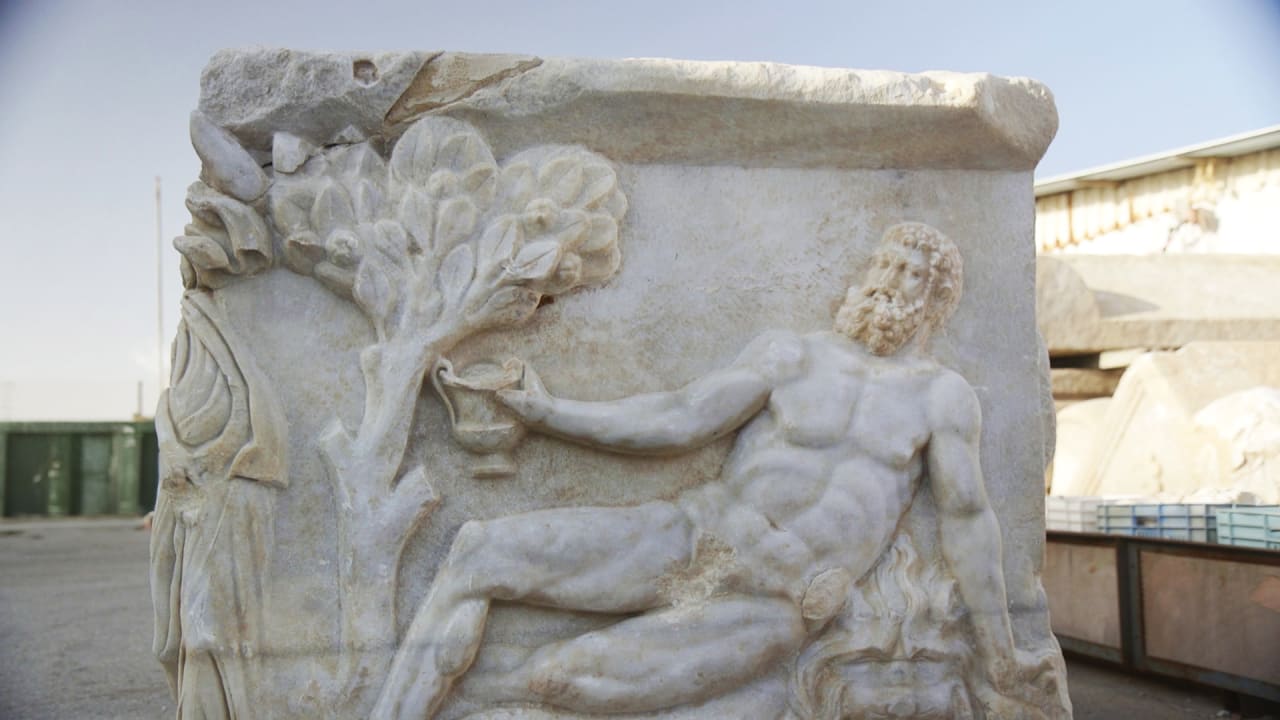
In a remarkable archaeological find, the Israel Antiquities Authority (IAA), in collaboration with the Caesarea Development Corporation, has revealed a Roman-period marble sarcophagus unlike any discovered before in Israel.
This elaborately decorated coffin, dating back approximately 1,700 years, bears a unique depiction of a drinking contest between Dionysus, the god of wine, and Hercules.
The discovery will be formally presented on June 12, 2025, at “The Feast” conference at the Eretz Israel Museum in Tel Aviv, hosted by the IAA, Tel Aviv University, and Bar Ilan University.
“It was like a scene out of a movie,” shared archaeologists Nohar Shahar and Shani Amit of the Israel Antiquities Authority. “As we gently brushed away the light sand of the dune, a marble object emerged. The entire excavation team gathered around in awe as more of the object was revealed – intricately carved figures of gods, animals, and trees. Each piece was more astonishing than the last. The highlight came in the final hour of the excavation, when we uncovered an entire intact side of the sarcophagus showing Hercules reclining on a lion skin, cup in hand.”
After excavation, the broken sarcophagus fragments were transferred to the IAA’s conservation experts, including Solomon Gavriel, Ilya Armanovsky, and Gadmo Vajpo, under the supervision of architect Ido Rosental. Their meticulous restoration work has brought the spectacular scenes to life, revealing a dynamic mythological tableau featuring Dionysus at the center, surrounded by Maenads (his female followers), satyrs, Hermes, Pan, and even lions and tigers.
First time the scene on a burial coffin found in the region
“This is the very first time we’ve found the Dionysus and Hercules wine competition scene on a burial coffin in our region,” explained Shahar.
“While Dionysian processions are a common motif on 2nd and 3rd-century CE sarcophagi, this particular drinking contest is typically known from mosaics, like those in Zippori and Antioch. Here, the figures seem to be accompanying the deceased on their final journey – a celebration of transition, where drinking and dancing symbolize liberation and the passage to the next life. It’s a rare and thought-provoking perspective on death, not as an end but as the start of a new journey.”

And who ultimately triumphed in this divine drinking contest? “Hercules, depicted slumped and unable to stand, leaves no doubt: Dionysus won,” Shahar said with a smile.
The sarcophagus was discovered outside the known walls of Caesarea, indicating that the ancient city was far more extensive than previously thought. “This expands our understanding of Caesarea’s layout and wealth of archaeological treasures,” Shahar added.
Eli Escusido, director of the Israel Antiquities Authority, emphasized the find’s significance: “This remarkable discovery provides insight into how life and faith were perceived in the Roman world. The sarcophagus is undergoing [a] meticulous conservation [process], and we look forward to sharing it with the public as part of our commitment to preserving and presenting Israel’s rich heritage.”
The story of the sarcophagus will be shared in detail at “The Feast” conference this Thursday at the Eretz Israel Museum in Tel Aviv. The event will delve into the significance of feasting in antiquity.