Archaeologists of the Israel Antiquities Authority (IAA) have uncovered a 1,600-year-old Samaritan agricultural estate at Khirbat Kafr Hatta near Kafr Qasim, central Israel, during a salvage dig supported by the Ministry of Construction and Housing.
Historical sources identify the site as Capparetaea, the birthplace of Menander the Samaritan, who succeeded Simon Magus — the magician often described as the father of Gnostic sects. Menander became a prominent figure in Samaritan tradition and early Christian polemics, linking the estate to one of the most controversial religious currents of Late Antiquity.
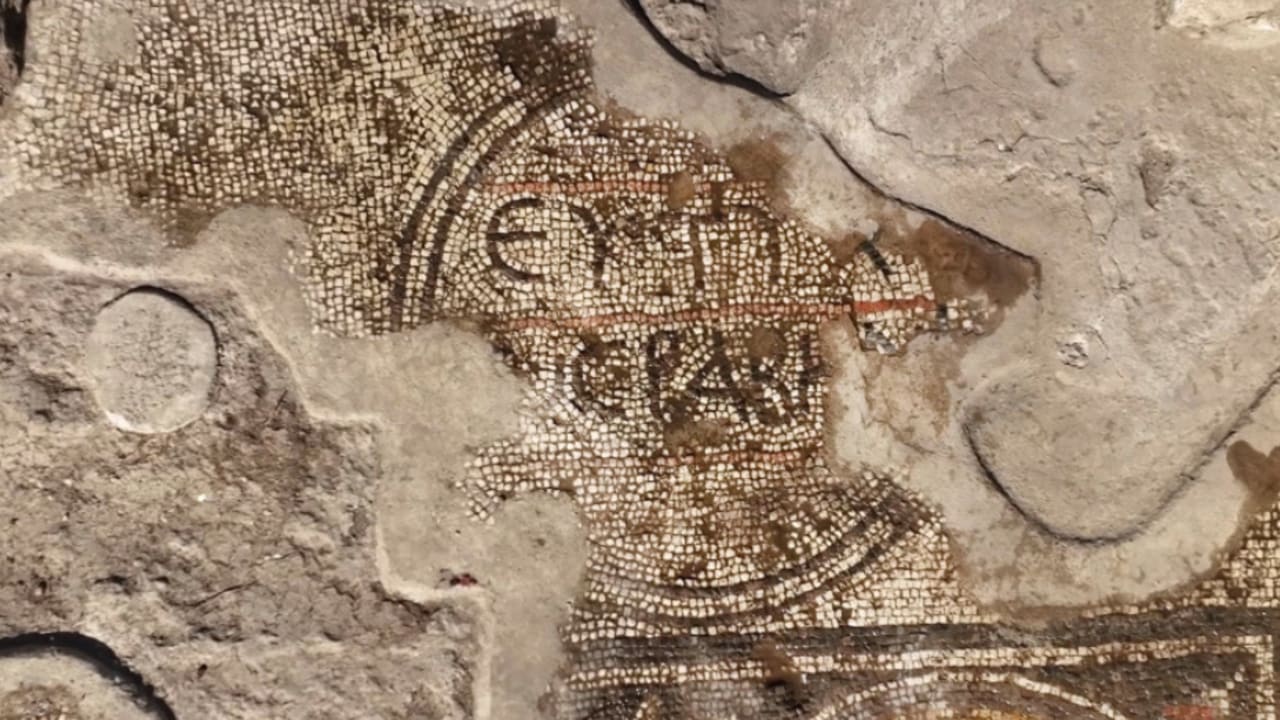
At the entrance to one of the estate’s rooms, archaeologists discovered a partially preserved Greek inscription reading “Good Luck!” The dedication was addressed to the building’s owner, whose name survives only in fragments but is recognizable as a name common in Samaritan communities of the time.
The estate included lavish mosaic floors decorated with geometric patterns and an unusually diverse array of vegetal motifs — acanthus leaves, grapes, dates, watermelon, artichoke, and asparagus. The artistry and realism of the imagery underscored the wealth of the community.
Excavators also uncovered a sophisticated olive oil production complex, remarkable for its integration of religious practice. Two screw presses, a crushing basin known as the “stone of the sea,” and a network of auxiliary rooms were paired with a public mikveh where workers immersed themselves before pressing olives to ensure the oil’s ritual purity. Such an arrangement is rare in Samaria and more characteristic of installations in Jerusalem and the Judean Plain.
Over the centuries, luxury gave way to utility. Walls cut through mosaics, capitals and columns were recycled, and the estate shifted toward pure agricultural production. Archaeologists connect this transformation to the Samaritan revolts of the fifth and sixth centuries, when Byzantine rulers imposed restrictive laws on minority religions. Yet the estate survived and retained its Samaritan identity, as evidenced by distinctive ceramic oil lamps.
“This is a fascinating site, which displays the historical gamut between the days of prosperity and the decline of the Samaritan community,” said excavation directors Alla Nagorsky and Dr. Daniel Leahy Griswold. Israeli Heritage Minister Amichai Eliyahu added that the discovery “illuminates another chapter in the shared story of the ancient peoples of this land,” noting that both Jews and Samaritans lived by the Torah and endured similar hardships under antagonistic rule.
The Khirbat Kafr Hatta estate not only enriches knowledge of Samaritan ritual and economy but also situates the community in the intellectual and spiritual debates shaped by Simon Magus and Menander — a reminder of how local lives intersected with larger religious currents in the ancient world.
Assisted by a news-analysis system.