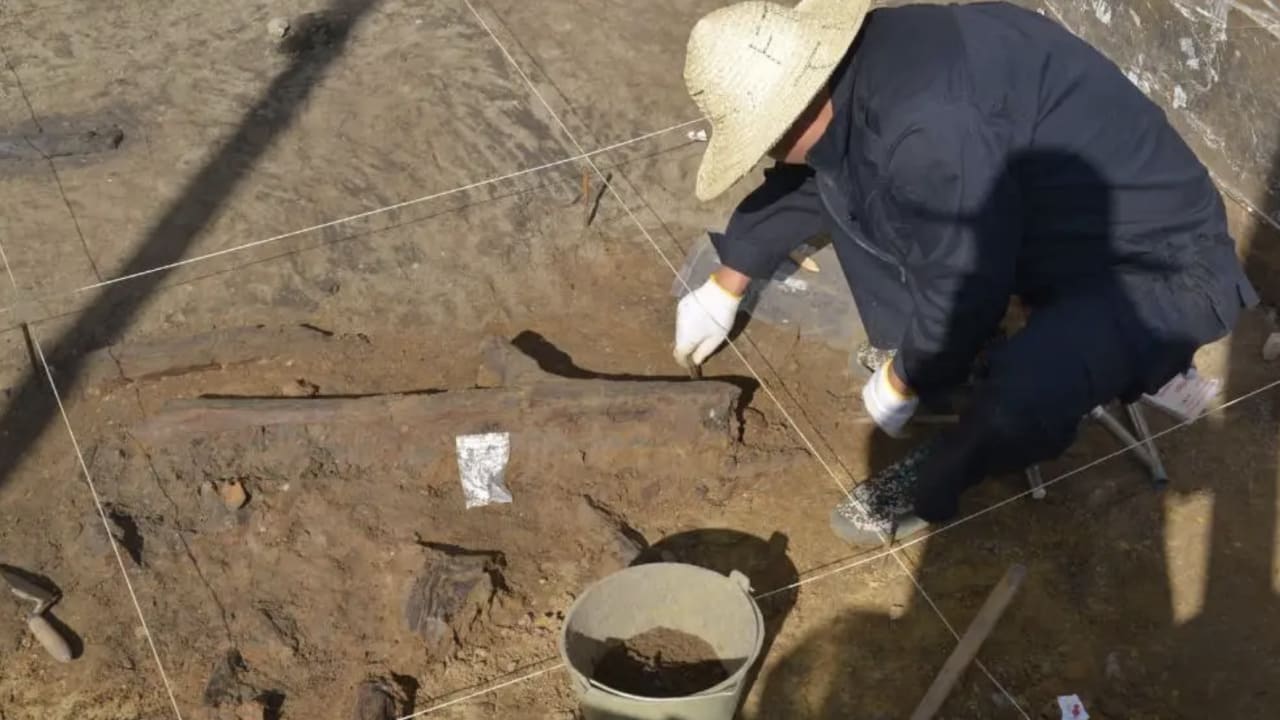
A groundbreaking discovery in China has revealed 35 wooden tools dating back to the Old Stone Age, approximately 300,000 years ago. These tools, discovered in the Gantangqing archaeological site in southwestern China's Yunnan province, provide valuable insights into the lives of early humans and their dietary habits.
According to a study published in the journal Science, the tools include digging sticks made of pine and hardwood, hooks for cutting roots, and small, pointed implements for extracting edible plants from the ground. The tools were crafted with impressive craftsmanship and demonstrate advanced cognitive skills.
"This discovery is exceptional because it preserves a moment in time when early humans were using sophisticated wooden tools to harvest underground food resources," said study lead author Bo Li, a professor at the University of Wollongong, Australia.
The tools were found buried in oxygen-poor clay sediments on the shores of an ancient lake, which helped preserve the wooden artifacts. The sediments showed deliberate polishing and scraping marks on the tools, as well as plant and soil remains on some of the edges, giving researchers clues about the tools' function.
The discovery suggests that early humans in East Asia were crafting and using tools for specific purposes, demonstrating considerable foresight and intention. The artifacts also indicate that these early humans had a good understanding of which plants and parts of plants were edible.

"The tools show a level of planning and craftsmanship that challenges the notion that East Asian hominins were technologically conservative," Li said.
Study challenges previous thoughts on early human adaptation
The study's findings challenge previous assumptions about early human adaptation and highlight the importance of plant-based food sources in the ancient diet. While contemporary European sites focused on hunting large mammals, the Gantangqing site reveals a unique plant-based survival strategy.
The researchers dated the tools using a technique developed by Li that uses infrared luminescence and another method called electron spin resonance. Both produced estimates indicating that the wooden tools were between 250,000 and 361,000 years old.
The plant remains on the tools have not been identified due to advanced decomposition, but other plant remains at Gantangqing indicate that early humans there ate berries, pine nuts, hazelnuts, kiwi fruit, and aquatic tubers.
This remarkable discovery provides a fascinating glimpse into the lives of early humans and their resourcefulness in exploiting plant-based food sources. As Li noted, "The discovery challenges previous assumptions about early human adaptation."