Recent archaeological findings led by Egyptian archaeologist Dr. Zahi Hawass challenge the long-held belief that the Great Pyramid was built by slaves.
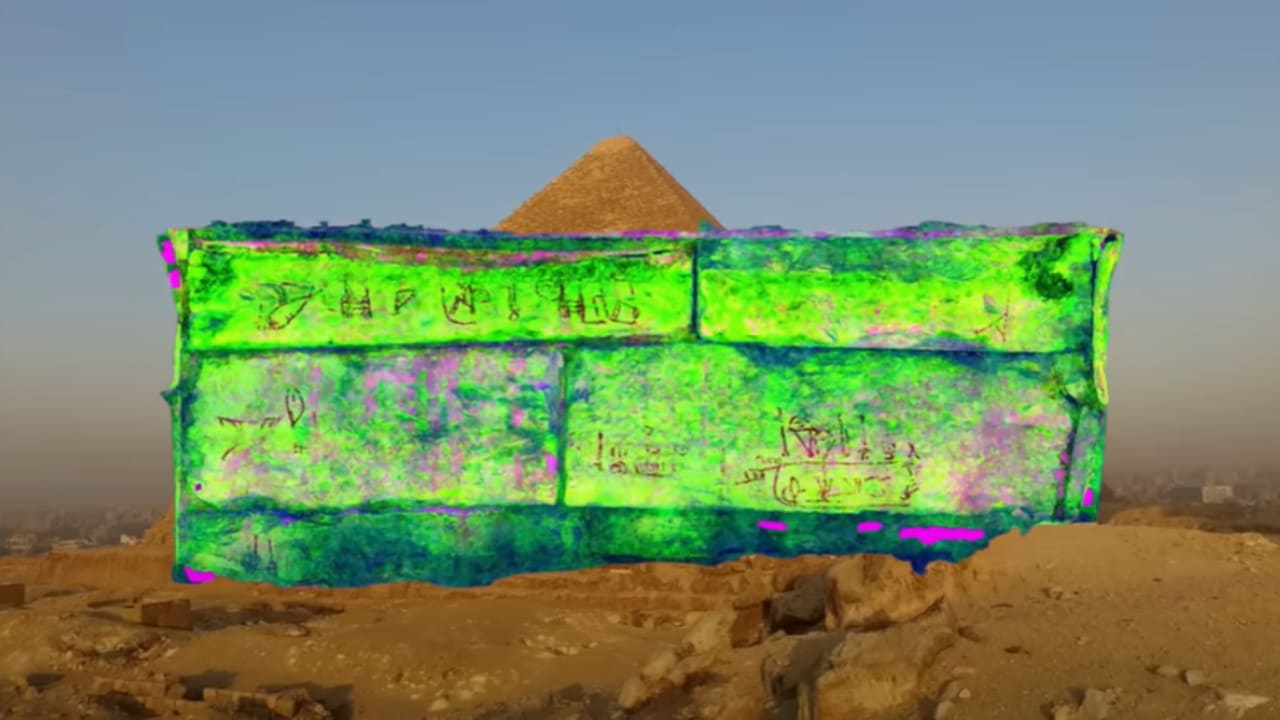
Hawass released details of inscriptions documented above the King’s Chamber in Khufu’s pyramid. The red-ochre marks log the names of rotating work gangs and tally days worked, echoing the Wadi el-Jarf papyri that detail stone deliveries to Giza. The find, adds weight to the view that the pyramid was built by paid, seasonal crews housed nearby rather than by enslaved labour.
Hawass discussed the material in an interview published on 6 June on the Matt Beall Limitless podcast, noting that the same inspection campaign inserted a snake-camera into the “Big Void”—a 30-metre cavity detected by muon imaging in 2017—to look for further graffiti or construction ramps. While lab results are pending, Hawass said the preliminary footage “shows ordinary quarry marks, nothing supernatural.”
The Big Void itself was first identified by the ScanPyramids project using three independent muon-radiography systems; the new camera work marks the first attempt to visualise its interior since that 2017 disclosure.
According to Hawass, graves discovered just south of the Great Pyramid are believed to be the final resting place of the workers who built the monument. These workers were skilled laborers organized into specialized brigades; some cut the stones, others shaped them, and others transported materials using wooden sledges pulled over the sand.
"We found thousands of animal bones at the site, including those of 11 cows and 33 goats," Hawass said. "This diet was enough to support about 10,000 workers a day." He emphasized that such provisions would not have been given to slaves, suggesting that the workers were well-cared for. Statues were found in the graves depicting workers moving large stone blocks, and inscriptions revealed 21 hieroglyphic titles, including "overseer of the side of the pyramid" and "artisan."
Written with the help of a news-analysis system.
Hawass reflected, "Slaves would not have prepared their tombs for eternity, as kings and queens did," noting the dignity of the workers buried near the pyramids. Inscriptions and artifacts found in the workers' tombs provide further evidence that the builders were skilled, paid laborers. The workers' villages included structures such as housing, bakeries, warehouses, and even medical facilities, with dormitories, food processing facilities, and ovens found, proving the existence of a permanent and organized settlement.
The discoveries also provided insights into the methods used to build the pyramids. Evidence of a ramp system used to transport limestone blocks was found, supporting the theory that materials were moved using ramps made of rubble and mud. Remnants of such a ramp were found on the southwestern side of the monument. Hawass detailed that the ramp was connected to a quarry just 300 meters away from the pyramid, indicating an efficient system for moving large stone blocks.
These findings suggest that the builders worked under a strict regime, almost without breaks, receiving a day off only once every ten days, with half a day off on some occasions. Despite the challenging conditions, the workers were not slaves but skilled laborers who contributed to the monumental construction project. The image of hundreds of slaves being whipped by overseers while dragging giant stones under the desert sun is part of the popular imagination about Ancient Egypt, but this narrative now seems to be a myth that persisted for decades.
The Great Pyramid of Giza, built during the reign of Pharaoh Khufu in the Fourth Dynasty, is the largest pyramid on the Giza Plateau and remained the tallest man-made structure until the Middle Ages. The new evidence reshapes our understanding of its construction, demonstrating the skill and organization of the ancient Egyptians. Excavations uncovered authentic workers' villages, further proving that these people were not mere expendable pieces, but an active part of the construction project.
Hawass and his team studied Egypt's pyramids for many years. They explored isolated chambers above the King's Chamber in the Great Pyramid, uncovering unknown information about the period of construction. In an interview in the Matt Beall Limitless podcast, Hawass showed images that had never been shared with the public, which included names drawn on the rock. "It's almost impossible that someone in modern times could have forged something like this," he said. "You have to climb about 14 meters and crawl through narrow spaces to even reach those chambers."
National Geographic Historia, The Sun, and El Universo reported on the findings, among other news publishers.