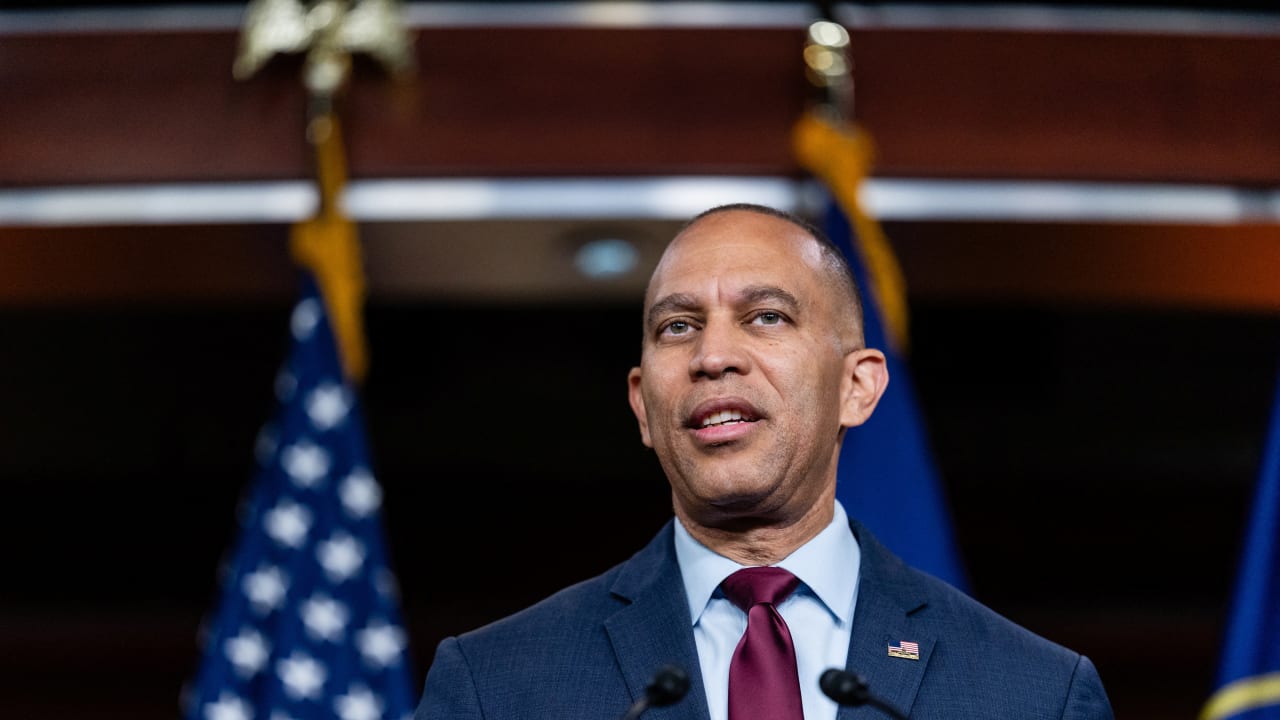
The Democrats' midterm election win puts Hakeem Jeffries in line to become the first black speaker of the US House of Representatives, with the dual challenge of opposing US President Donald Trump while bridging the gap between his party's moderates and its more vocal progressives.
As speaker, Jeffries, representing a New York City congressional district, would preside over a majority that will be sworn in the first week of January, taking the reins from Republicans who controlled the House for the past four years.
"Today begins the great American comeback," Jeffries proclaimed in a victory speech late on Tuesday after media outlets projected the likelihood of Democratic majorities in the House and Senate.
He attacked the Trump-led Republican agenda in Congress over the past two years, pledging to pass legislation reversing steep spending cuts - enacted into law on July 4, 2025 - to the Medicaid healthcare program for the poor and people with disabilities.
"The American people have spoken and made clear that they've had enough of the extremism, enough of the corruption. They want a Congress that's going to deliver for the American people," Jeffries said.

Jeffries has long said that, while his caucus would focus on helping the poor and middle class cope with the high cost of living, Democrats would also investigate the Trump administration's dealings with corporate executives, including those who have donated heavily to his various campaigns and projects. He has stopped short of saying the House, under his leadership, would attempt to impeach Trump for a third time.
Democratic Representative Robert Garcia of California, who is expected to become chair of the House Committee on Oversight, had two words of advice. "Lawyer up," he said in an election night statement.
With votes still being counted across much of the country after Tuesday's elections, the size of the Democratic majority in the House for the next two years was unclear.
The House speaker acts as the boss of the often boisterous 435-member chamber, deciding what legislation advances to a vote or dies on the vine. The House speaker is second in line for the presidency, after US Vice President JD Vance.
Later this month, the newly elected House Democrats will gather behind closed doors to anoint their candidate to run in the January election for speaker. Nobody is seen posing a serious threat to Jeffries, according to multiple Democratic aides.
Weeks later, with the start of a new Congress, the full House will vote to select the 57th speaker since 1789, with Republicans putting up their own candidate who will be all but certain to fail.
Jeffries unable to count on far-left votes due to Israel support, Medicare for All
But Jeffries still has some work to do in nailing down the support of several far-left progressives, such as fellow New Yorker and Representative-elect Darializa Avila Chevalier.
In a September 30 interview with Vanity Fair, Avila Chevalier would not commit to voting for Jeffries.
Instead, she gave a list of policies she said the next speaker must support: voting rights reforms, public housing investments, blocking offensive weapons to Israel, and universal healthcare.
However, pro-Israel groups are among Jeffries' biggest campaign contributors, and he has been cool toward proposals for a "Medicare for All" healthcare program, which many moderate Democrats fear will be too costly.
"The question is what he has to give them to get them on board," said Michele Swers, a Georgetown University professor of American government.
Tacking too far to the left, however, could cause a revolt among Democratic moderates.
Jeffries, 56, is known as a consensus-builder within his caucus, in contrast to the top-down style of former Speaker Nancy Pelosi. Yet he knows how to throw punches, particularly to rally the troops.
"In the majority, one of the first things we're going to do is run Pete Hegseth out of town," Jeffries said at a political rally just three days before Tuesday's midterms.
But Jeffries' mantra has been that Democrats will attack the "affordability crisis," which voters repeatedly cite as their top concern.
"America is too expensive" has been his refrain in public appearances.
A senior House Democratic aide said there is a series of bills he could lead off with that likely would unite Democrats: an expanded child tax credit that Trump and Republicans in Congress let expire, a housing tax credit to make home-buying more affordable, ending the war in Iran, bringing back subsidies for clean energy, and renewing some "Obamacare" healthcare subsidies.
That would be low-hanging fruit, some of which Trump could veto. Jeffries' tougher challenge will be to reach across the aisle to pass critical legislation. That would include raising the debt limit for US borrowing, to avoid a government default, and approving federal spending, to avoid a government shutdown.
Jeffries likely to protect Social Security, revamp immigration laws
Jeffries will also spearhead other Democratic priorities such as protecting Social Security, undoing $900 billion in Republican cuts to Medicaid, and revamping immigration laws.
Kate deGruyter, a spokeswoman at Third Way, a moderate Democratic consultancy, said he should resist calls from progressives to impeach the president.
"I don't think having a huge impeachment fight over the president is going to be helpful," she said.
Newly elected progressives are "likely to come to Washington expecting to be able to change the universe starting on day one," said David Miller, professor of government at American University. Jeffries' challenge will be to temper those expectations "given that Democrats don't control the White House."