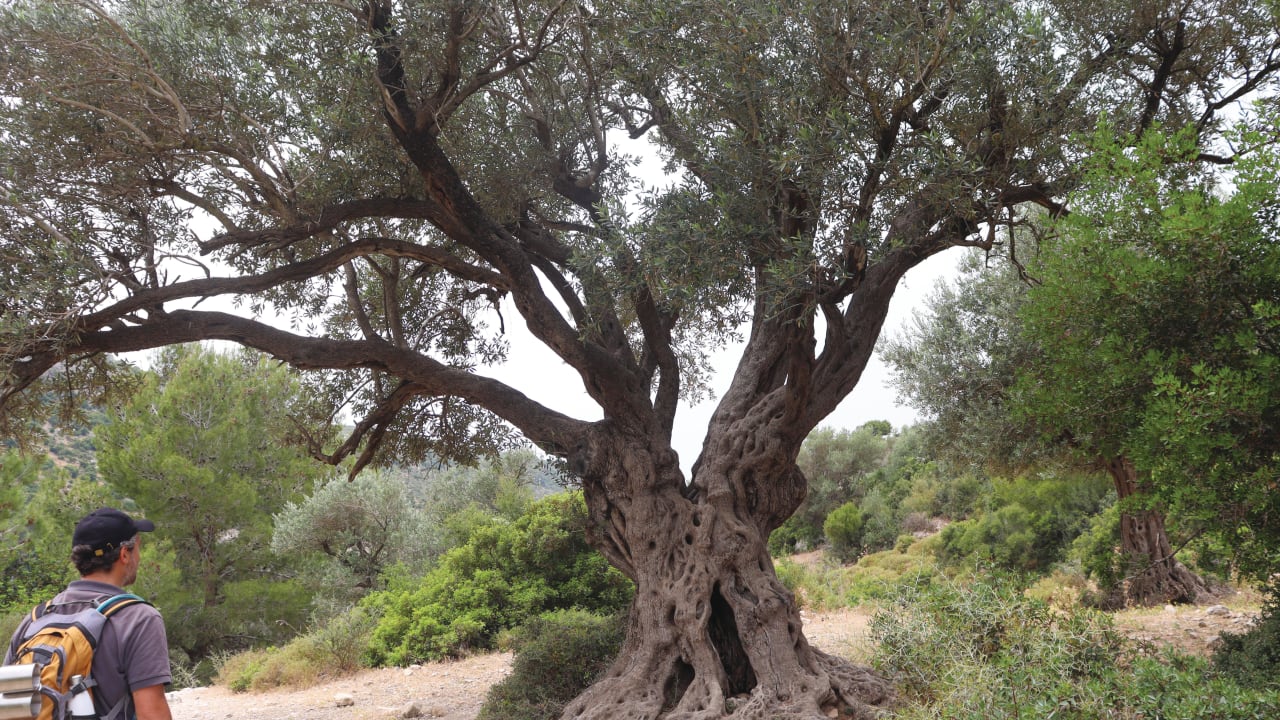
An early fall morning. I am walking up a familiar pathway with my husband, not far from Ein Kobi in the Jerusalem Hills northeast of Tzur Hadassah. We’re scoping out the scenery – the blue sky, migrating birds flying overhead, and golden grass that still lines the pathway. But, soon enough, we come across the very trees we have been seeking on this autumn walk – the olive trees.
Their gnarly bark is beautiful and twisted, crowned with a canopy of perfectly green leaves, shiny on one side and matte on the other. These trees are easy on the eye, and they photograph well, too. But the purpose of today’s outing isn’t to take pictures; it’s olive picking. So we find ourselves searching and scanning for the clusters of purple and green fruits that these beautiful trees produce.
In previous years, we’ve had much success with our olive-picking efforts. Two years before, we filled glass jars with olives from this very same spot, and salted them through the winter until, come springtime, they transformed from bitter fruit into the most delicious olives imaginable. Flavored with sprigs of rosemary or segments of lime, we were able to enjoy the fruits of our labor well into the summertime.
The next year, we focused our efforts on olive oil. We spent a full day in Park Canada, armed with large mats, rakes, olive pickers, and bags to collect our harvest. Afterwards, we headed over to the olive press, a charming place where hobbyists and local farmers carried in their bounty in gigantic crates. Our one small crate was laughable next to the plentiful pickings of most of the customers – but as we watched our purple and green olives being pressed and turned into liquid gold, we felt a deep sense of satisfaction.
We carried our prize home and consumed our olive oil on sourdough bread each Shabbat for an entire year, savoring every dip and drizzle. So, it was with hearts full of hope and possibility that we approached this year’s harvest. This year, we thought we would pick more olives than ever. This year’s olive oil production would be so plentiful that we wouldn’t have to reserve our prize for Shabbat dinner.

Or so we thought.
Olives go through a biennial bearing cycle
If we had known the Israelites of ancient times, perhaps we would have known to check our expectations about this year’s harvest. To them, an understanding of the land’s produce and its seasons was probably as fundamental as knowing how to live, breathe, and move.
But, as urban-dwelling olim, we have only just begun to uncover the Land of Israel’s many secrets. So, as we scoped out the trees near Ein Kobi, we found no olives worth picking – just a few shriveled remnants from last year’s crop. We traveled further to Park Canada and found almost the same story. There were very few olives on very few trees, and the rest were completely bare.
A brief check-in with our farmer friend, Assaf, shed light on the situation: olives go through a biennial bearing cycle, meaning that they produce significantly fewer fruits every other year. During an “on year,” the trees put all their energy into producing abundant fruit. But this depletes their reserves, and the following year becomes an “off year” with minimal production. Add poor rainfall to an off year (like we had last winter), and you get what we found – trees with hardly any olives at all.
This agricultural pattern – so obvious to ancient farmers that it apparently never needed explanation in Jewish texts – made me think more deeply about biblical verses I’d read a dozen times before.
In several places throughout the Tanach, Israel is referred to as an olive tree itself
Isaiah describes a remnant of Jews in Israel, “For thus it shall be in the midst of the earth among the peoples, like the beating of an olive tree, like the gleanings when the vintage is done” (24:13).
Before I’d ever beaten olive branches myself – watching the ripe fruit rain down onto tarps, then reaching fruitlessly for those last few olives tucked high in the canopy – I might not have understood this metaphor. But I know from experience that this remnant isn’t theoretical. No matter how much we beat those trees last year, some olives always remained, stubbornly clinging to their stems. The 19th-century Jewish scholar Samuel David Luzzatto (Shadal) understood this physical reality: “Like the olives that remain on the olive tree after its beating, and like the gleanings after the vintage is finished.”
In several places throughout the Tanach, Israel is referred to as an olive tree itself. Jeremiah 11:16 calls the Jewish people “a thriving olive tree, beautiful with shapely fruit.” The commentator Malbim breaks this down into three levels: the leaves that stay green both summer and winter; the beautiful appearance representing strength and numbers; and the beautiful fruit representing good deeds and Torah study.
Perhaps more poignantly, olive trees endure – they are nearly indestructible. They can be burned, cut down, appear completely dead, yet sprout again from ancient roots. Some trees in Israel are over a thousand years old, their twisted trunks bearing witness to centuries of survival.

This may be why the olive tree is such a fitting symbol for the Jewish people. It’s not just the beautiful bark and evergreen leaves, but their uncanny ability to survive, to come back, to bear fruit again even after seasons of scarcity.
Walking back from Ein Kobi empty-handed, I felt more grateful than disappointed. True, we wouldn’t have homemade olive oil this year. But we had gained something that no book could have taught us: the embodied knowledge that abundance and scarcity are both built into creation’s rhythm, represented by the common olive tree. Resilience is about the long view – the patience to endure lean seasons, the roots that go deep enough to survive, the certainty that flowering and fruit will return.
Next autumn, God willing, those same bare branches near Ein Kobi will hang heavy with purple and green fruit. We’ll return with our bags and poles and mats. We’ll press our olives the same way that Jews have done for millennia in the Land of Israel. And when we drizzle that oil over our bread, we’ll taste not just the fruit of one abundant year, but the rhythm of centuries – the endurance of olive trees, and of the people they symbolize.
The writer is the author of From Southerner to Settler: Unexpected Lessons from the Land of Israel and the founder of Hiking the Holyland.