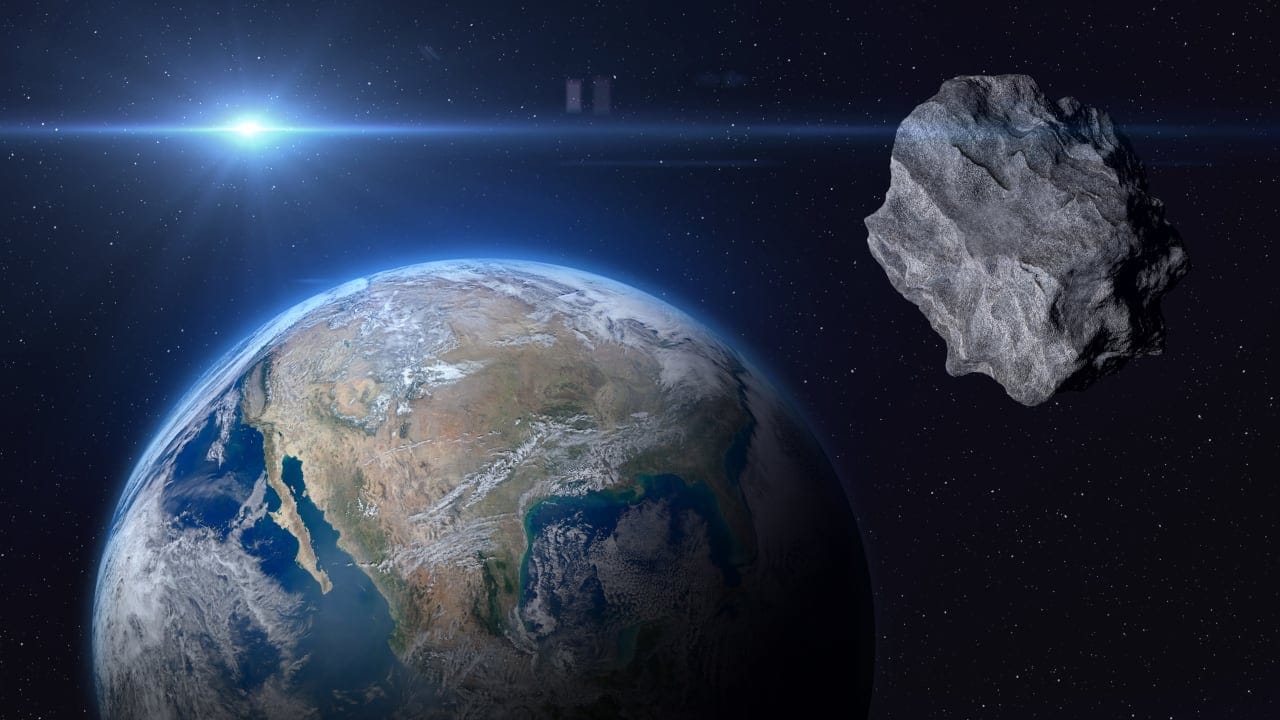
An asteroid the size of 60 sloths is set to pass by the Earth on Friday, May 1, according to NASA's asteroid tracker.
The asteroid in question has been designated 2026 HX3, and is merely the first of three asteroids set to fly past the planet, according to the Center for Near-Earth Object Studies (CNEOS) at NASA's Jet Propulsion Laboratory (JPL).
Sloths are the slowest mammals of all, but make no mistake, these asteroids are anything but that – both in terms of being slow and in terms of being mammals. Rather, their speeds are metaphorically and literally out of this world – because they're in space.
Slooooooow down: How big is asteroid 2026 HX3?
NASA's estimates put asteroid 2026 HX3's diameter as being somewhere between 16 meters and 35 meters. But we're rounding up here, because bigger numbers are more exciting.
If you're anything like the residents of a certain country home to over 300 million people, you might be wondering, "What's a meter? How do I know how big that is? I need something to compare it to."
So, my metrically-challenged readership, to that I give you a solution. I give you a way to put this strange number and measurement into perspective. I give you... the sloth.

According to National Geographic, the average three-toed sloth is around 23 inches, or 58.42 centimeters. Now we have to do something that isn't very fun in practice, but is still very important: Math.
Converting our centimeter measurement into meters, we get 0.5842 meters. Then, we divide 35 by 0.5842, which gives us a scary number of 59.9109893872. And that is where we once again round up, giving us the far less intimidating result of 60.
And with all that math out of the way, we can determine that asteroid 2026 HX3 is the size of around 60 sloths. And if that math was too much for you, maybe don't become a rocket scientist or physicist.
Stay away from accounting, too.
Now, sloths are slow. I mean, they are very, very slow. They're so slow that algae ends up growing on their fur. They're so slow that it takes them a month to fully digest a leaf. They're so slow that their top speed on land is just a few feet a minute.
In fact, they can't even run or walk. They can only move on the ground by crawling.
Many mammals hibernate, like bears, meaning they spend months at a time asleep. But not sloths. They don't hibernate, but you'd be forgiven for thinking otherwise, considering how much they sleep and don't move. They spend almost all of their time just hanging on trees.
Asteroid 2026 HX3 is, to put it simply, not like that. Rather, NASA's estimates put its velocity at around 11.42 kilometers per second, or 41,112 kilometers per hour.

To put this in more sloth-related terms, let us consider the fact that, according to the World Wildlife Fund, the average sloth's land speed tops out at around 0.24 kilometers per hour. So, if a sloth was feeling threatened and moving at its maximum ground speed, 24/7, without stopping to eat or sleep, then according to our calculations, it would take the sloth nearly 20 years to move as much as asteroid 2026 HX3 does in a single hour.
Hang in there: Will asteroid 2026 HX3 hit the Earth?
Should an asteroid be about to hit the Earth, the natural result could best be described as mass panic. After all, asteroid impacts have the potential to be among the most catastrophic natural disasters of all.
People and animals might scramble for cover in an attempt to find safety amid an impending calamity. But rather than stress out our poor sloth friend that we've been using for this article, who no doubt will be struggling to move anywhere considering how slow it is, we can take solace in the fact that asteroid 2026 HX3 will not be hitting the Earth, nor will any of the other asteroids flying past the planet on Friday.
According to NASA, this asteroid will pass Earth by over three million kilometers, meaning our planet – and its sloths – are safe.
But that doesn't mean scientists aren't hard at work trying to prevent an asteroid from becoming a threat in the future.
The field of planetary defense has been pushing hard for solutions to defend the planet against menacing space rocks. Models such as kinetic deflection (punching an asteroid with a spacecraft of some kind to shift its orbit slightly), explosives (exactly what it sounds like), and more have been proposed, with NASA's Double Asteroid Redirection Test (DART) Mission being a landmark effort in this regard.
But the private sector hasn't been idle either. Everything from nonprofits like the B612 Foundation to major companies like Jeff Bezos's Blue Origin have thrown their metaphorical hats in the ring to try to come up with solutions to keep the Earth safe.
Luckily, there hasn't been a major risk of catastrophic asteroid impacts lately, and estimates by NASA put the 21st century as largely risk-free of these possible disasters.
But that isn't guaranteed to last.
However, the development of the space industry and space sciences has been progressing quickly, as seen in everything from new technologies and scientific discoveries to major missions such as the Artemis program – a far cry from our hypothetical sloth model's speed, indeed.