
A star pulled to its doom by a faraway supermassive black hole has managed to do the impossible, having not only survived but come back for a second bout two years later, Israeli scientists revealed in a new study.
The findings of this study were published in the peer-reviewed academic periodical The Astrophysical Journal Letters.
The star's survival despite the presence of a flare goes against the scientific understanding of how stars encounter black holes, showing there is more than meets the eye to these stellar events.
A stellar menu: How supermassive black holes light up with the corpses of stars
Supermassive black holes are the larger cousins of black holes. Like their smaller counterparts, they are enormous concentrations of gravity that are so strong that they pull everything into it through a process known as accretion. Nothing, not even light, is able to escape the pull of a black hole. Supermassive black holes are far larger, measuring between 100,000 to millions and billions of solar masses, with one solar mass being equal to the Sun.
These black holes are so large and draw so much toward them that they end up sitting at the center of galaxies. Our own Milky Way Galaxy is no exception, with the galactic center being home to the supermassive black hole known as Sagittarius A*.
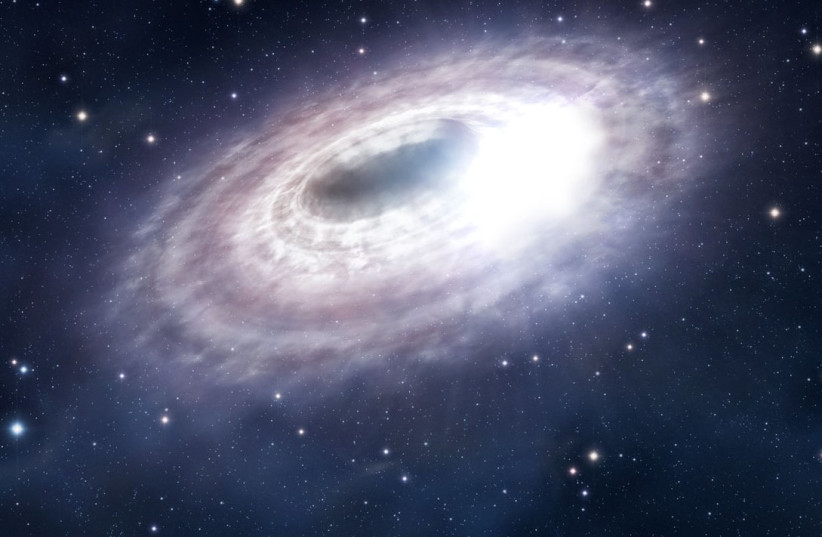
These enormous black holes are very mysterious, and while scientists are certain that they play essential roles in the forming of galaxies, it isn't quite clear exactly how this happens, or even how supermassive black holes are formed in the first place - unlike regular black holes, which are formed when stars die and collapse in on themselves.
The mere existence of black holes in the first place is only known to us because scientists were able to determine that such a force of gravity is impacting all the things around it - black holes are, after all, devoid of all light, making them functionally invisible.
In the Milky Way, scientists figured out that Sagittarius A* existed because of how the stars around it moved. But we can't see this as clearly in more distant galaxies. In general, researchers have to wait for a very brief window to actually study these distant supermassive black holes, specifically during feeding time.
Every now and then, usually once every tens of thousands of years or more, a star will be caught up in the pull of a supermassive black hole. The resulting process is known as a tidal disruption event, the result of which is the star quite literally being ripped apart, with half being thrown outward and the other half being pulled into this inescapable maw of gravity and darkness.
This descent into the void occurs much like a sink drain or a toilet being flushed. The star, or rather the mutilated part of its corpse, spins around and around in a circular motion, heading to the center. This is not a slow decent - quite the opposite. It spins so fast that it approaches the speed of light. This causes the stellar remnants to heat up and light up.
When this happens, the huge ring of accumulated debris around the black hole - known as an accretion disk - will be lit up by the fast-moving star fragment. This causes the are around the black hole to effectively shine in a massive bright flare. This is known as an optical-ultraviolet tidal disruption flare, and it can lasts for weeks if not months. It is this precious moment, when the black hole's surroundings are lit up for meal time, that scientists have the chance to study them.
This all makes sense. And based on this theory, there should be consistency in how bright these flares of light are and how hot they are. The problem is that this isn't the case, with the brightness and temperature not as intense as they should be in many cases scientists have observed.
But now, scientists think they know why.
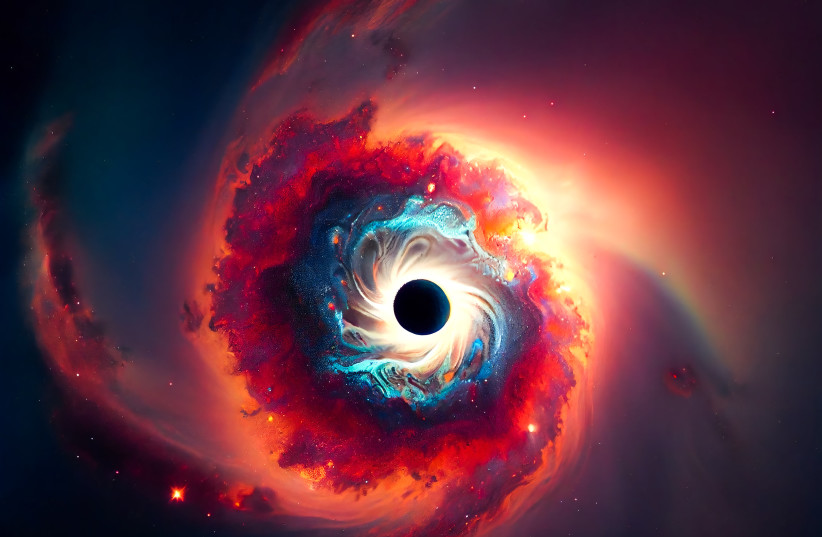
Round two, black hole boogaloo: How a star survived an encounter with the void
The scene is WISEA J122045.05+493304.7, a galaxy 408 million light years away with a supermassive black hole at its center.
In February 2022, scientists observed a flare, dubbed AT 2022dbl, from this galaxy, allowing them to study the supermassive black hole at its center.
That should have been the end of the story. But around 700 days later in 2024, an almost identical flare was spotted again in the same galaxy.
The conclusion scientists had was that AT 2022dbl returned. But how could this happen? While a few theories were put forward, one curious one was that it was simply the same star, which survived the first time but evidently the black hole wanted seconds.
The subsequent research effort was led by Dr. Lydia Makrygianni, a former Tel Aviv University postdoc now working at Lancaster University, and under the supervision of TAU Astrophysics Department researchers Prof. Ehud Nakar and Prof. Iair Arcavi, the latter also being the director of the Wise Observatory in Mitzpe Ramon.
One by one, the team approached the different hypotheses for how this could occur, and one by one they were shot down.
The only conclusion is that it's the same star both times.
So how is this possible?
The researchers say there are two possibilities. Either loose debris from the first flare got caught in the black hole's pull and ultimately sparked a second flare, or it was the same star. Since there doesn't seem to have been enough loose material to produce a second flare, the latter explanation is the most likely.
For that to happen, the star would need to have survived its first encounter with the supermassive black hole, which only took some of the star but not enough to finish it off. In other words, it's more of a snack than a meal, or a sort of cosmic case of catch and release.
But there is still one question here. Was this second flare the death throes of a star that finally succumbed to the black hole's inescapable pull, or did this star refuse to give up once again and escape the clutches of the void?
There's really only one way to know: if it happens again.
“The question now is whether we’ll see a third flare after two more years, in early 2026,” Arcavi said in a statement. “If we see a third flare, it means that the second one was also the partial disruption of the star. So maybe all such flares, which we have been trying to understand for a decade now as full stellar disruptions, are not what we thought.”
If this is in fact the dying gasps of this survivor star, that has another added implication: the flares from a dying star and the flares of a star that survived its brush with a black hole look identical.
This is something that had already been theorized in the past, in particular by the work of Hebrew University of Jerusalem's Prof. Tsvi Piran and his research group. But regardless, this lone star's struggle against a supermassive black hole promises to completely upend our understanding of the flares.
“Either way,” Arcavi said, “we’ll have to rewrite our interpretation of these flares and what they can teach us about the monsters lying in the centers of galaxies.”