
For years, the early history of domestic cats, long before they curled up on couches or dominated the internet, has been uncertain. New ancient DNA research is now reshaping that story.
Archaeologists once believed that humans and cats began living together about 9,500 years ago in the Levant, where early farmers stored grain that attracted rodents. Wildcats followed the mice, people welcomed the natural pest control, and domestication began.
The oldest known cat–human association comes from a Neolithic burial in Cyprus. These findings were published in the journal Science.
Now, new genetic analyses tell a different tale. DNA from cat bones recovered across Europe, the Middle East, and Asia shows that the cats familiar to us today emerged far more recently — and were not the first felines to live alongside humans.
“We looked at bones labeled as domestic cats going back 10,000 years and checked which matched the genome of today’s cats,” said Greger Larson of the University of Oxford, a coauthor of two new studies published Thursday. “It completely overturns the old narrative.”
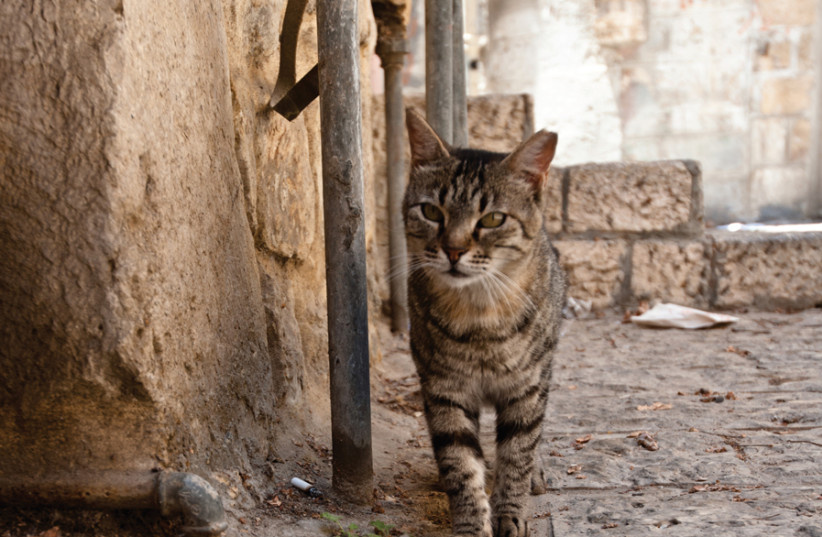
One of the studies, published in Science, examined 87 ancient and modern genomes and found that Felis catus, the modern domestic cat, originated in North Africa, not the Levant. Its closest ancestor was the African wildcat, Felis lybica lybica. These cats spread across Europe around 2,000 years ago, likely propelled by the expansion of the Roman Empire.
A second study, published in Cell Genomics, analyzed DNA from 22 feline remains found in China. It shows that by 730 AD, domestic cats had reached China via Silk Road trade routes. Before that, however, a completely different species lived alongside humans for millennia: the leopard cat (Prionailurus bengalensis). This small Asian wildcat coexisted with people from at least 5,400 years ago until about AD 150.
'Their relationship with humans was mutually beneficial'
Although leopard cats lived near human settlements and helped control rodents, they were never fully domesticated. “Their relationship with humans was commensal, mutually beneficial, but people never managed or bred them,” explained Shu-jin Luo of Peking University, a senior author of the study.
One likely reason: leopard cats also preyed heavily on chickens, earning the nickname “chicken-catching tiger” in Chinese folklore. As poultry farming shifted from free-range to enclosed systems after the Han dynasty, conflicts with leopard cats intensified. Combined with centuries of social upheaval and environmental change, the species eventually withdrew from human communities and returned to forest habitats.
Today, leopard cats still live in the wild across Asia, rarely seen but far from extinct.
The studies highlight how shifting human landscapes, from farms to trade routes, shaped different human–cat relationships across regions. William Taylor of the University of Colorado, who was not involved in the research, noted that these findings connect the story of domestic cats to early long-distance trade networks like the Silk Road.
The idea that domestic cats originated in North Africa also aligns with their prominent role in ancient Egyptian culture. Egyptian art shows cats as treasured household companions, though researchers still debate whether Egypt was the primary site of domestication or simply where cats transitioned from rodent hunters to family pets.
Still, many questions remain. Early cat remains in Europe are genetically European wildcats, not domestic cats, even though their skeletons look similar. And a shortage of ancient DNA from North Africa and Southwest Asia leaves key parts of the story unfinished.
As Jonathan Losos of Washington University in St. Louis put it, “Cats, ever sphinx-like, give up their secrets slowly.” More ancient DNA will be needed to fully unravel the long and tangled journey that led to the modern housecat.