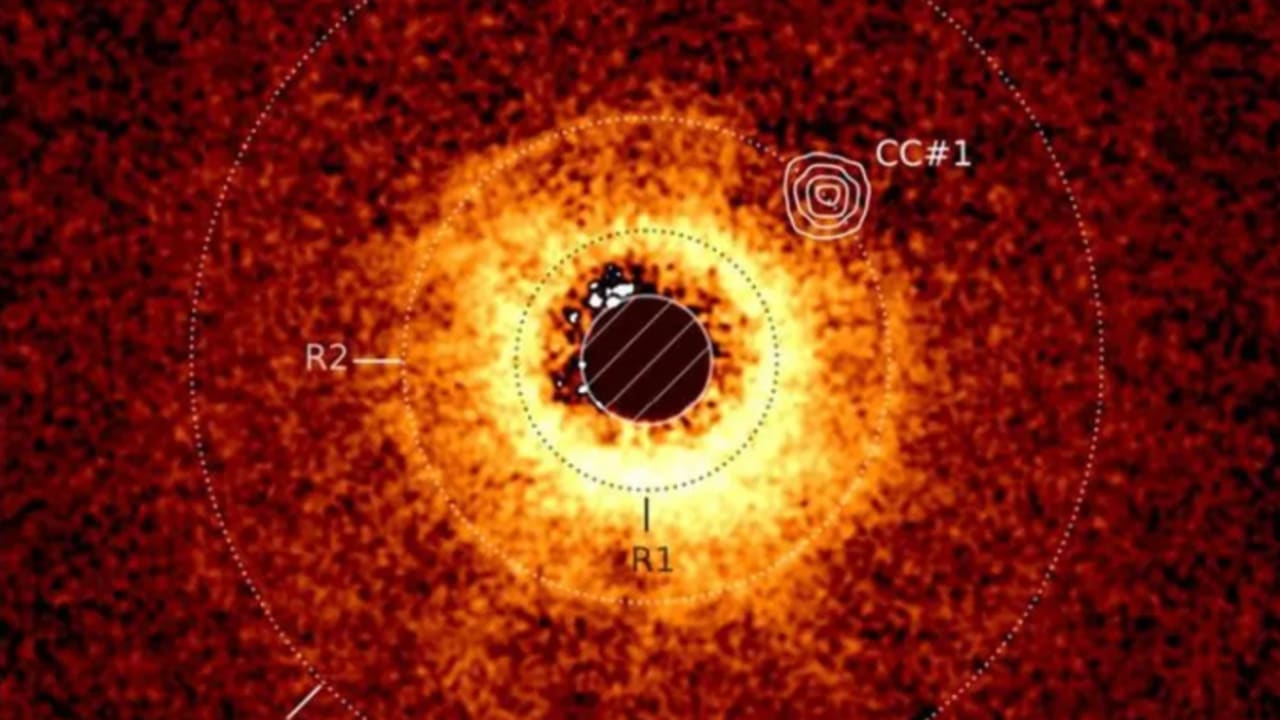
Astronomers announced that the James Webb Space Telescope (JWST) directly captured an image of TWA 7b, a young gas giant approximately the size of Saturn. Located about 110 light-years away in the constellation Antlia, TWA 7b is classified as a cold gas giant and stands as the lowest mass planet ever imaged beyond our solar system.
The discovery was led by astronomer Anne-Marie Lagrange from the Centre National de la Recherche Scientifique (CNRS) at the Paris-PSL Observatory. The findings, published in the journal Nature, mark a milestone in the direct observation of planetary formation.
TWA 7b is ten times lighter than any exoplanet previously captured in images, making it a "lightweight" by exoplanet standards. With a mass comparable to that of Saturn—approximately 30% of Jupiter's mass—it offers insights into the formation of planetary systems, particularly in their early stages.
Directly imaging exoplanets remains a challenge because they are much fainter than their host stars and are located very close to those stars when observed from Earth. The JWST overcame this obstacle by utilizing a coronagraph installed in its Mid-Infrared Instrument (MIRI), which blocked the light emitted by the host star, TWA 7. The coronagraph allowed the faint infrared emissions of TWA 7b to be detected.
"TWA 7b is the first exoplanet light enough to be directly photographed," said Lagrange, according to Live Science. "We are really witnessing the youth of the planetary system."
The exoplanet orbits a young star named TWA 7 in a solar system that is approximately 6 million years old—a mere infant compared to our 4.6-billion-year-old Sun. Surrounding TWA 7 is a disk of dust and gas leftover from the star formation stage, where planets may be gradually forming. This disk has three ring-like structures composed of rocky and dusty material, with gaps in between, similar to Jupiter's rings.
TWA 7b is located at a distance of 52 astronomical units (AU) from its parent star. This places it in a region analogous to the outer area of our solar system, beyond the orbit of Pluto.
Since the discovery of the first exoplanet in 1992, nearly 6,000 exoplanets were confirmed in the Milky Way galaxy, with most identified through indirect methods such as observing the dimming of host stars as planets pass in front of them. Less than 2% of these exoplanets have been directly imaged.
The JWST's capture of TWA 7b demonstrates its capabilities in exoplanet research. By blocking out the star's light with its coronagraph, the telescope could detect the planet's faint glow. This achievement demonstrates the potential for studying smaller and colder exoplanets that were previously beyond our observational reach.
"This result marks a new step in the research and direct imaging of increasingly small exoplanets, which are more similar to the Earth than to the gas giants of the Solar System," Lagrange noted. "The JWST has the potential to go even further in the future."
The presence of TWA 7b within one of the disk's gaps suggests that the planet is influencing the structure of the surrounding material. Astronomers believe that young planets like TWA 7b can shape circumstellar disks, forming gaps and ring-like structures as they clear a path through the dust and gas.
The discovery underscores the relevance of future generations of space and ground-based telescopes designed to search for exoplanets, especially with the help of more sophisticated coronagraphs. Researchers hope that such technology will enable them to capture images of planets with masses as low as 10% that of Jupiter.
"Our observations reveal a strong candidate for a planet shaping the structure of the TWA 7 debris disk, and its position is exactly where we expected to find a planet of this mass," Lagrange said.
Written with the help of a news-analysis system.