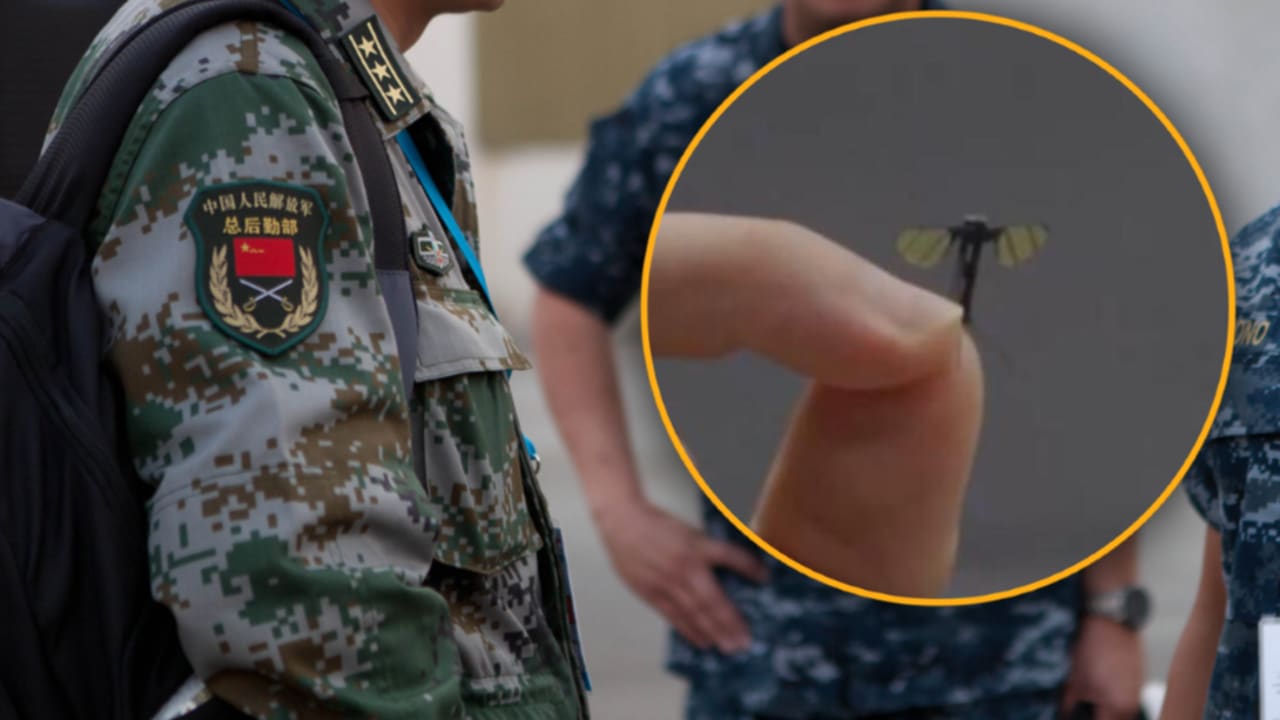
China unveiled a mosquito-sized drone designed for military reconnaissance and covert operations. Developed by engineers at the National University of Defense Technology (NUDT) in Hunan Province, Central China, the miniature unmanned aerial vehicle (UAV) promises to enhance the capabilities of soldiers on the battlefield by providing unprecedented levels of stealth and maneuverability.
The super-small drone resembles a mosquito in both size and appearance, measuring approximately 1.3 centimeters in length and weighing less than 0.3 grams. Its design incorporates an elongated body, three tiny legs as thin as human hair, and two semi-translucent wings shaped like leaves, allowing it to flap like real insect wings. This biological mimicry enables the drone to infiltrate restricted areas such as buildings, underground tunnels, or military bases without being detected.
The drone is equipped with ultra-small cameras and microphones to collect images, sounds, or electronic signals, making it ideal for secret reconnaissance missions. Its small size allows it to be hidden in the palm of a hand or fit between two fingers, rendering it almost invisible and undetectable by the naked eye or conventional radar systems.
"In my hand is a robot like a mosquito," said Liang Hexiang, a student at NUDT, while holding the small drone, according to CCTV. He added, "Such small bionic robots are especially suitable for information reconnaissance and special missions on the battlefield."
Developing such a tiny aerial vehicle presents technical challenges. Clarín notes that integrating power systems, sensors, control circuits, and materials into a microscopic frame is a complex task. The main obstacle remains the power supply: finding a battery small and efficient enough to maintain flight without compromising key functions.
Despite these challenges, the research team made progress in micro-mechanics and integrated artificial intelligence. The drone is controlled by a smartphone and can be operated through Bluetooth connectivity. It is equipped with a custom-designed chip and battery, enabling it to perform activities such as hovering, rotating, and diving at low altitudes.
The drone's applications extend beyond military reconnaissance. Micro drones can locate survivors among debris in emergency situations, making them valuable assets for search and rescue operations. However, due to their small batteries, micro drones generally have a short flight time and may have difficulty maintaining flight for long periods.
Improvements in battery life, sensor technology, and AI are expected to enhance the capabilities of micro drones, escalating the global UAV technology race. VietnamNet emphasizes that the technology combines advancements in micro-devices, bionics, and materials science, with micro-electromechanical systems allowing the integration of many functions in an ultra-small size.
The Norwegian PD-100 Black Hornet drone, currently the smallest drone available on the market, measures 10 centimeters in length and resembles a small helicopter. It is used by the armed forces of Germany, the US, Australia, Norway, France, and Poland for reconnaissance missions.
In the US, scientists at Harvard University developed the RoboBee project in 2019, producing a type of super-small drone capable of switching from swimming underwater to flying in the air or landing on surfaces using electrostatic force. Additionally, Beihang University in China designed a biological insect robot named BHMbot, which can run extremely fast without wires, moving through narrow spaces to reach designated positions and perform special missions.
The development of these micro-drones reflects a global race where ultra-small, intelligent, and hard-to-detect robots can redefine military operations and scientific exploration.
The preparation of this article relied on a news-analysis system.