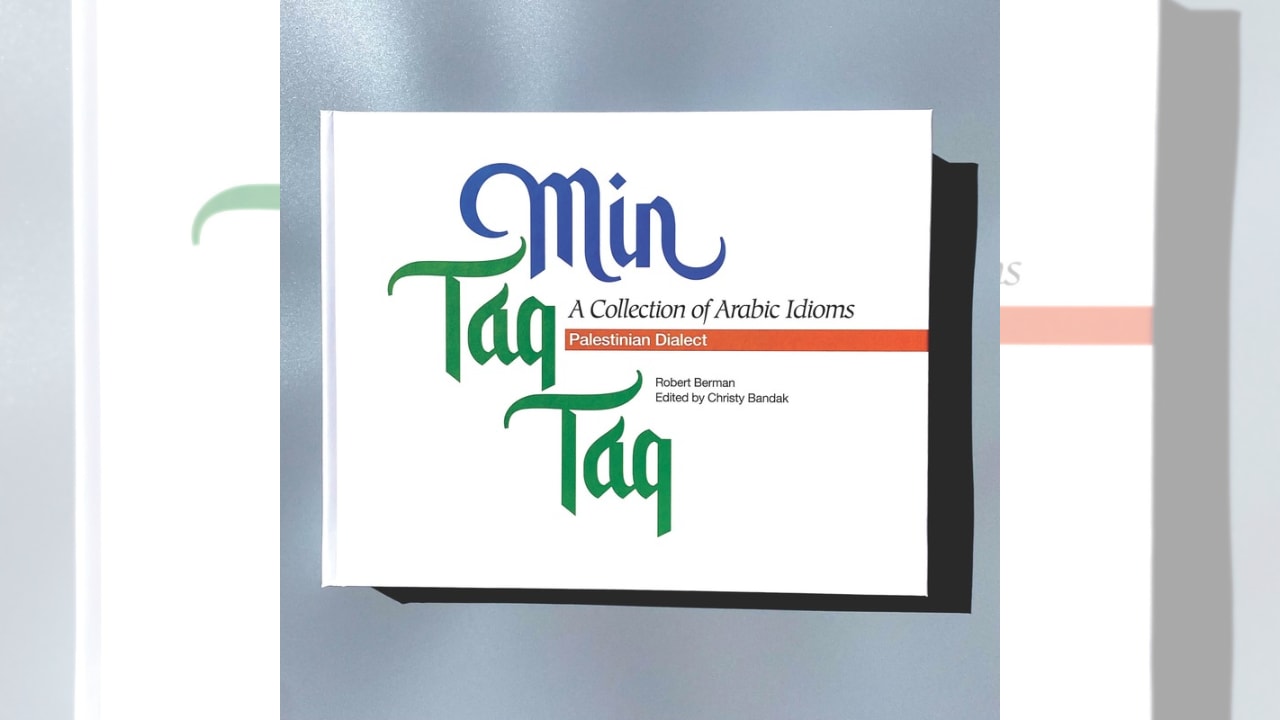
Knock knock. Who’s there? This isn’t a joke. It’s a book.
Ever since Robby Berman dropped off his labor of love called Min Taq Taq, I’ve found it fascinating reading, from beginning to end, or as they say in Arabic, “Min taq taq la salamu wa alayqom” – from the knock knock on the door until you say goodbye.
Not my usual reading material, Min Taq Taq is a 272-page hardcover that includes a comprehensive collection of idioms and expressions in colloquial Arabic, with transliterations into English – literal translations and then the parallel saying in English.
For instance, in English we say: “He’s wet behind the ears,” while in local Arabic you would say, “He still hasn’t gotten out of the egg.”
Ever since Berman self-published Min Taq Taq – now celebrating its fourth printing – customers, he says, have come from China to Chile and from England to Ecuador. They include former Mossad head Efraim Halevy, Israeli brigadier-generals, politicians, professors, and ambassadors. Security organizations such as IDF Unit 8200 and the Shin Bet (Israel Security Agency) have purchased multiple copies.
An unlikely Arabic lexicographer
Berman, 60, is an unlikely Arabic lexicographer. He grew up in Woodmere, New York, a hub of Modern Orthodoxy, graduated from yeshiva high school, Yeshivat Hakotel, the Gruss Kollel, and Yeshiva University, and also holds graduate degrees from Baruch College (MBA) and Harvard University (MPA).
He is the founder and former director of the Halachic Organ Donor Society, a nonprofit organization that encourages Jewish organ donation. He’s also a journalist, an actor, and a stand-up comedian who has appeared on an Israeli version of The Tonight Show.
Berman is fascinated by idioms. When he moved to Israel in 1989, he tried to translate English idioms to Hebrew. He reportedly once told a government clerk: “At noheget oti bananot”: you are driving me bananas. His service in the IDF thankfully filled in the idiomatic gaps.
Why Arabic? The story goes that two decades ago, while café sitting in Jerusalem’s German Colony, Berman noticed an Israeli Ashkenazi man at the next table reading a book in Arabic.
“Wow! I’m so impressed! I really wish I could speak Arabic,” Berman said.
The Sabra put down his cappuccino and used the idiomatic Arabic expression “Do you want the truth or its cousin?”
Berman got the gist and picked “the truth.”
The Arabist launched into a scathing attack on Berman’s sincerity. If Berman really wanted to know Arabic, he would simply enroll in an Arabic course.
Had Berman known Arabic idioms at the time, he might have told him “to go to 60 disasters.” Instead, he indeed enrolled in an Arabic class and kept studying for two decades.
Along the way, he kept a list of Arabic idioms on an Excel sheet, so he wouldn’t make a bananot-like faux pas.
On his linguistic odyssey, Berman was long frustrated for not having a proper dictionary of local Arabic idioms. He bought every dictionary of Arabic aphorisms he could find, and paid Arabic teachers to go through these books and mark those used in the region. The result: Min Taq Taq.
Still, what Berman calls his “obsession” with Arabic cost him not only cash for classes, dictionaries, and the publication of Min Taq Taq (dedicated to his father, the late Arnold Jay Berman) but also close friends, who, in his words, “thought I was consorting with the enemy” as his empathy for Palestinians, with whom he was practicing Arabic, grew.
He has been vociferously unfriended, both in person and on social media.
As he says, “Some judge me as ‘holding the stick from the middle’ (acting in a balanced and wise way), while others wish me, as they say in Arabic, ‘the sleep of the cave people,’ or worse.”
You’re in for a roller-coaster ride
TO FOLLOW Robby Berman on Facebook, you’re in for a roller-coaster ride, including its highs, loops, neural chaos, and occasional motion sickness.
You can, for instance, see him these days visiting his mother, Hannah Berman, in her homey Woodmere kitchen, filming their debate about Israel.
Says Mrs. Berman, while eating breakfast: “Robby never met a Palestinian he didn’t like.”
Robby asks his mom who of the two of them has served in the IDF, and wonders how he achieved his do-gooder social justice values in this kitchen.
You wind up falling in love with his octogenarian mom and resenting his badgering.
But just when I am about to write him a malicious note for his behavior, I find a captivating video of Berman peddling his newest invention, a double-bladed challah knife, at the convention of 6,500 Chabad Hassidim in Crown Heights. The knife is called Nuu Nuu for the impatient diners waiting for their slice of Shabbat manna.
The post even features a Chabad rabbi lauding the invention, which allows him to instantly cut multiple slices of the rebbetzin’s challot for their eager guests.
If you follow Berman online, you’ll also be impressed by the recent erudite obituary he wrote for the late Israeli Torah scholar Uriel Simon in The New York Times.
And if you happen to hire Berman as a tour guide (full disclosure – as our multigenerational nationalistic family did on a pouring day in Tel Aviv), he’ll show you places you’ve never seen, although you live in Israel, and express a love for every meter of the country sans politics.
MIN TAQ TAQ, thankfully, has no political overtones. Berman says creating better understanding between Arabs and Jews is his ultimate goal.
While the book includes the easy and well-known idioms like “Sabahak sukkar,” (May you have a sweet morning), it goes way beyond being a phrase book, giving us a peek at how Arabic-speakers think about everyday objects and occurrences.
A few of my favorites from Min Taq Taq:
“Someone is talkative – he’s swallowed a radio.”
“He got married – he completed half his religion.”
“What’s the rush? Why is your onion burnt?”
And one we can use, as the winter winds have arrived: “Don’t worry, relax! Put a summer watermelon in your belly.”■
The writer is the Israel director of public relations at Hadassah, the Women’s Zionist Organization of America. Her latest book is A Daughter of Many Mothers, cowritten with Holocaust survivor and premier English-language witness Rena Quint, soon to be published in Hebrew.