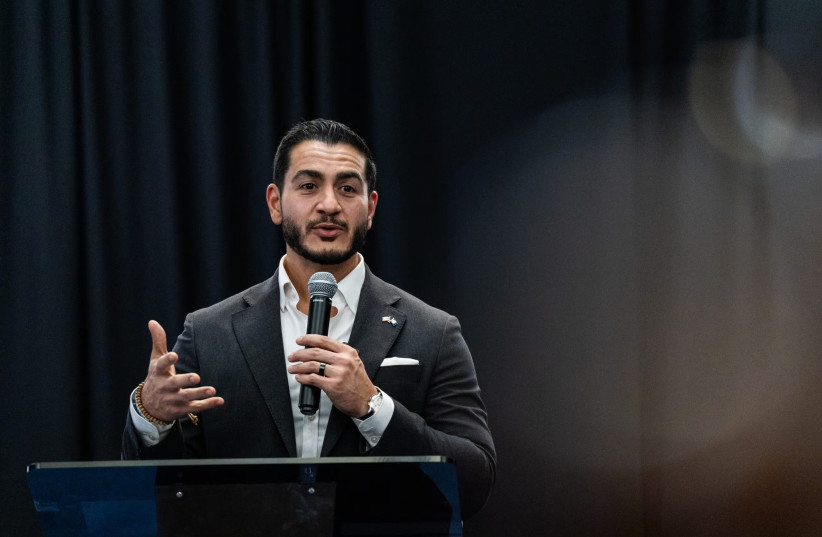
When Michigan Democratic Rep. Haley Stevens endorsed Republican Senate candidate Mike Rogers on Sunday, two days before the midterm elections, she exposed a rupture that will outlast this campaign. Stevens, who lost her party’s primary to Abdul El-Sayed, cited concerns about antisemitism and his association with streamer Hasan Piker. She also insisted that she remained a Democrat.
Her decision brings into focus a question that reaches beyond Michigan: How will the increasingly bitter divide over Israel affect Jewish life in America? Neither Jewish safety nor the freedom to maintain an attachment to Israel should depend on party allegiance.
Michigan is not America in miniature, and one bitter Senate contest cannot explain an entire electorate. It does, however, bring several national tensions into view: divisions over Israel, the influence of political personalities who thrive on provocation, and the difficulty of confronting prejudice when doing so carries a political cost.
Stevens’s endorsement came amid an escalating dispute over Israel and antisemitism, including an outside group’s advertisement that supported El-Sayed linking US aid to Israel to American grocery prices. El-Sayed said he disagreed with the ad’s contents. In announcing her support for Rogers, Stevens specifically cited El-Sayed’s earlier campaign appearances with streamer Hasan Piker.
The wider change is measurable as well. Pew Research Center reported in April that 80% of Democrats and Democratic-leaning independents viewed Israel unfavorably, up from 53% in 2022. Among Republicans aged under 50, 57% held an unfavorable view. Israel faces a generational challenge as well as a partisan one.
Criticism of Israel cannot be automatically treated as antisemitism
Those figures measure attitudes toward Israel, not antisemitism. Criticism of Israeli policy, opposition to military assistance, and concern for Palestinian civilians cannot simply, automatically, and directly be treated as hostility toward Jews. Making that distinction is essential to confronting actual antisemitism credibly.
But the distinction has to work in both directions. A foreign-policy argument cannot excuse holding American Jews collectively responsible for Israel, threatening Jewish institutions, or demanding that Jews disavow their connection to the country before being accepted in public life and having their physical safety secured.
Democratic leaders should confront that boundary clearly, even when offenders are useful allies. A party committed to minority rights must make room for Jews whose identity includes Zionism. Disagreement with an Israeli government cannot become a reason to dismiss their concerns about safety or belonging.
Republican leaders face the same obligation within their own coalition. Support for Israel does not excuse antisemitic conspiracy theories or offer protection from scrutiny. Nor does concern for Jewish safety justify attacks on a Muslim candidate’s religion. A consistent defense of religious freedom protects the principle on which Jewish security also depends.
For Israel, the lesson is urgent. A durable relationship with the US requires sustained engagement across party lines. Jerusalem cannot afford to treat Democratic estrangement as inevitable or Republican support as permanent.
That means working with lawmakers who disagree with Israeli policy, maintaining relationships beyond election cycles, and seriously addressing questions by younger Americans about the war, Palestinian rights, and Israel’s future. Public diplomacy cannot succeed if every difficult question is dismissed as evidence of bad faith. Israeli decisions themselves also shape how the country is understood abroad.
Israel must listen to US Jews as independent community
Israel must also listen to American Jews as a community with its own needs and responsibilities. Their lives cannot be reduced to their usefulness in defending Jerusalem’s positions. They are entitled to disagree with Israel’s government without having their attachment to Israel questioned.
Above all, their security in the United States must remain a responsibility of American government and institutions, regardless of the state of the bilateral relationship.
What are the practicalities of that responsibility? Reliable protection for threatened schools and synagogues, effective investigation of threats, enforcement against violence and vandalism, and university leadership that protects Jewish students while preserving lawful expression. It requires officials to respond consistently, including when the perpetrator comes from their own political camp.
Congressional arithmetic will command attention as the election unfolds, as Israel will understandably examine what the results mean for assistance, diplomacy, and the future of the alliance.
The more fundamental test will continue after the results are declared: whether Jews can worship, study, work, and participate openly in American life without fear. No party’s victory can substitute for that obligation, and no disagreement over Israel can diminish it.