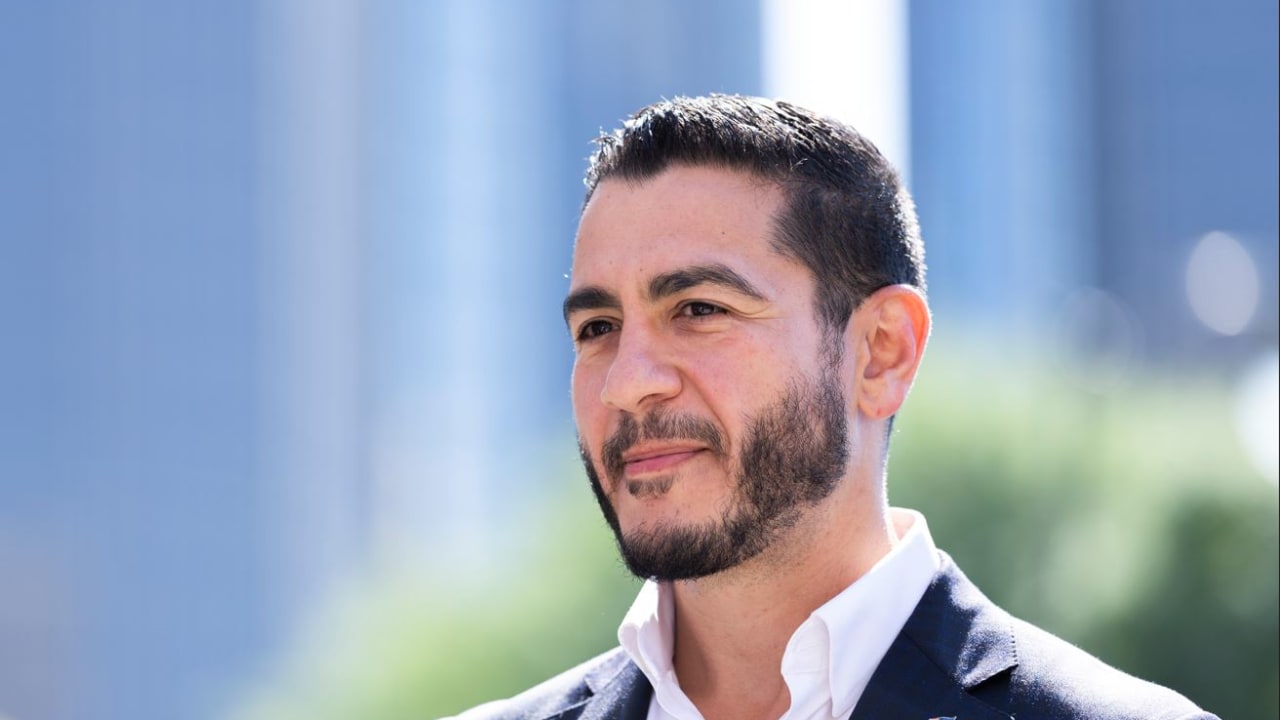
Israelis have enough on their plate without tracking a Democratic Senate primary in Michigan. This one deserves our attention anyway, because it’s about a growing American political movement that has stopped criticizing Israeli policies and started working to end Israel’s existence as a Jewish state, and to delegitimize the alliance that helps it survive.
That alliance was never a favor one country did for the other. It built intelligence cooperation, military coordination, and technological innovation that both nations depend on, and for decades, it commanded support across party lines. What is rising inside the Democratic Party’s socialist wing threatens not one Israeli government, but that entire bipartisan consensus.
Like Zohran Mamdani’s win in New York, Abdul El-Sayed’s victory in Michigan matters less because he won a primary and more because of what the win proves: ideas that were fringe a decade ago now win statewide Democratic primaries.
After winning, El-Sayed told Jewish voters that “my commitment to Jewish safety is the same commitment that I have to the safety of my own daughters.”
It’s an appealing line. It’s also a claim, and politicians get judged by their record, not their applause lines. El-Sayed’s record contradicts it directly.
He calls Israel, home to roughly half the world’s Jews, genocidal and apartheid. He calls its government “evil,” the same word he uses for Hamas, an organization whose founding charter calls for killing every Jew and which carried out the largest single-day massacre of Jews since the Holocaust.
That’s not mere criticism. It’s a deliberate equivalence, and once it’s accepted, every other position follows on its own: if Israel is Hamas, why sell it weapons, why help fund Iron Dome, why support it fighting back at all?
El-Sayed's profile: A US leader who justifies terrorism
That’s exactly where El-Sayed lands. He opposes offensive weapons for Israel and defensive ones alike, meaning Iron Dome interceptors protecting Israeli kindergartens are, in his framework, as objectionable as strikes on Hamas tunnels.
The inaptly named Jewish Voice for Peace Action, which opposes a Jewish state under any borders, gave him its first-ever Senate endorsement this year.
And after a Hezbollah-linked attacker rammed a car into a Detroit-area synagogue in March, during preschool hours, El-Sayed didn’t just respond weakly. He explained it.
The attacker, he said, had lost a brother (a Hezbollah commander) in an Israeli strike, and “hurt people.” He has stood by that since. He didn’t fail to condemn an antisemitic attack on Jewish children. He supplied its justification.
That’s not a man objecting to policy. That’s a man building the case that the Jewish state has no right to defend itself, wrapped in the language of empathy.
He’s also not an outlier, and that’s what makes this a machine, not a moment. JVP Action had never endorsed a Senate candidate before El-Sayed. In Michigan’s 7th District, William Lawrence rallied with Bernie Sanders and Alexandria Ocasio-Cortez in Lansing, demanding an end to arms sales to Israel.
In New York, Mamdani won the mayoralty without softening his hostility to Israel while courting Jewish voters. This is a coordinated bloc with money, infrastructure, and now electoral proof of concept.
El-Sayed’s public appearances complete the picture. He has shared friendly platforms with Hasan Piker, a streamer whose commentary on Israel, Judaism, and Hamas routinely crosses into open antisemitism.
Standing beside that rhetoric tells the roughly 90% of the world’s Jews who live in Israel and/or support its existence as a Jewish state exactly what his “Jewish safety” promise excludes: them.
That exclusion is the tell.
The question isn’t whether El-Sayed feels warmly toward Jews. It’s whether he understands what Jewish safety has really required.
For 2,000 years, Jews were told they belonged – right up until they weren’t. Spanish Jewry flourished for centuries before expulsion and the stake. Russian Jews held legal status before the pogroms came. Iraqi Jews considered Baghdad home until the Farhud. German Jews were among Europe’s most decorated, assimilated citizens, and none of it mattered after 1932.
Tolerance granted by some can be revoked by others. That’s not cynicism. It’s the historical record, and it’s one of the main reasons why Zionism exists: not romantic nationalism, but the conclusion a people reached after exhausting every other option.
That conclusion kept being proven right. When Yemen expelled its Jews, one country took them. When Iraq stripped over 120,000 Jews of citizenship, one country absorbed them. When Ethiopian Jews sat in refugee camps under threat, one country took great risks to fly them home twice, in Operations Moses and Solomon.
The only remedy to antisemitism is a Jewish state
Statelessness was the disease that endangered Jewish bodies. Jewish sovereignty was the only cure that ever worked.
A politician campaigning to strip Israel of the means to defend itself isn’t offering a different theory of Jewish safety. He’s attacking the only one history ever vindicated.
Notice, too, how El-Sayed argues. Telling Rep. Haley Stevens her AIPAC support was “the pro quo that comes with the quid” revives the oldest slander in the antisemitic playbook: that Jewish money, not conviction or shared strategic interest, buys American policy.
He didn’t invent that idea. He just gave it a campaign-finance vocabulary so it wouldn’t sound like it came from David Duke.
The genocide charge works the same way. Israel fights a war it didn’t start, against an enemy that names Jewish extermination as its purpose, and it alone gets branded with the word meant for the worst crime imaginable.
Syria’s Alawite regime killed hundreds of thousands of non-Alawites.
Sudan is in the middle of an actual genocide against the Masalit. Neither produces a JVP endorsement, a campus encampment, or a Senate campaign. Only Israel does. That’s not consistency. It’s a fixation, and fixations on the Jewish state have a name that predates this election by centuries.
None of this puts Israel beyond criticism. Israelis criticize their own governments harder than any outside commentator manages, because their children serve, and their families live under the consequences. But there’s a hard line between criticizing a democracy and campaigning to disarm it in the face of people sworn to destroy it. El-Sayed crossed that line and called it love.
So, take his sentence at face value. Suppose he means every word. If defunding the Iron Dome, branding Israel uniquely evil, and explaining away an attack on a Jewish preschool is what “the same commitment I have to my daughters” looks like, then his daughters should be worried, and so should ours.
Jews spent 2,000 years learning what El-Sayed hasn’t: that sympathy is not security, a kind word is not an army, and a state that cannot defend itself isn’t a state; it’s a waiting room for the next pogrom or expulsion.
The bill always came due after the reassurances, never before them, and no one who has genuinely and empathetically reckoned with that history offers to disarm the one place built to make sure it never comes due again.
El-Sayed isn’t confused about Jewish safety. He’s too smart for that. He has simply redefined it to mean whatever’s left of the Jewish people once they’ve surrendered the ability to defend themselves, an idea as old as Jewish powerlessness itself, now delivered in the voice of a father who has never had to bury a child for being Jewish.
And Michigan Democrats just made him their nominee.
Call his commitment what it actually is: a commitment to Jewish defenselessness, and a vote for the next attack or expulsion to arrive on schedule.
The writer is an attorney, a former IDF soldier, and a former NYPD officer. He writes widely on Israel, Zionism, antisemitism, and Jewish history. He serves on the board of Herut North America.