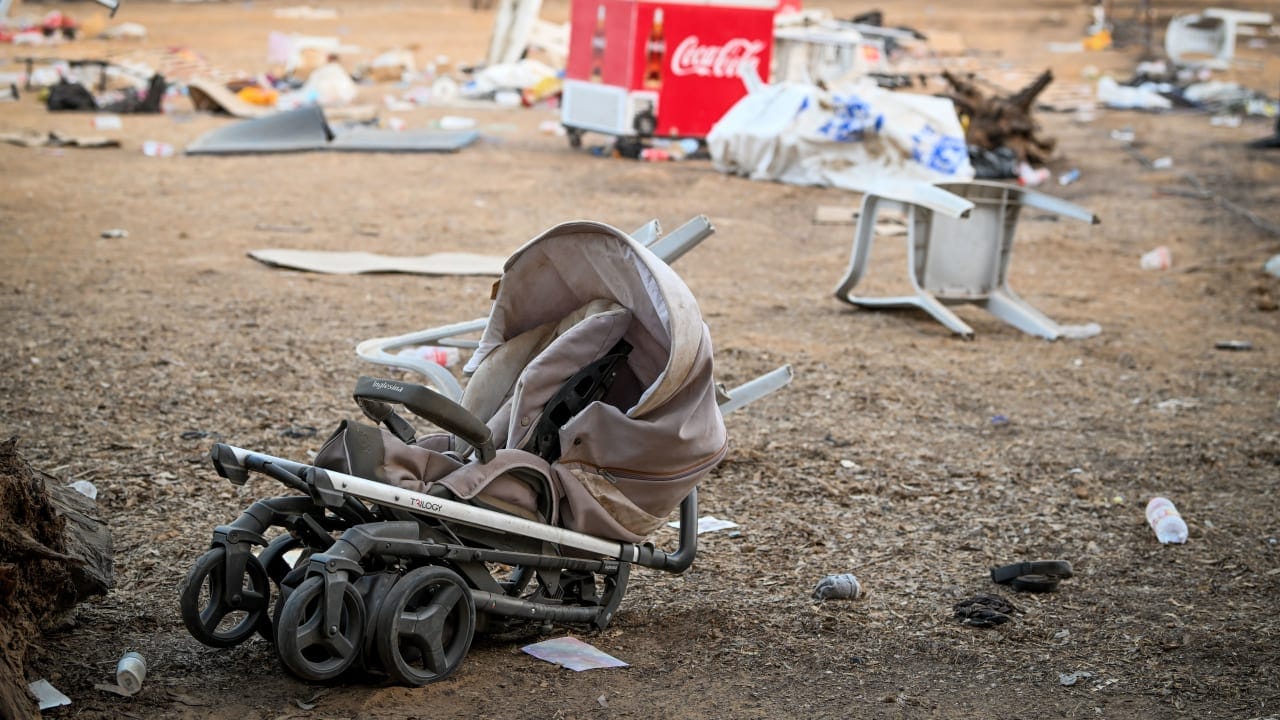
There are two main ways to understand the October 7, 2023, attacks.
One is that there is no hope of mollifying the Palestinians. It was appalling to see the sheer joy of the Hamas terrorists as they butchered families while filming their acts and calling their parents to brag, and dragging innocents into the Gaza Strip, where crowds cheered wildly.
But the real shock was the support for this in the West Bank and Gaza. Polls have shown that two-thirds to three-quarters of Palestinians approved of Hamas’s October 7 terrorist attacks, which suggest that coexistence is impossible. Many Israelis lost all sympathy for Palestinians and concluded that a cleansing inferno is required; the brutal war has certainly reflected that.
The second way to see October 7 is that the Palestinian issue cannot be ignored; that the situation of the Palestinians was so unacceptable that something terrible was bound to happen. Many Israelis have trouble accepting this, because it does not really represent Hamas, which would fight Israel no matter what. But it might explain why so many Palestinians – even those not in denial about the facts – were prepared to support it.
It also offers at least one reason why the propaganda war waged by Hamas and its supporters has been so successful. There are others – antisemitism, hatred of the West by the far Left, the cluelessness of the global progressive movement, Arab oil money, and Russia and Chinese efforts to use this as a wedge issue to destabilize democracies. But the fundamentally unacceptable situation of the Palestinians is one of them as well.

Accusations of genocide made against Israel
The combination of these factors yielded stunning results. By October 9, before Israel had even identified all its dead or invaded Gaza, accusations of “genocide” were already circulating online, then among activists, NGOs, academics, and eventually governments. By October 13, protests denouncing “genocide” took place in London. On October 17, the Qatar-based Arab Center for Research and Policy Studies held a symposium called “The War on Gaza: Palestinian Defiance and Resistance against Orchestrated Genocide and Expulsion.”
Within weeks, South Africa accused Israel of genocide at the International Court of Justice at the Hague – the “crime of crimes” widely attached to only the Holocaust, the Armenian genocide, and Rwanda, defined by the UN as an attempt to wipe out a people.
When Israel’s military did roll into Gaza, it faced an enemy that explicitly engineered the maximization of civilian casualties on its side, because this could be used to isolate Israel globally as a perpetrator of genocide. That could also be used to try to detach US Jews from Israel, and if that happened, perhaps American support would cease as well.
Thus, the IDF encountered weapons caches, command centers, and rocket launchers embedded in houses and crowded neighborhoods, and within or beneath hospitals, schools, mosques, and UN sites. As Hamas fighters disappeared into tunnels beneath homes, every dead child, every collapsed building, every grieving parent became part of a rolling indictment presented in real time to the global masses on social media.
The plan had a second element, and it is one I have dealt with constantly on international television, especially on networks like Al Jazeera: October 7 was perhaps terrible, but it was a response by Hamas to the suffering of Palestinians.
It’s true that the Palestinians are oppressed, but Hamas is not defending them. I am mystified by interviewers who seem not to understand that this Iran-backed jihadist terrorist group is in large part the reason for it. Like the Israeli Right, it wants to prevent the partition of the Holy Land; it is not seeking a Palestinian state but instead the destruction of Israel along with other neighboring countries, and the creation of a far larger caliphate.
But understanding the truth about Hamas does not make the pre-October 7 situation OK. In the West Bank, three million Palestinians live alongside half a million Jewish settlers, without equal rights, and for the most part, still under military occupation (the Palestinian Authority is effectively municipal). In recent years, they have also faced not just land encroachments but outright terrorism from extremist Jewish settlers while Israel’s military and government look the other way.
In Gaza, over two million Palestinians face a devastating blockade by Israel and Egypt – because Hamas rules the Strip. The blockade has failed to compel the population to rise up, because Hamas is ruthless. The blockade has made life a misery and brought comparisons to an open-air prison, while failing to prevent Hamas from arming itself (which, over two years of war, frustratingly, has also failed to undo).
Hamas, which launched terrorist attacks immediately after the 1993 Oslo Accords were signed between Israel and the Palestine Liberation Organization, had for decades hoped to destroy the peace process by driving Israeli voters to the Right, and it succeeded. October 7 was the next stage of the plan, and with its open-ended war, Israel walked right into the trap.
On Al Jazeera recently, I was placed opposite the young Gazan Ahmed Abu Askar, who was introduced as a humanitarian activist and engineering student. He said he had gone three days without eating, and looked like it. He hoped an aid flotilla might get through and then smuggle his ailing father out.
I tried to put things in perspective, explaining about Hamas and the need to be rid of it. Ahmed answered emotionally: “Israel, not Hamas, they are the ones who killed my sister, killed her children, and her entire family on November 6, 2023. Not all Palestinian people are Hamas. The goods, why isn’t it entering? ‘It’s because of Hamas.’ We are not Hamas. We are human, in the end.”
I replied: “All my sympathies go to Ahmed. Yes, Israel killed members of his family, and that’s horrible. But I suspect he knows that the war was started by Hamas. And it was started by Hamas in a way that was so epically brutal that Israel concluded it had no choice but to try to uproot Hamas. People in Gaza cannot speak freely. Our audience is not naive. They know that if Ahmed were to criticize Hamas, they would kill him.”
Then the host snapped: “But also, Dan, our audience isn’t so naive to think that this started on October 7.” He then asked Ahmed for a wish list. “Open the border,” he said, “so we can go out and we can come in.” Then he added: “This is not about Hamas. Believe me, if Israel did something to us, I won’t kill Israeli babies. I won’t let them starve.”
He’s wrong – everything I said was true – but he won the argument anyway, because he was a decent person suffering. No history lesson trumps that.
The insane situation has traumatized Palestinians and Israelis in parallel ways. The Palestinians – who are rooted in a conservative society disinclined to compromise – have been made, in large numbers, crazy enough to support a nihilistic movement like Hamas, which is truly genocidal against Jews.
As for Israelis, the situation has made huge numbers of them stop wanting to think seriously about Palestinians except through the lens of security and punishment. Some openly fantasize about expulsion. Empathy is viewed as naive. October 7 made Israelis a little crazy too – exactly as per Hamas’s plan.
But if Israelis conclude that Palestinians only understand force – which, by the way, Hamas clearly doesn’t – we’re guaranteeing a death spiral. Such a problem left to fester, without any attempt to change the equation, will blow up again and again. So after the election, if Prime Minister Benjamin Netanyahu is mercifully gone, this will need to be addressed in new and creative ways.
The writer is the former Cairo-based Middle East editor and London-based Europe/Africa editor of the Associated Press, the former chairman of the Foreign Press Association in Jerusalem, and the author of two books.