
There is no easy way to call off Lag Ba’omer at Mount Meron.
For hundreds of thousands of Israelis, this is not just a gathering. It is a yearly ritual that families plan for weeks in advance, and communities travel together. So when the state says it cannot happen this year, the disappointment is real.
That disappointment is understandable. But leadership has to look past it.
Prime Minister Benjamin Netanyahu, on the recommendation of the IDF Home Front Command, has limited Lag Ba’omer at Mount Meron to symbolic participation, with no more than 1,500 people permitted to gather in the surrounding communities of Kfar Hoshen, Or HaGanuz, Bar Yochai, and Meron. Against the tens of thousands who would normally make the pilgrimage, that is effectively a closure.
Cabinet Secretary Yossi Fuchs spelled out the reasoning in plain terms: a real risk of mass casualties, a fragile ceasefire on the Lebanon front, the site’s exposed location near the border, continued rocket fire into the area, and the impossibility of evacuating tens of thousands of people quickly under attack. That is not a list a serious government can ignore.
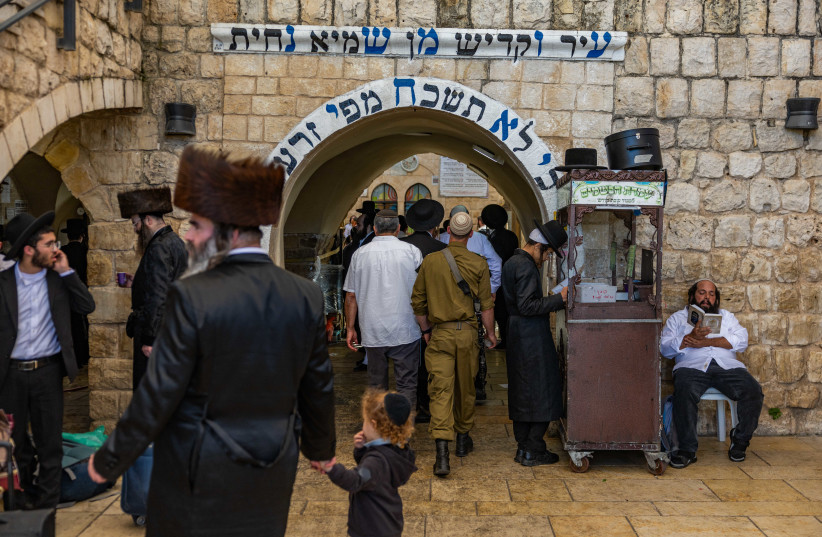
This decision is not a rejection of tradition. It is an acknowledgment of the security environment in which Israel is still operating. Hezbollah continues to test the ceasefire, drone and rocket fire into the North has not fully stopped, and Hamas remains a live threat in the South. Concentrating tens of thousands of worshipers at an exposed mountain site within striking distance of Lebanon under those conditions is not a risk the state can absorb.
It is also the lesson of the past five years.
The 2021 Mount Meron tragedy
In April 2021, at least 45 people were killed, and some 150 were injured when a stampede broke out at the Mount Meron Lag Ba’omer bonfire-lighting ceremony, the deadliest civilian disaster in Israel’s history. The crowd had funneled into a narrow, steep stairway slick with spilled drinks; when some fell, those behind them kept moving, and the pressure was fatal.
The Mount Meron Disaster Commission’s final report, submitted in 2024, assigned personal responsibility to Netanyahu, Israel Police commanders, and local officials, citing negligence, lack of preparation, a lack of governance, and failure to enforce construction law. Even in calmer years, the site has tested every limit of crowd management.
To layer today’s security environment on top of those failures would not be resilience. It would be denial.
There is a temptation, after months of war, to define resilience as refusal: to insist that life continue exactly as it did before. But resilience is not rigidity. In Jewish tradition, the principle has a name: pikuach nefesh, the obligation to preserve human life above almost all else. Life sits at the top of that hierarchy. That is the calculation here.
This decision shouldn’t be read as isolated. It belongs to a wider pattern of adjustment Israelis have absorbed over the past months. Reservists have left their jobs and families for extended service. Communities in the North remain displaced. Businesses operate under constant contingency.
But there is a line that has to be watched. A country cannot indefinitely shrink its public life without consequence. The danger is not in any single cancellation but in the accumulation of them, in the quiet normalization of a reality where rituals and shared spaces are continually deferred.
That cannot be the future. Decisions like this must remain temporary, targeted, and rooted in necessity, not habit. The objective is not to redefine normal life downward but to protect the conditions that allow it to return.
The holiday itself does not depend on the mountain. Bonfires can be lit at home and in communities. Synagogues will hold their own commemorations. The tomb of Shimon Hatzadik in Jerusalem and other sites associated with Rabbi Shimon bar Yochai will draw worshipers. The pilgrimage to Meron is a central tradition of the day; it is not the entirety of it.
Security is not only about preventing harm. It is about preserving the possibility of life as it is meant to be lived.
The fires of Lag Ba’omer will burn again on the slopes of Meron. The songs will return. The crowds will gather. What matters is that when they do, they come back to a country that chose, at the right moment, to be careful.
This time, Israel chose responsibility.