Quo vadimus is a Latin phrase meaning “Where are we going?”
It was also the title of the finale of Aaron Sorkin’s Sports Night, a TV series my son Ari rewatched faithfully every year.
Ari fell in Gaza on December 10, 2023.
Today, as I look at the state of our nation on Independence Day, a day after gathering with Ari’s brothers in arms on Mount Herzl for Remembrance Day, I find myself asking that same question with a heavy and increasing urgency.
Our family made aliyah in July 2005, just one month before Israel withdrew from Gaza. In the two decades since, Hamas transformed Gaza into a fortress of terror, expanded its rocket arsenal to threaten major Israeli cities, and constructed a vast subterranean network of command centers and attack tunnels.
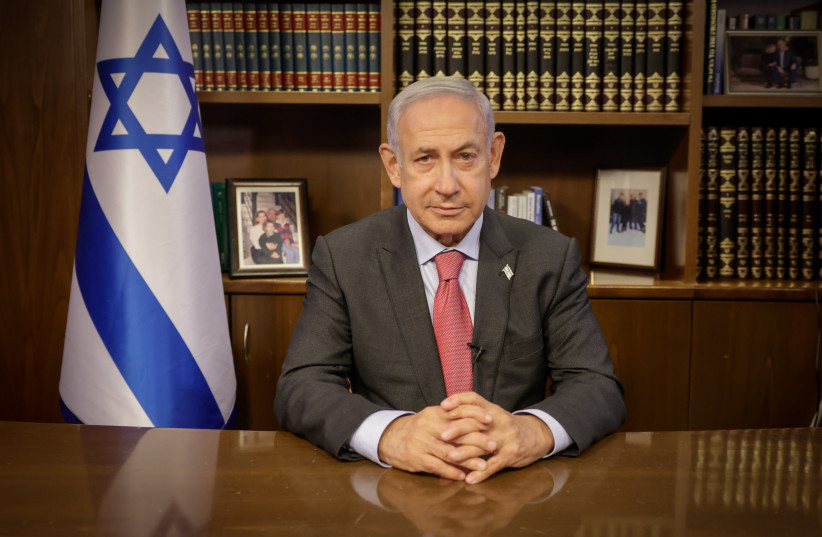
For almost 15 of those years, nearly three-quarters of the post-disengagement era, Benjamin Netanyahu has served as prime minister.
Under his watch, nearly 20,000 rockets have been launched at our citizens, and he has led the nation through four of the six major military operations in Gaza, including the current Israel-Hamas war.
My generation grew up with the words of former US president Harry Truman: “The buck stops here.”
Truman wasn’t seeking blame, but rather acknowledging the weight of responsibility that comes with leadership. Yet, inexplicably, Netanyahu has refused to accept responsibility for the October 7 disaster, the deadliest day for the Jewish people since the Holocaust, despite it occurring on his watch.
Similarly, we were raised on former US president John F. Kennedy’s challenge: “Ask not what your country can do for you – ask what you can do for your country.”
While political “pork” is a staple of global democracy, nothing prepared me for the version practiced in today’s Knesset.
Netanyahu's grip on power
To maintain his grip on power, Netanyahu has abandoned his self-professed fiscal conservatism for a form of hyper-socialism. He diverts value created by the working class and redistributes it to a sector ideologically committed to remaining outside the workforce.
This shift mirrors George Orwell’s warning in Animal Farm, where revolutionary ideals of equality are perverted until only one law remains: “All animals are equal, but some animals are more equal than others.”
In Israel today, we see a two-tiered system. On one side are the “equal” animals: the tax-paying, draft-eligible public who sustain the state’s economy and security.
On the other hand are the “more equal” animals: the haredi (ultra-Orthodox) sector, which, through political leverage, has secured exemptions from military service and massive subsidies for institutions that refuse to teach core subjects like math, English, and science.
This policy prioritizes a guaranteed outcome for a specific group over equality before the law for all. Netanyahu’s coalition treats the IDF draft and the national budget as spoils to be divided, subordinating national responsibility to the political needs of the most insular and fastest-growing sector of society.
The contrast in sacrifice is stark. When my wife and I met President Herzog after Ari fell, he shared his relief and pride that his son had just returned from deployment in Gaza.
History remembers the son of former president Yitzhak Ben-Zvi, who fell in the War of Independence, and more recently, the son and nephew of Gadi Eisenkot, who fell in this current conflict.
While some leaders’ families pay the ultimate price, others oversee a system that enables their own families and constituents to evade sacrifice.
History offers a compelling parallel in the American experience: when former US president Franklin D. Roosevelt died in 1945, the nation was shocked because an entire generation had never known another president.
This led to the 22nd Amendment, limiting US presidents to two terms. There is wisdom in this constraint.
Term limits provide a new vantage point – a cognitive reset that enables leaders to see the “as-is” reality of a situation rather than the “intended” outcome they have spent years defending.
New leadership brings a fresh perspective necessary to disrupt the biases that cause them to overlook their own errors.
We cannot keep electing the same people and expect different results.
In 2016, Netanyahu told CNN he wanted to be remembered as the “protector of Israel.” More recently, he told Douglas Murray that legacy is beyond one’s control unless “you write it yourself.”
But legacy is written in results, not rhetoric.
Today, the mission of these existential wars remains unfinished. We did not choose these conflicts.
Instead, they were thrust upon us by Hamas’s October 7 atrocities and Hezbollah’s unprovoked aggression in the north, where their massive, albeit diminished, missile arsenal poses a constant, lethal shadow over our citizens.
Furthermore, we cannot ignore the shadow of an Iran that stands at the nuclear threshold while holding a ballistic arsenal like a proverbial sword over our heads. These are not wars of choice, but of survival, and the threats remain formidable.
Internationally, we face a perilous erosion of our standing. Even in the United States, our most vital ally, a majority of adults under 50 now hold unfavorable views of Israel and its leadership.
If we continue down this path, where do we end up? The buck must stop somewhere. It is time for a new perspective, a commitment to shared burden, and a leadership that prioritizes the nation’s future over its own political survival.
Quo vadimus?
The writer is an intellectual property professional specializing in cybersecurity. He has lived in Ma’aleh Adumim since making aliyah in 2005.