I hate to admit it, but I’ve always been biased.
When it comes to watching surf competitions, the women’s heats have always taken a back seat to the men’s. Don’t get me wrong, it’s mostly an internal struggle that I’m working through. I encourage my children to watch both heats equally; it’s the only way to break the cycle.
But all that changed when Anat Lelior stepped onto the scene, and what started as a story about watching habits became something else entirely.
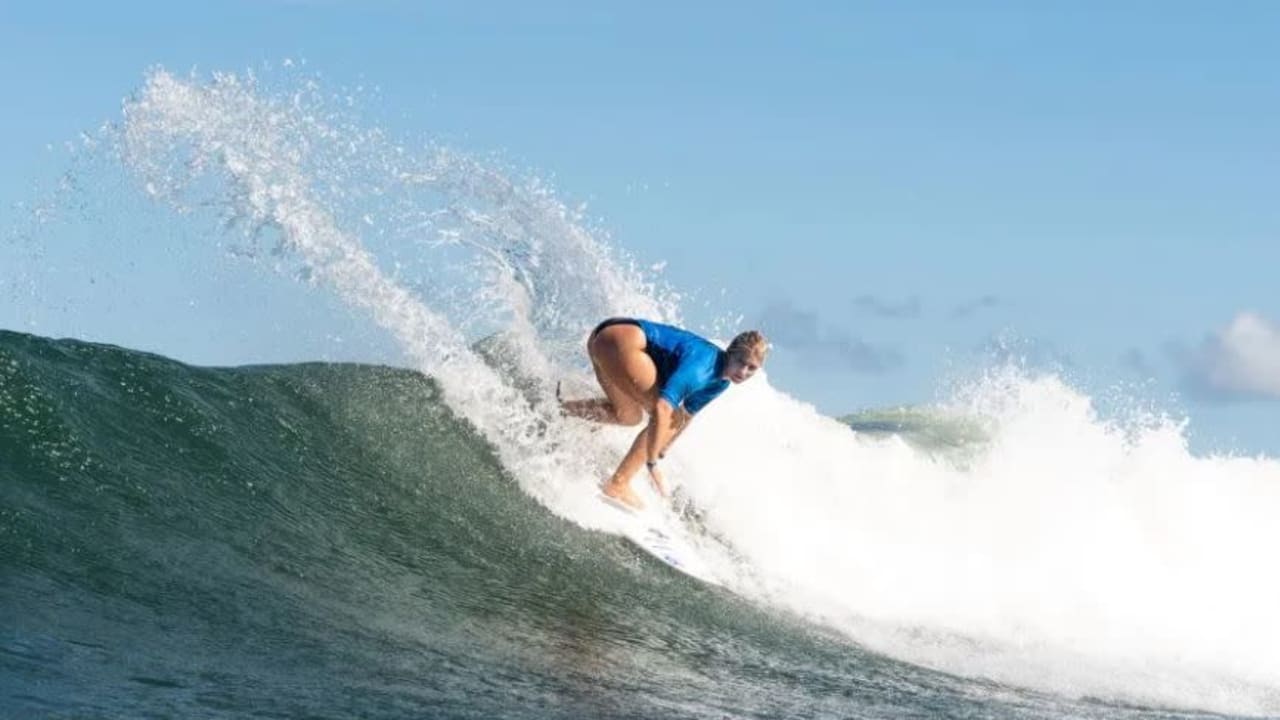
Anat did what no other Israeli had done before: she shattered surfing’s glass ceiling, qualifying for the Championship Tour – the sport’s highest level of professional competition.
Watching her debut at Bells Beach, Australia, felt like seeing The Matrix for the first time. She came out guns blazing – not only making it through the first round, but doing so with an excellent score which ended up being the wave of the day.
“Could she win her first Championship Tour contest?” I thought. “Is she ‘the one?’”

Those dreams were quickly dashed like Neo missing the jump between two skyscrapers. As her second-round heat progressed, she seemed to come unglued before our eyes. Just like the character Mouse, who watched Neo plummet, I found myself asking, “Wait, what does this mean?”
When Lelior first arrived in Australia, it felt like a clean slate. The Israel-Hamas War was no longer front-page news, and it seemed like this would no longer plague her campaign. But it appears there was more happening onshore than made the live stream.
When surfing meets politics
Similar to past contests in the Qualifying Series and Challenger Series, the beginning and mid-tier levels, anti-Israel protesters made their appearance. During her second-round heat, people waved Palestinian flags, demanding Lelior remove hers.
“Just as Russian athletes compete under a neutral flag at the Australian Open, we call on Israeli athletes to compete as neutral athletes, without their flag and the name of their country,” they protested. Descending the famed Bells steps through that crowd couldn’t have made it easier to keep a clear head.
However, the contest protesters’ calls will never be heeded. The World Surf League has already made its position well known on the issue. Last year, when the Junior championships were set to commence in Spain, the contest organizers made the same demand of Israeli participants. The WSL swiftly shut down the entire event, quoting its own bylaws that discrimination will not be tolerated.
Just over a year ago, it seemed like Lelior might have succumbed to such pressure. At the Morocco contest, which saw her qualify for the Challenger Series, the Israeli flag was noticeably missing from her jersey. It was replaced with the “World” flag.
However, she had made this decision for her own well-being. Traveling alone in a Muslim country during the height of the war, Lelior was concerned for her own safety.
While Lelior was in the water during the recent Australia contest, surf media was telling a different story. Scrolling between heats, I found an article that The Inertia ran about surf life in Gaza. Since the war, many need medical attention, general living conditions are dire, and according to the article, there are almost no surfboards in Gaza.
As a surfer and as an Israeli, this report hit me hard.
In the past two years, I haven’t spent enough time thinking of how the local population has been affected by the Israeli offensive. It’s most likely a defense mechanism to support my country. Hearing the Gazan people’s tribulations made me feel as if maybe Israel was at fault, and that maybe Lelior should hide her country’s emblem.
The Inertia article made me feel trapped between two worlds. There was a line that stood out at the end of the piece: a Gazan surfer was quoted, saying, “I always dreamed of representing Palestine in surfing all over the world, raising my country’s flag high in the sky, but Israeli soldiers deliberately shot me so I would be disabled and unable to achieve my dream.”
This story moved me, but so did another. On October 7, 15-year-old Carmel Bachar and his mother were murdered by Hamas in their safe room in Kibbutz Be’eri. Right before Carmel perished in his father’s arms, his dying wish was to be buried with his surfboard. His father, who lost a leg in the terror attack, fulfilled his son’s final wish.
Carmel is not alone. There are hundreds of surfers in the Jewish state who wanted nothing more in the last two years than to surf to their hearts’ content. None of them set out to stop anyone else’s dreams, but they’ve been called up for service time and time again to protect our country and its inhabitants from the aggressors who surround us.
Like all Israelis, Anat Lelior has had to overcome immense challenges since October 7. When it comes to displaying her national symbol, the defense of her home should be worn as a badge of honor, not hidden out of embarrassment.
Through her skill and determination, she has earned her place in the water and in the hearts of those, like myself, who looked down on women’s surfing. She shouldn’t have to hide either aspect of her identity.
The writer is a surfer, rabbi, wedding officiant, and mohel who performs britot (ritual circumcisions) and conversions in Israel and worldwide. Based in Efrat, he is the founder of Magen HaBrit, an organization protecting the practice of brit milah and the children who undergo it.