
What stood out at Sunday’s High Court hearing on the government’s failure to enforce military service obligations against ultra-Orthodox (haredi) draft dodgers was not only the legal standoff. It was the spectacle of the government trying to blur what should be unmistakably clear: The IDF has a manpower crisis, and it cannot afford more draft evasions.
The November 2025 ruling required the state to move toward meaningful enforcement, after the court’s June 2024 judgment made clear that, without a lawful exemption framework, the state had no authority to keep avoiding the enlistment of yeshiva students. Yet the justices were again confronting the same gap between legal obligation and political reality.
That was why Cabinet Secretary Yossi Fuchs’s attempt to invoke IDF Chief of Staff Lt.-Gen. Eyal Zamir was so striking. Fuchs told the court that Zamir had effectively backed the draft package now being advanced by the government. The military quickly issued a clarification: Zamir did not endorse any conscription law.
And if the government wants to cite Zamir, it should cite him accurately. In late March, he warned that he was raising “10 red flags before the IDF collapses into itself.” Days later, in a letter to lawmakers dated March 30 and reported on April 1, he warned that without action to address the personnel shortage, the army would suffer “severe harm,” including a shortage of thousands of combat and combat-support troops.
These are the words of the chief of staff, warning that the burden on the army, especially on reservists, has become unsustainable.
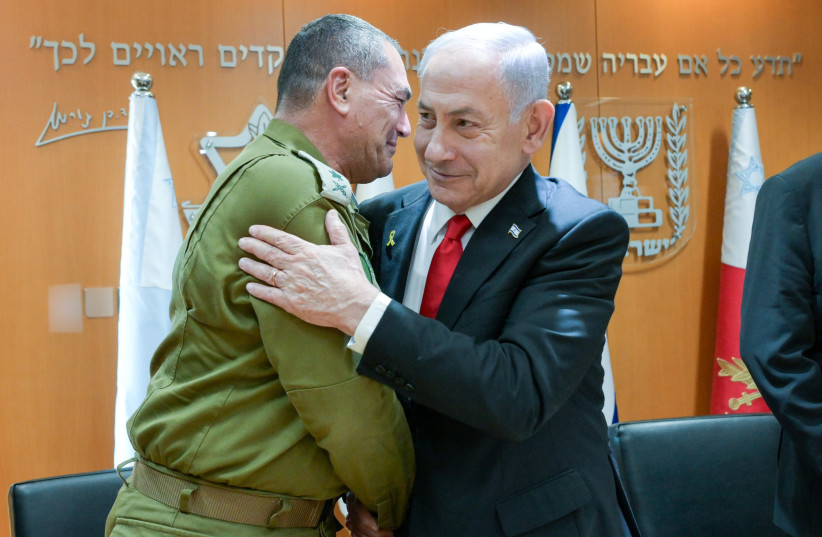
Zamir is Prime Minister Benjamin Netanyahu’s own choice for chief of staff. So when he speaks this clearly about the gravity of the manpower crisis, the proper response is to listen.
The High Court sounded exasperated. Deputy Supreme Court President Noam Sohlberg said the enlistment figures were “very difficult,” noted that the court had already ruled and had to be implemented, and remarked that the ongoing back-and-forth seemed mainly to be delaying matters. This was not a bench persuaded that the state is doing all it can. It was a bench confronting what looked like policy failure dressed up as procedural drift.
That is why this issue should not be flattened into the usual political binaries. This is not Right or Left, nor is it pro-Netanyahu or anti-Netanyahu. It is national security.
Draft debate takes sharper edge on Holocaust Remembrance Day
As Israel marked Holocaust Remembrance Day today, the draft debate took on an even sharper moral edge. A country built in the shadow of Jewish powerlessness cannot defend a reality in which some citizens are asked to carry the burden of its survival while others are shielded from it by politics. Memory alone does not protect a state. Shared responsibility does.
Israel is more than two years into a war that has strained the standing army, reservists, and their families to the limit. To be entertaining legislation that does not amount to real, broad enlistment is not serious. At this stage, it is an embarrassment.
Of course, the draft crisis did not begin this year or last year. It is the product of years of avoidance by successive governments, and of a broader Israeli failure to build integration rather than separation.
That neglect has harmed not only the wider public but the haredi community itself. A society cannot sustain inequality in education, employment, civic obligation, and military service forever and expect the strain not to break something essential.
An army cannot function like this. Not when soldiers are being called up again and again, and reservists are carrying a burden measured in exhaustion, careers interrupted, families stretched, and lives lost. That is why this debate reaches so deeply into Israeli society: because it is a matter of life and death, and because that burden is not being shared equally.
The government still has a choice. It can continue to approach the matter as a coalition-management problem, trimming language here, buying time there, and hoping the contradiction can be managed a little longer. Or it can finally treat the draft crisis as what it is: a test of seriousness, fairness, and national responsibility.
The court has spoken, the army has warned, and this country does not need more spin. It needs soldiers, and it needs leadership willing to act on the fact that matters.