The Passover Seder, which we celebrated at the start of the festival last week, is symbolized by the “Four Questions.” Traditionally sung by the youngest participant around the table, the questions start with “Ma nishtana?” asking, “Why is this night different to all other nights?”
This year, Pessah in Israel was clearly different from all other years. And that was obvious to everyone, from the youngest to the oldest. The ongoing war with Iran and the rockets from its terrorist proxies, Hezbollah in Lebanon and the Houthis in Yemen, overshadowed the holiday – but didn’t cancel it.
The question of where to go to celebrate hinged this year around how safe it was to get to the Seder and how safe the place it would be held was. Did getting there and back involve passing along roads lacking in adequate protection from missile attacks? Did the host have a safe room, a shelter in the building, or a nearby public shelter?
When friends met up later and asked each other, “How was your Seder?” the answer didn’t relate only to the food, atmosphere, and family dynamics but also contained a subtext: Was it disturbed by rocket attacks, and did you have to run for shelter in the middle of the meal or while recounting of the story of the Exodus from Egypt?
It is not normal – or shouldn’t be – that missile attacks are part of Israeli life for now. When we get a rocket alert on our phones, we shouldn’t have to nonchalantly ask ourselves: “Who is shooting at us this time?” Is this a rocket from Lebanon, which is so close that residents of northern communities usually receive the alert after the rocket has landed? Or is this from Yemen, launched by Houthis suffering from FOMO, whose rockets are usually fired singly, which means we generally need to stay in the shelter for just 10 minutes?

Suddenly, we are all interested in munitions and statistics. We should not be deliberating what is better, whether an (illegal) cluster-head missile, which affects a much greater area and is harder to shoot down, but has lower-density impact, or a half-ton warhead which causes greater devastation on impact?
The answer is, there is no good answer. When someone is trying to kill you, the caliber of the bullet in the barrel being pointed at you is not really the main issue. The same goes for the missiles being launched at Israel – every one of them a war crime.
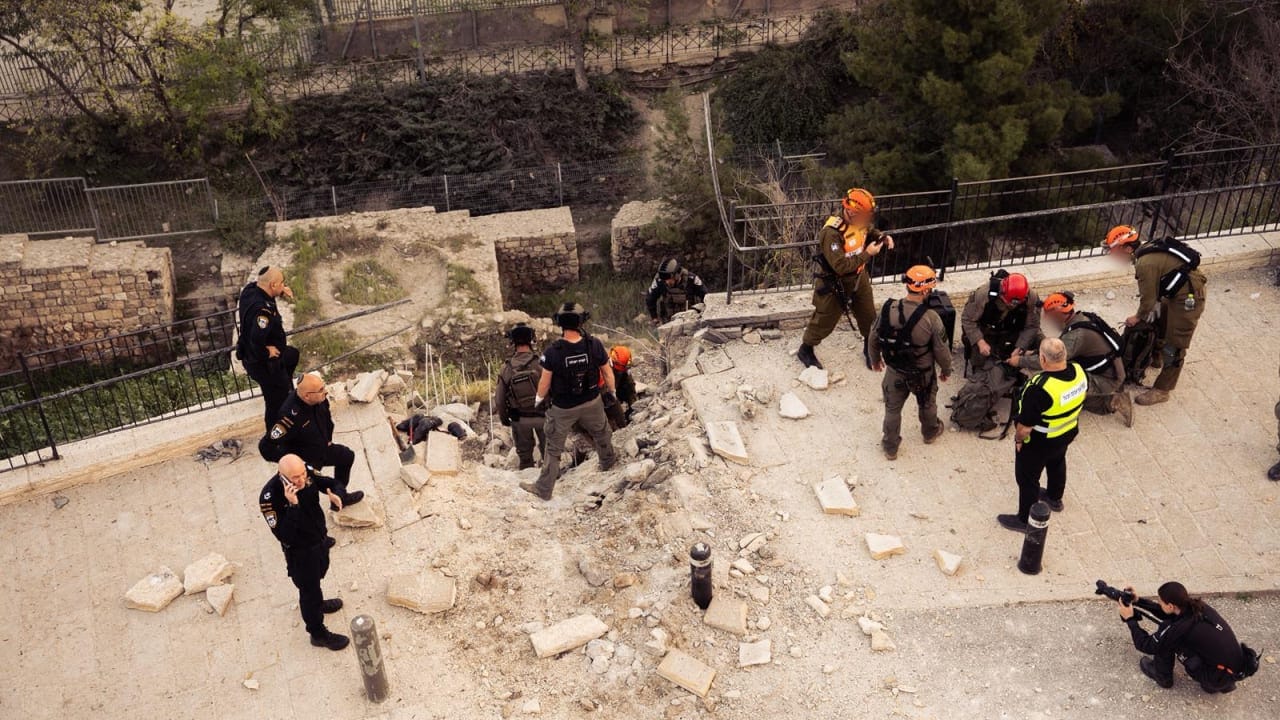
The Iranians do not know what they will hit, and they don’t care. For all their professed love of Jerusalem, rockets and shrapnel have hit the Holy City, including close to sites sacred to Jews, Muslims, and Christians. Iranian missiles and drones have killed people of different religions and different backgrounds – including four Palestinian women killed in a village near Hebron last month as they prepared for the Eid al-Fitr holiday at the end of Ramadan.
On Sunday, the IDF said that some 165 Hezbollah rockets launched at Israel are estimated to have fallen short and hit UNIFIL (United Nations Interim Force in Lebanon) positions or nearby – more indiscriminate firing.
Despite Israel’s outstanding defense systems, rockets have caused fatalities – including parents with their son and daughter-in-law buried under the rubble of their home in Haifa this week. Schools and hospitals have been damaged.
And stop for a minute to consider both how amazing and absurd it is that most Israeli hospitals have converted their underground parking lots into makeshift wards, including maternity units for babies born in wartime. What stories will they be told as they gather around the table for future Seders?
Somehow, life is going on within the constraints of the war. Our kids are living a “sheltered existence” in the most perverse sense of the word.
Holocaust Remembrance
Next week, Israel commemorates Holocaust Remembrance Day (Yom Hashoah). In that quintessential Israeli roller-coaster way, it is sandwiched on the Hebrew calendar between Passover and the back-to-back Remembrance Day and Independence Day (Yom Ha’atzmaut).
International Holocaust Remembrance Day, on the other hand, marked January 27, has been so hijacked in the name of universalism and by pro-Palestinian narratives that it has become close to irrelevant – or worse: a tool with which to bash Israel.
The Shoah is part of the Israeli psyche, but not the reason for its existence – that is found in the Passover story.
Three statements come to mind whenever I write about the Holocaust.
The first I can attribute to Elie Wiesel: “The Shoah wasn’t a crime against humanity, but a crime against the Jews.”
The second was told to me by writer Haim Gouri: “Israel was created not because of the Shoah but in spite of it.”
I don’t remember who told me the third, but it is no less valuable: Had there been a Jewish state in the 1930s, the Holocaust might not have happened at all or would have been on a much-reduced scale.
I get tired of emphasizing these three points, but don’t dare stop.
The more the Shoah is universalized, the more it is dumbed down – the greater the attempts to apply it to all, the less it recalls what it really was. The Holocaust, as Wiesel noted, was about the systematic attempt to eradicate the Jews, their religion, and their culture. Six million Jews were murdered simply for being Jews. We cannot change that, but we need to learn from it.
The Holocaust was not about the Palestinians – although the grand mufti of Jerusalem Haj Amin al-Husseini conspired with Hitler’s Final Solution, Palestinian Authority head Mahmoud Abbas’s doctoral thesis is an exercise in Holocaust denial, and the Islamic Republic of Iran has for more than a decade annually hosted an international cartoon contest, with bloody and savage images, dedicated simultaneously to mocking the Holocaust and taunting the Jews as the “new Nazis.”
As Gouri noted, the Jewish state would have grown faster and stronger had there been no Holocaust; the Holocaust would have been smaller and shorter had there been a Jewish state to offer sanctuary.
There is no point in going through the motions of commemorating the Holocaust while denying Israel the right to exist and the right to defend itself.
Antisemitism – including deadly attacks – is running rife. In places once considered almost immune – Australia and Canada – Jews have found themselves literally under fire and firebombs. We should not only remember the number of the murdered in each attack – in Manchester, Bondi Beach, Colorado, and Pittsburgh, among them – but internalize that the intent was to cause the maximum number of casualties, to sow terror.
There is not a “new antisemitism”: It is the same old vile hatred in different packaging.
Targeting and boycotting Israeli companies, even companies with tenuous connections in some cases, has become the new form of the “No Jews allowed” signs in shop windows. When Jewish students are afraid to reveal their identity on campus, bizarrely including the most “liberal” campuses, this is the new “Jewish quota.”
When Jews need more and more armed security outside synagogues, this doesn’t ensure “religious freedom,” and you can be sure that churches are also increasingly at risk. When Jewish cultural events are canceled, or Jews are prevented from participating in cultural or sporting events, this is a step back to 1930s Germany, and it doesn’t bode well for the world in 2026.
Terrorist infrastructure and weapons require money – big money. That is what the Iranian regime has been happy to supply Israel’s enemies. Social media platforms have been used to spread the anti-Israel message, lies, and blood libels. The delegitimization is deliberate – another weapon of war, preparing the ground and fuelling more attacks.
Demonizing Israel while allowing its attackers to get away with murder will not bring peace any closer. It does, however, raise questions that not only Jews should be asking and dealing with.