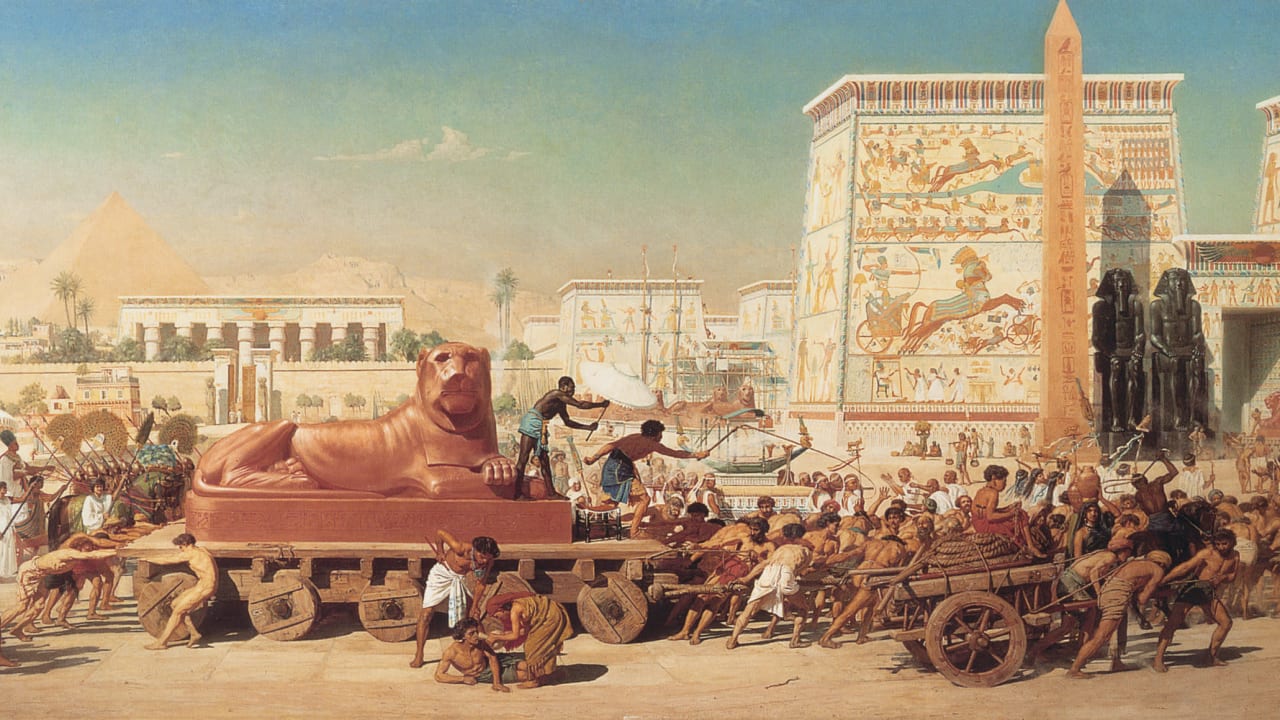
There is something counterintuitive, almost radical, about the founding myth of the Jewish people.
Most nations throughout history anchor their origin stories in glory – epic battles, heroic conquests, and displays of might. They tell of how they crushed their enemies and established their power.
But the Jewish people chose a different path. Our story is not one of strength but of vulnerability; not of total victory but of powerlessness. It is the story of a journey from the depths of degradation to the heights of liberty: the Exodus from Egypt.
More than history: a living experience
The most profound aspect of the Passover Seder is that we aren’t just reciting history. In fact, the Haggadah barely focuses on the historical facts at all – Moses, the central figure of the era, is famously absent from the text.
Instead, the story is oriented toward the future. We are commanded to experience it personally: “In every generation, one is obligated to see themselves as if they personally went out from Egypt.” The focus isn’t on our ancestors; it’s on us. Each year, we are invited to step out of the narrow confines of our own “Egypt” (Mitzrayim), the places of constraint in our lives, and move again toward freedom. Passover transforms memory into an existential experience, turning the past into a moral compass for the future.

The morality of memory
The choice to remember slavery is intentional. The Torah commands us no less than 36 times: “For you were strangers in the land of Egypt.” This is the heartbeat of Jewish ethics. Only those who remember what it feels like to be a slave can truly cherish the gift of freedom. They know it is never a given; it is a responsibility.
This memory permeates our lives – in our daily prayers, our Shabbat sanctification, and our rituals. We don’t daily recount the conquest of the land or even the revelation at Sinai; we recount the Exodus. Even at the Ten Commandments, God does not introduce Himself as the Creator of the Universe or an omnipotent ruler. He says: “I am the Lord your God, who brought you out of the land of Egypt, out of the house of slavery.”
The God of Israel is the God of Freedom – a presence that invites us to leave our narrow constraints and step into a life of purpose and meaning.
The art of the story
The Haggadah is perhaps the greatest educational manual ever written. It is a guide for parents and teachers on how to spark curiosity. “And when your child asks you tomorrow…” the Torah insists.
Even at the most dramatic moment – the sea ahead, the Egyptians behind – the Torah pauses the action to ask: How will we tell this story to the next generation?
We may never “prove” every historical detail of the Exodus, but for thousands of years, Jewish families across the globe have sat around one table to tell this story. David Ben-Gurion once expressed this beautifully. Speaking to members of a United Nations committee, he reminded them of the Mayflower, the ship that sailed to America some 300 years ago.
“How many Americans know the exact day on which the ship sailed?” he asked. No one answered.
“How many know what kind of bread the passengers ate?” Again, no one knew.
“How many know what they wore, or at what hour the ship departed?” Still silence.
Then Ben-Gurion said, “Our Mayflower is the story of the Exodus. Every Jew knows the exact day on which the Israelites left Egypt, what bread they ate, what they wore, and even how many people were there.”
Remarkably, the first Passover was celebrated while still in Egypt, before the actual liberation. A nation of slaves celebrated freedom. Why? Because to achieve true liberty, one must first be able to imagine it. To envision a free world is to take the first step toward creating it.
Today, in these complex and painful times for Israeli society, the Exodus story resonates with renewed power. It reminds us that freedom is not just a right – it is “hard work.” It is the ongoing mission of a society striving to be more just, more compassionate, and more attentive to one another.
A journey that never ends
As we sit at the Seder table this year, we will ask questions and pass the torch of memory to the next generation. But we must also look forward. Passover reminds us that freedom is not a one-time event; it is a continuous journey.
- A journey of a people.
- A journey of a society.
- A journey of every individual soul.
May we merit to sit with our loved ones, to tell our story, and above all, to dream together of the freedom we are still building here.
Wishing you a meaningful and happy Passover.
The writer is headmaster and managing director of the Leo Baeck Education Center.