
The picture painted by the speeches and mainstream media coverage of the recent Turning Point USA’s annual conference was concerning for the American Jewish community, Israelis, and pro-Israel Americans of all religions. It seemed that it had become popular among right-wing Americans to criticize Israel and try to undermine the strong US-Israel relationship.
Turning Point USA (TPUSA) made sure the correct sentiments of its members were understood by releasing the results of a poll it ran after the conference. The results were clear: its members soundly support the US-Israel relationship. According to the poll, only 13.3% said Israel is “not an ally” compared to nearly 87% of attendees who view Israel as an American ally. From those 87%, more than half (53.4%) described Israel as “one ally of many” and a third as a “top ally.”
TPUSA is considered a great representation of Republican American viewpoints, and these results represent a notable demonstration of traditional Republican Party support that has always framed Israel as America’s most crucial ally.
The US-Israel relationship has always been supported by shared strategic goals, friends, and enemies. The partnership between the two allied nations has found expression in joint military ventures, technology projects, and intelligence. Above all else, the relationship has been built on the foundation of shared values.
Americans have always appreciated Israel’s protection of all religions’ ability to worship freely in Israel, and Israelis have appreciated America’s separation of church and state.
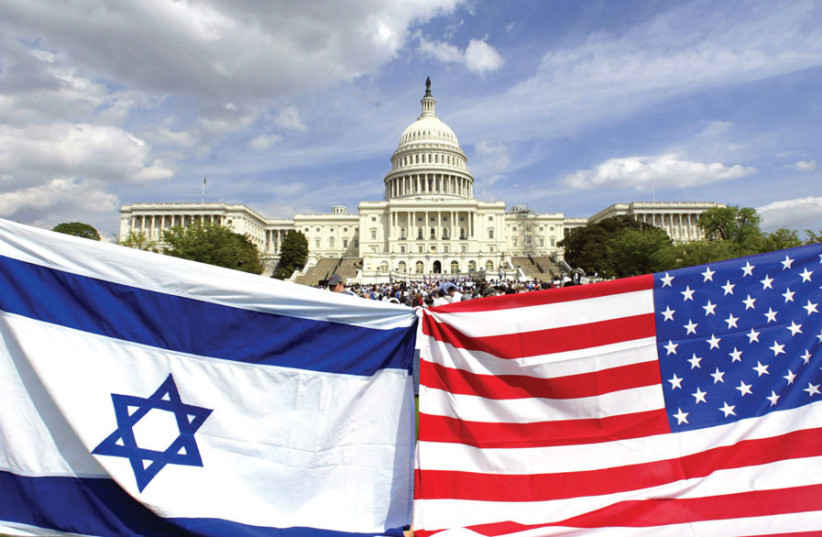
Shared values at the core of the US–Israel alliance
The First Amendment of the America Constitution states, “Congress shall make no law respecting an establishment of religion or prohibiting the free exercise thereof; or abridging the freedom of speech, or of the press; or the right of the people peaceably to assemble, and to petition the Government for a redress of grievances.” The part before the first semicolon is called “The Establishment Clause,” which prohibits the government from establishing or favoring a religion; it is the constitutional basis for interpretations involving separation of church and state.
The popular phrase “separation of church and state” is commonly thought to originate from an 1802 letter by Thomas Jefferson to the Danbury Baptist Association, where he referred to a “wall of separation between Church & State.”
Jefferson wrote, “Contemplate with sovereign reverence that act of the whole American people which declared that their legislature should ‘make no law respecting an establishment of religion, or prohibiting the free exercise thereof,’ thus building a wall of separation between Church and State. Adhering to this expression of the supreme will of the nation in behalf of the rights of conscience, I shall see with sincere satisfaction the progress of those sentiments which tend to restore to man all his natural rights, convinced he has no natural right in opposition to his social duties.”
There are many incorrect interpretations of the separation between church and state. The consensus interpretation is that it makes it illegal for Congress to establish an official religion, favoring one religion over others, or favoring religion over non-religion (and vice versa). It requires governmental neutrality toward religion, preventing coercion, endorsement, or excessive entanglement while protecting the free exercise of religion.
The statement recently made by American Vice President JD Vance at the Turning Point USA conference – that the United States of America will always be a Christian nation – is nauseating in its inconsistency and undermining of the founding fathers’ intentions. Even with the qualification that you don’t have to be a Christian to be an American, he still suggests that Christianity is America’s creed. This is a wholly un-American position.
Yes, calling America a Christian nation is not establishing an official religion, favoring one religion over others, or favoring religion over non-religion. It doesn’t violate governmental neutrality toward religion, coercion, or excessive entanglement.
But it does violate the law against endorsing a religion. Worse, in these partisan, and divisive times, it makes Jews, Muslims, and any other non-Christian American feel that America is not their nation, for they do not align with the Christian creed. American leaders must be careful to stay loyal to the centuries-old tradition of neutrality in religious speech. An American leader must be a uniter, not a divider.
There is an additional, even more problematic issue with calling America a Christian country. Positing this because the values of America were inspired by and align with the values found in the Bible is both ignorant theologically and historically. Almost all Christian values are based on Judaism’s values of ethical monotheism. To think that Christian values exist in a vacuum independent of Jewish values demonstrates an ignorance of both Judaism and Christianity. Historically, Jewish values were set forth at the revelation at Mount Sinai, 1,300 years before Jesus’s birth and 1,500 years before the publishing of the Christian Bible.
Only a person lacking an understanding of Christianity would call America a “Christian nation” because of America’s values. Just as in Judaism we often find people with incorrect notions of Torah who are led by passion more than knowledge, Christianity also has adherents who are better cheerleaders than theologians. This confusion becomes problematic when errors are made regarding basic axioms.
America was created as a home for all freedom loving people. Irrespective of one’s religion, it opened its shores to all who needed and wanted refuge. As Jewish poet Emma Lazarus wrote in her poem that is engraved on the Statue of Liberty, “Give me your tired, your poor, your huddled masses yearning to breathe free. The wretched refuse of your teeming shore. Send these, the homeless, tempest-tost to me, I lift my lamp beside the golden door!”
In conclusion, despite media portrayals of division at Turning Point USA’s conference, attendee polls affirm robust Republican support for the US-Israel alliance. This enduring partnership, grounded in strategic cooperation, transcends rhetoric to rest on profound shared values: America’s constitutional religious neutrality and Israel’s protection of worship for all faiths, uniting both nations in freedom, pluralism, and ethical monotheism.
The writer is a certified interfaith hospice chaplain in Jerusalem and the mayor of Mitzpe Yeriho, where she enjoys spending time with her family.